The Grey Wolf and The Black Wolf, Louise Penny’s most recent Inspector Gamache/Three Pines novels, roved across countries and continents as her detectives raced to uncover international conspiracies that threatened Canada’s sovereignty and natural resources.
They’re fast paced books, but some readers complained that there were too few glimpses of Three Pines.
Penny then co-authored a political thriller, The Last Mandarin, with journalist Mellissa Fung; it came out last spring. I enjoyed the mother-daughter story, the intrigue, and the evocation of some fabulous settings (and some fabulous dumplings).
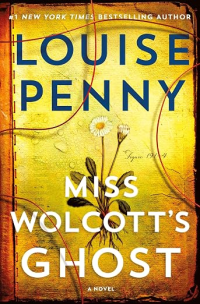
For readers who have been waiting (and waiting) to see more of Three Pines, the Québec village that can’t be found on any map, Miss Wolcott’s Ghost will be rewarding. There’s as much food and friendship on offer here as ever, with Armand and Reine-Marie Gamache firmly ensconced in the Three Pines community.
Penny’s longtime readers enjoy the vicarious pleasures of sitting by the bistro fireplace and sipping hot chocolate while children frolic outside in the snow. It’s very Krieghoff, and very Canadian.
Every now and again, watching an outdoor curling match proves murderous. Or a corpse turns up inconveniently in the bistro.
But this is the intriguing paradox of Louise Penny’s murder mysteries: notwithstanding the brutality of some of the crimes featured in her books, and the heartbreaking grief that she portrays so brilliantly in Still Life and again here in Miss Wolcott’s Ghost, Three Pines is a refuge, a near-impossible sanctuary of friendship and food.
Aptly, a company that plays a significant role in the book is named Réunion, and this is very much a gathering of Penny’s familiar characters: now-celebrated artist Clara, bookstore owner and former psychologist Myrna, elderly irascible poet Ruth and her duck Rosa, and (more fleetingly) Olivier and Gabri, who run the bistro.
A botanical mystery that has close links to an all-but-forgotten Canadian maritime disaster, Miss Wolcott’s Ghost is both familiar and innovative.
As in Bury Your Dead, Penny is exploring a Canadian historical mystery, but here the puzzle is why a terrible tragedy was not enshrined in national memory.
Plants and gardens have been featured in Penny’s novels since the first book in her series, Still Life. In Miss Wolcott’s Ghost, botany drives the plot.
It’s summer in Three Pines, and Gamache is awoken by a middle-of-the-night phone call. A panicked message is conveyed before the caller hangs up: a body has been found in Lost Nation. The call is traced to Clara Morrow’s phone, but their friend and neighbour definitely wasn’t the vaguely familiar voice on the phone.
Gamache, perplexed, has no idea where to look for Lost Nation, but as he digs into Clara’s recent visitors, he uncovers links to a successful Québec company that reunites distant relatives and connects people to their ancestors’ homelands. And he finds a vital connection to Clara’s late husband, Peter, and the Morrow family history.
When the investigators locate the body in a small cemetery, it is dressed in clothing that dates back more than a century. An unrecognizable plant, ugly to look and unpleasant to smell, is growing around the corpse.
To give away any more than this would be unfair, so I’ll just add that Penny is working with several plot strands here, and while the juxtaposition is generally effective in conveying her themes of cowardice, bravery, and guilty, there’s a amount of repetition.
But the evocation of place is as strong as ever, and Penny’s fans will enjoy revisiting Three Pines in this well-paced and compelling mystery novel.


Leave a Reply