In her Newsletter a few months ago, Canadian crime writer Gail Bowen announced that she had completed revisions on her final novel in the series she began writing in the late 1980s. Homecoming will be out next year from ECW Press. Here’s an excerpt from the first chapter.
You’ll notice that Bowen is concluding this series with a wedding, in the tradition of comedies, and that points to the underlying humanist, compassionate impulse at the centre of these novels. Unlike some contemporary crime writers, Bowen has never fixated on blood and gore; there is little in the way of graphic violence, although The Wandering Soul Murders and a few others in the series have haunting moments where trauma is explored with empathy and care. I’m thinking of a young woman who has an acquired brain injury, Chloe, who appears later in the series; she experiences a terrifying assault, and Bowen does not shy away from exploring the impact on both Chloe and her family.
The publishing industry has been transformed over the decades that Bowen has published her Joanne Kilbourn novels.
Bowen recalls 1990-2000 as a high point for her own work’s publication and reception; this is also when several adaptations of her novels were produced for TV by Shaftesbury, of Hudson & Rex and Murdoch Mysteries fame.
In recent decades, many Canadian authors have lost the support they had previously from McClelland & Stewart, which was bought out in a still-controversial purchase by an American conglomerate: “The golden age for writers was over,” writes Bowen.
Small press publishing in Canada is thriving in some regions: Biblioasis in Windsor, Ontario is doing extraordinary work, and many other presses, including Book *hug, Talonbooks, and Breakwater (to name just a few examples) are producing important new poetry, drama, fiction, and creative nonfiction books.
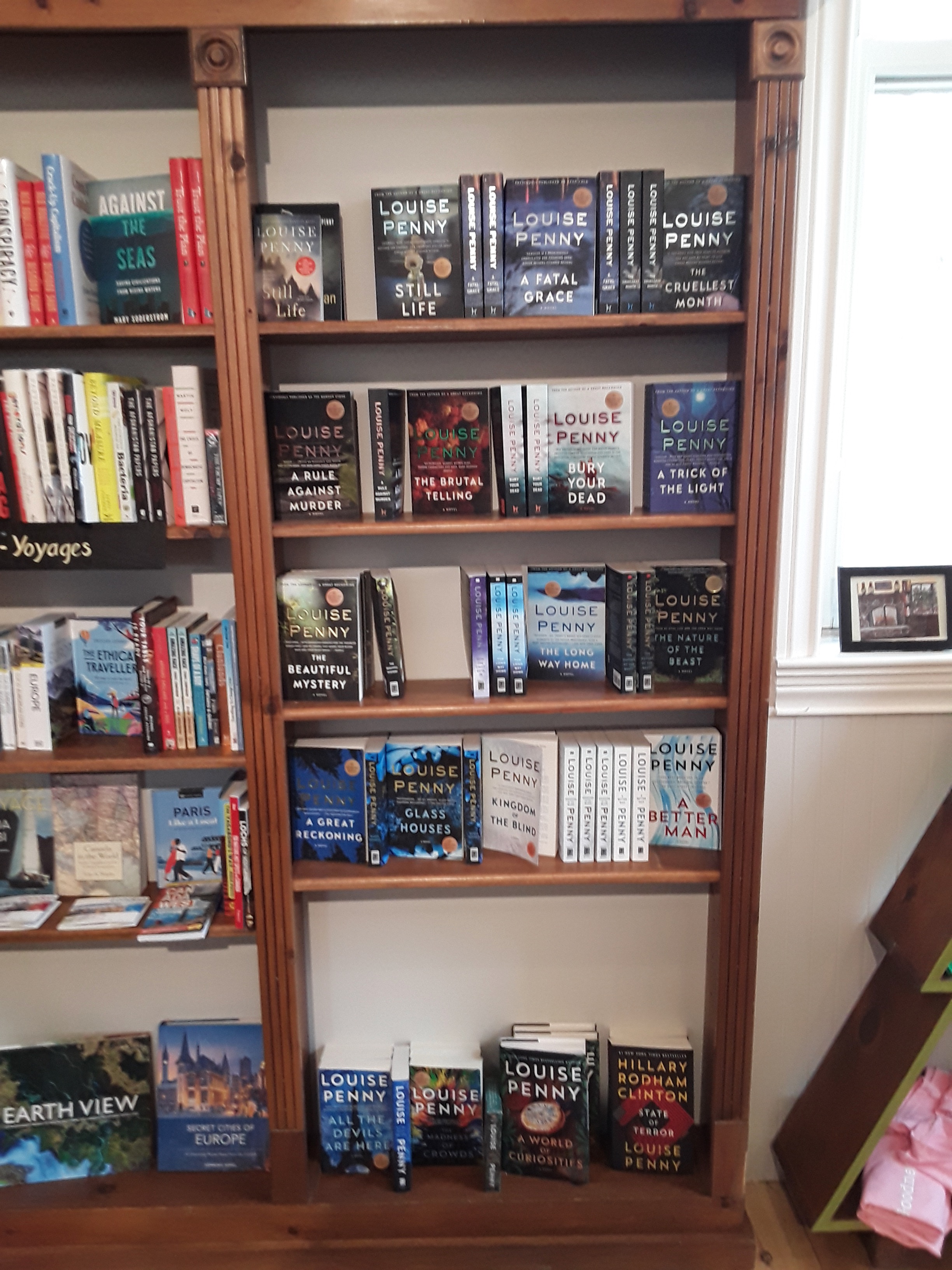
But I think it’s harder now (Rachel Reid’s extraordinary success notwithstanding) for a writer to publish with a Canadian press and reach an international audience. Notably, Louise Penny sent out her first novel to countless publishers, garnering only rejections until Still Life placed as runner-up in the UK’s Début Dagger award, which led to publication by Minotaur/St. Martin’s, a Macmillan imprint.
I suspect she tried M & S, and if she did, I’m sure they’re still ruing that particular editorial rejection.
Gail Bowen’s first novel featuring amateur sleuth Joanne Kilbourn appeared in 1990, which makes hers one of Canada’s longest-running crime series. Up to and including her 2019 A Darkness of the Heart, her mystery novels were published by McClelland, and since then they’ve appeared with ECW.
Nearly all of the books are set in Regina, Saskatchewan, where the author lives, and in Bowen’s hands the small Prairie city is endlessly fascinating: class conflicts, Indigenous-settler relationships, and clashes between faculty and students all feature in the first several books.
And perhaps the biggest source of drama is Jo’s immersion in the world of provincial (and later, municipal) politics.
During her long marriage to the province’s late Attorney-General, who was murdered when he stopped to help a young couple in a snowstorm, Joanne was immersed in politics. Both her own needs and those of their three children often came second to the demands of her husband’s public office.
As the series progresses, Jo completes her doctorate and gets a tenure-track job as a political science prof, publishes a biography of her political party’s leader, Andy Boychuk, has a few serious relationships, and eventually falls in love with the notororious “prince of darknessm” criminal defense lawyer Zach Shreve.
In the later books, Jo and Zach’s happy marriage and family life takes centre stage while the crime investigations recede a bit.
What Bowen never stints on is a deep commitment to social justice: nearly all of the books explore, in one way or another, the plight of characters who have been marginalized and who have struggled to be taken seriously.
Jo’s do-gooder tendencies are pronounced, but her social conscience means that Bowen’s crime stories are as much about social and political harms as they are about interpersonal violence. Bowen skilfully explores how contexts ranging from abusive childhoods to cut-throat profession shape her characters, including the ones who cause others the most pain. These are generously empathetic books.
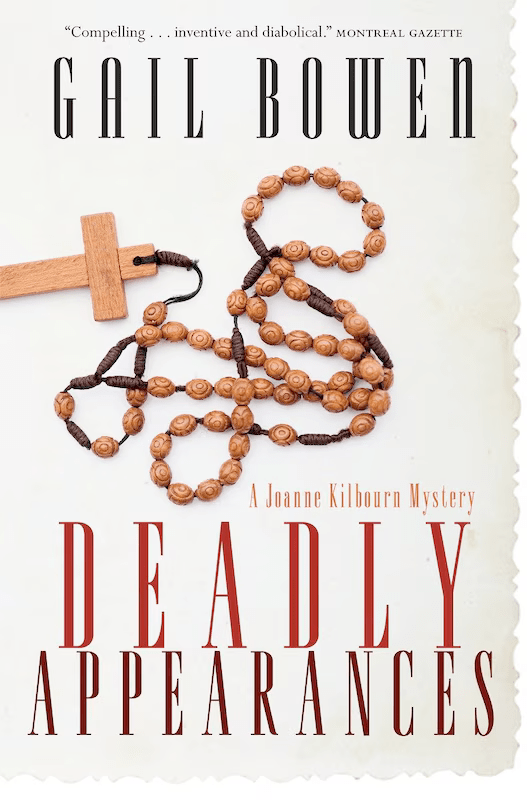
Deadly Appearances was a confident début novel, back in 1990.
I read the novels as they appeared, and I’ve re-read them several times over the subsequent decades. P.D. James is the only other mystery author I re-read as frequently, and I think it’s because the resolution of the crime is only one strand, and not even necessarily the most significant, in both authors’ fiction.
These are mysteries with a strong sense of place. Each book conjures up a community, which in James’s novel is more likely to be insular, while in Bowen’s fiction there is an expansive (and expanding) social world of academia, politics, and city neighbourhoods.
Long-time readers have come to know a bewildering range of characters, a cast so diverse that the last several books have included an introduction to the principals and their relationships as a prologue to each novel.
They will be missed. Bowen’s writing has enhanced my reading life.

