
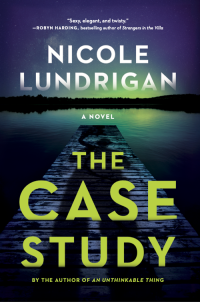
Canadian author Nicole Lundrigan has written several well-received psychological suspense thrillers. The Case Study juxtaposes the lives of two women who seem to have nothing in common, depicting one of them through a first-person narrative and the other through third-person narration, which works well.
Mia is the wife of a well-regarded therapist and college professor. She’s trying to forgive him in the wake of a betrayal, but the move to a new house that is supposed to represent their fresh start is marred by several complications. Their fifteen-year-old daughter, Elise, is secretive; her mother, who sheds personas like a snake sheds skins, is harbouring a grudge about Mia’s philandering husband and won’t let him forget it. And Mia is also wondering why each of her friends in turn has abandoned her for no obvious reason. Could her husband have something to do with that?
Ian, Mia’s self-important husband, is hoping to reinvigorate his academic career by returning to his most famous case study: a teenage girl diagnosed with Cotard’s Syndrome, which causes its sufferers to believe that they are dead and decaying. Lainey was found alone at a ramshackle cabin next to the body of her uncle, having apparently murdered him. While Lainey was incarcerated in a psychiatric hospital, Ian was her therapist, but they’ve been out of touch for some years.
Now Ian is hoping to publish an update about her case, ideally one that demonstrates the effectiveness of his treatment.
Instead, when he manages to track down his former patient, Lainey informs him that much of what she told him during her years of treatment was fabricated.
Over the course of a number of Zoom sessions, Lainey carefully doles out her story, but she doesn’t realize that she has more than one audience: Mia has access to her husband’s confidential files.
Watching her avid husband fail to pick up on crucial cues, Mia develops an uneasy sense that Ian is not a very effective therapist, his ambition overtaking his ability to listen and respond with empathy.
This is especially crushing because, years earlier, it was Ian’s famed treatment of Lainey, who was identified in news accounts only by her initials, that intrigued Mia. She signed up for a class with him–and they ended up marrying.
This is a carefully paced and compelling domestic drama with some very effective twists. Lundrigan has an acute sense of adolescent girls’ dynamics and the intensity of very close friendships.
For some readers, the depiction of sexuality (including Lainey’s open/swinger relationship) may be a bit graphic, but it’s not gratuitous: her unusual upbringing has had an impact on her sense of self and her relationship to her body.
A convention of this genre is that the female characters are often drawn with more subtlety and sympathy, and that’s true here, too (although villainy is not restricted to the novel’s male characters).
Another common feature of psychological thrillers by Canadian authors is that they don’t have a specifically Canadian–or even especially distinctive–setting. Perhaps more of a sense of place would slow down the plot?
Overall, an accomplished psychological thriller.


Leave a Reply