
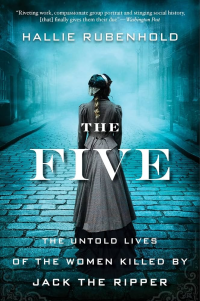
Hallie Rubenhold’s The Five shifts the focus from the shadowy figure of the 1888 Whitechapel serial killer who came to be known as Jack the Ripper to the women he murdered.
The Five is a deeply researched social history. Rubenhold isn’t interested in trying to identify the killer or in delving into the gruesome details of how each murder was carried out, a hallmark of other Ripper accounts. Instead, in this important feminist revisionist history she offers a nuanced approach to understanding late-nineteenth-century London through the prisms of social class and gender.
A substantial part of her analysis reconstructs the lives of the five victims within their own individual circumstances, with careful attention to how late-Victorian social mores held women accountable for sexual transgressions, creating a dichotomy of angels in the house and fallen women.
As Rubenhold describes, the five female victims have frequently been lumped together as women of ill repute who were inherently vulnerable to violence due to their involvement in sex work, when in fact they had complex lives filled with a range of tragedies, including early orphanhood, marital breakdowns due to violence and alcohol, the deaths of siblings and children to contagious diseases, and recurring encounters with the notorious Victorian work houses, where scant charity was doled out in flea- and rodent-infested buildings.
The deaths of what are known as the “canonical five” victims, meanwhile, have been depicted with sensationalism and gratuitous horror in a range of books, television programs, and films. Rubenhold isn’t having that: she eschews an exploitative approach and offers a dignified approach to each woman’s history.
Crucially, Rubenhold’s research suggests that the belief that the five women were sex workers, a claim made at the time of the murders and that has been repeated for more than a century, is erroneous or exaggerated. Survival sex work was undertaken by some, and one woman–the final victim, Mary Jane Kelly–identified herself as a prostitute–but most scrabbled together lives with male partners whom they married or lived with, while struggling to earn a living from domestic and factory work, sewing, and other occupations that didn’t pay female workers a living wage. Their lives were marked by reversals of fortune, with some nearly obtaining a toehold in the middle class before alcoholism or family tragedies pulled them into deep precarity.
Rubenhold hypothesizes that the women were all killed while they were sleeping, which is supported by the fact that one was actually found murdered in her bed, while others were likely to have been sleeping rough between stints in flea-ridden lodgings rented by the night. This would help explain how the murders could be accomplished without notice, under cover of night, but it shift away from the notion of the Ripper as exceptionally adept at escaping detection or identification.
And this may be, in part, why Rubenhold’s analysis irritated the amateur community obsessed with the Ripper and that has paid scant attention to his victims beyond the specific circumstances of their deaths. As Rubenhold points out, “Over the centuries, the villain has metamorphosed into the protagonist; an evil, psychotic, mysterious player who is so clever that he has managed to evade detection even today. In order to gawp at and examine this miracle of malevolence, we have figuratively stepped over the bodies of those he murdered, and in some cases, stopped to kick them as we walked past.” Rubenhold’s book may help ensure that future commentators are less callous.


Leave a Reply