The early twenty-first century has become more forgiving of difficult women, at least in literature. Novels like Claire Messud’s The Woman Upstairs, as well as the complete oeuvre of Otessa Moshfegh, have gradually acclimated readers to interesting, spiky women, women who know what they want (but who make life difficult for other people).
I’m reading a preview of Doireann Ní Ghríofa’s new novel, Said the Dead, which is due out soon in Canada and has already been published in the UK to rapturous reviews. It’s about a (possibly auto-fictional) narrator, who terms herself the Reader, and her quest to recuperate the lost lives of women who spent time in a Cork asylum over a hundred years ago. Some are relatively docile, but the more interesting ones resist with all their might the imposition of institutional order and the attribution of diagnoses.
A female doctor piques the Reader’s interest, but the most compelling, and largely imagined, stories she recounts are about the array of unhappy women she meets in the archival records. The building they once lived in has been abandoned for decades; now it’s being repurposed as luxury apartments. The Reader wanders the grounds, seeking clues of the past.
Ní Ghríofa’s book is about how we tell the story of other people’s lives, and it deals with complex questions of archival documentation and gaps, which enable imaginative recreation, alongside ethical obligations to confidentiality. How, the Reader wonders, can she tell the women’s stories if the strict archive rules mandate that she strip them of their names to ensure their anonymity and limit how much text she can transcribe verbatim from the records?
Because I’ve recently started an MFA in Creative Nonfiction, these questions are feeling urgent to me. How do we write about ourselves without violating the privacy of others? How do we conjure up an incompletely documented past with our inadequate recollections?
I’m working on a piece about friendship memoirs, where one friend (most often the one who survived the other’s death) recalls their intimacy in intricate and sometimes painful detail.
Writer Lucy Grealy’s (Autobiography of a Face) family objected to how Ann Patchett portrayed Lucy in Truth & Beauty, a book I treasure as a monument to a complicated but deeply loving relationship; but Grealy’s family felt Patchett was building on a “better” writer’s reputation to promote herself, while portraying Lucy inaccurately and negatively.
Similar issues are raised by the other books I’m writing about, including Paul Lisicky’s The Narrow Door, which deals in part with his ambivalent and intense relationship with his friend, writer Denise Gess. And much further back, Vera Brittain’s Testament of Friendship portrayed her early twentieth-century closeness to Winifred Holtby with both warmth and condescension.
And then there are those we write about yet have never met, encountering them only through their work or through even more tenuous connections, like a shared neighbourhood.
New York
In September of 1999 we moved to New York. We’d snagged a four-month sublet near NYU from students who were off to Italy to take classes in English. One was wealthy, the other so burdened by education loans that she’d cheerfully signed on to spend an semester in Rome: what possible difference could it make, as she approached a 100K loan balance? They called the Au Bon Pain bakery where we met to sign the sublet agreement the “good pain.”
Wracking up debt in New York was as easy as breathing. As I stood in line for a student card photo, credit card applications were pressed on me along with free merch from a half-dozen banks: key rings and coasters and water bottles. It was predatory lending to credulous young people on a scale I’d never witnessed in Canada.
The students left us an E. 9th Street first-floor flat in a peeling brownstone. The front door of the building was often jammed shut by the dozens of takeout menus thrust under it each day. The young women we rented from stored phone books in the minute kitchen’s oven.
The East Village was gentrifying rapidly. Tompkins Square Park was a block away in one direction, but it was now known for its popular dog run, rather than the protests and violence of a decade earlier.
In the other direction, Eileen Fisher (closed, now) was down the street, while long-time Eastern European and Kosher favourites like Veselka and the B&H Dairy stayed open late to dish out latkes and cabbage rolls and blintzes. You could browse dense theory texts and literary magazines in the St. Mark’s Bookshop (closed, now, for a decade) until midnight and eavesdrop on industry gossip passed back and forth between the writers browsing for new competition.
St. Mark’s Church-in-the-Bowery featured avant-garde poetry readings and stalwarts like Ferlinghetti. There were rumours that Patti Smith might turn up for open mic night: she’d launched her career there in 1971. Nearby was CBGB’s, now more tourist attraction than punk music nirvana.
A scattering of tiny theatres survived, remnants of the Yiddish-language performance houses that thrived during the early twentieth century, when they’d attracted homesick immigrants from the tenements in the East Village and Lower East Side.
I learned to avert my eyes from drug deals as I walked down Houston on my way to the Angelika for bitter espresso and incomprehensible Polish films.
I studied African American lit in an NYU grad seminar and spent two days a week as a law intern at the Legal Aid Society, making phone calls for a children’s law guardian who worked with kids in care to find out if parents were following up on court-mandated drug treatment.
An exhausted woman pointed out to me she had six grandchildren in her two-bedroom apartment and no help or money: when, precisely, would I like her to attend parenting workshops?
The racial divide in the court buildings was stark, white social workers and lawyers waved through without a check by bored security guards; white judges deciding the fates of racialized babies and toddlers who were third-generation foster children.
Several afternoons a week I was booked at a marble-fronted townhouse on Parry Street to tutor a brother and sister, the children of a former Brazilian model and her diamond merchant husband. Some days, Sex in the City was filming, the street blocked off from excited fans. The exterior of Carrie Bradshaw’s building was several doors down and across the street, but I never caught a glimpse of actors, just haggard production assistants gulping from blue and white paper coffee cups.
Sorel
Two weeks after we moved in, I picked up the weekly paper to browse theatre listings. Norah Vincent had written a long feature for The Village Voice about a local lesbian writer, Sorel, found murdered just a few blocks from where we were living. She had died some days before her murder was discovered, and it would turn out to be an attempted robbery that went awry: Sorel eked out a living selling drugs, and her clients wanted the drugs and her money.
Other than Vincent’s extraordinary account, stories about the murder and arrest were limited to the New York Post. The author’s life and work quickly vanished.
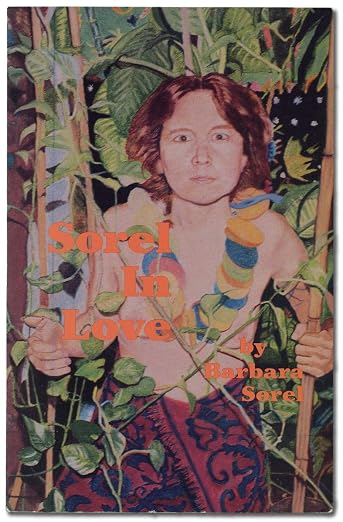
This is a story that haunted me for a time, because Vincent made Sorel’s life and work matter for people who would never meet her or find a copy of her one self-published novel, Sorel in Love: “Modeled after her favorite writer Marcel Proust’s “Swann in Love,” Sorel in Love is a deeply introspective work about an obsessive lesbian love affair” (Vincent).
Sorel wrote endlessly, tirelessly. Journalism for a small paper, but also mounds of fiction, mostly unpublished. She had a cable TV talk show for a while. By the time she hit her fifties, she was an unwanted tenant–the residents of her building petitioned to get rid of her–in a poorly maintained studio apartment. She played Poulenc too loudly in the early hours of the morning while she was writing.
As soon as her death was announced, the building manager had people begging for her apartment.
I’ve been re-reading Patti Smith on her years in the East Village, which she spent in the company of Robert Mapplethorpe, Lou Reed, and other downtown denizens. Sorel must have had some contact with this crowd, but she was on the edge. Novelist Sarah Schulman noted in Vincent’s article that Sorel seemed isolated, a little lost: “We used to talk about politics and books. She was very intellectual. She was hyper-hypercritical and she thought that people were fake. She was alone a lot.”
Vincent, too, a brilliant and empathetic writer, had more than her share of challenges; like Sorel, she died (although by choice, of a sort) when she was still in her fifties.
These stories haunt me. I don’t know what to do with them. I value Vincent’s tribute to Sorel–I regret how little Sorel’s fiction seems to have mattered in the world. There are no plaques on buildings for obscure writers, no literary criticism assessing their merits.
But several years ago, Maya Ciarrocchi, an installation artist, did an interesting Sorel-focused project that identified the writer’s obscurity as part of her appeal: “Apart from [Vincent’s article] and the memories of friends, she is largely forgotten by history. Combining these memories with Ciarrocchi’s own, and by utilizing text from Sorel’s self-published book Sorel in Love, the exhibition merges language with image to reveal where the two women’s experiences intersect and collide.”
I’ve searched newspapers and court documents, but I haven’t been able to find out what happened to the two people arrested for killing Sorel.
The NY Post, in its account of their arrest, captures a brief but vivid image of the writer: “Sorel, 54, was a self-published lesbian novelist who blasted classical music and zoomed around the neighborhood on a skateboard.”


Leave a Reply