I came across Monroe’s book while seeking comps (comparable titles) for my own work-in-progress, which is a bibliomemoir: a life story told through reading and, in my case, crime fiction.
It’s an expanding genre, and I highly recommend Guardian culture writer Lucy Mangan’s excellent Bookworm and Bookish. Other examples include Austen Years: A Memoir in Five Novels by Rachel Cohen and My Life in Middlemarch, by New Yorker writer Rebecca Mead, which is perhaps the best-known example to date. In each work, the author traces her life through touchstone books, ranging from the single (albeit monumental) George Eliot novel considered by Mead to Mangan’s eclectic reading recollections.
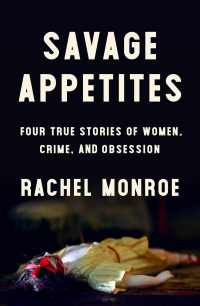
Monroe’s book isn’t quite a bibliomemoir, but it incorporates some autobiographical vignettes that portray the author’s life-long fascination with crime, in various guises. In the opening and closing scenes she finds herself at a True Crime convention in a labyrinthine hotel, in the company of an enthusiastic audience of women fans and a smaller contingent of the husbands and boyfriends they’ve dragged with them. By the last presentation she attends, which seek to immerse attendees in a virtual recreation of a murder victim’s experience, each instructed to tie her hands together and blindfold herself, the author is discomfited, and then disgusted by the use of a murderer’s detailed description of his sex slayings to horrify and titillate the largely female audience.
She experiences similar feelings, this time directed at herself, when she takes a trip detour to visit the Columbine High School that was the site of an infamous school shooting; at the last minute, she decides that her interest is too prurient and returns to the highway.
Her four key subjects are women of different eras obsessed, in different ways, with true crime.
The first section introduces the fascinating Nutshell Studies of Unexplained Death developed during the 1940s and 50s by a murder-involved wealthy woman, Frances Glessner Lee, who sought to bring a more scientific and systemic approach to crime scene investigation.
The dramatic scenarios that Glessner Lee created in miniature are dioramas (she steadfastly refused to refer to them as dollhouses) in each of which a scene of unexplained death is portrayed using tiny figures. These studies include countless minute details, ranging from blood spatter evidence and murder weapons to the positioning of a corpse. They’ve been a valuable instructional tool for law enforcement for decades.
In her second cast study, Munroe presents a more troubling story of a young woman who lived in the guest house on the property where the first Manson murders, of actress Sharon Tate and her guests, took place; this woman becomes increasingly embroiled in the lives of the surviving Tate family members, who helped champion the victims’ rights movement that led to the inclusion of victim impact statements.
Another woman becomes involved in the wake of a notorious triple child murderer after viewing a documentary about the case that leaves her deeply shaken. She begins corresponding with one of the accused, convinced of his innocence, and they become a couple; she spends years working alongside his legal team to exonerate him, and he and his co-accused are eventually released from prison. Munroe gets to know these research subjects especially well, offering an intimate view of their complicated relationship and the woman’s sense of a mission, which puzzled and worried her family members and friends when she gave up her job and life in New York to move near the prison, enabling weekly visits.
The final case study explores a young woman, an obsessive “Columbiner,” who plots her own mass shooting with an accomplice; they ultimately don’t succeed in implementing their horrific plans.
At certain points the book can seem schematic, with its four sections titled Detective, Victim, Defender, and Killer.
Some reviewers have suggested that Munroe’s memoir sections slow the pace and feel unnecessary, but I disagree: this is very much a project about how the narrator is herself implicated in the world of true crime obsession, although the book’s ending is a bit pat.
This is a deeply researched and thoughtful analysis of women’s fascination with crime.


Leave a comment