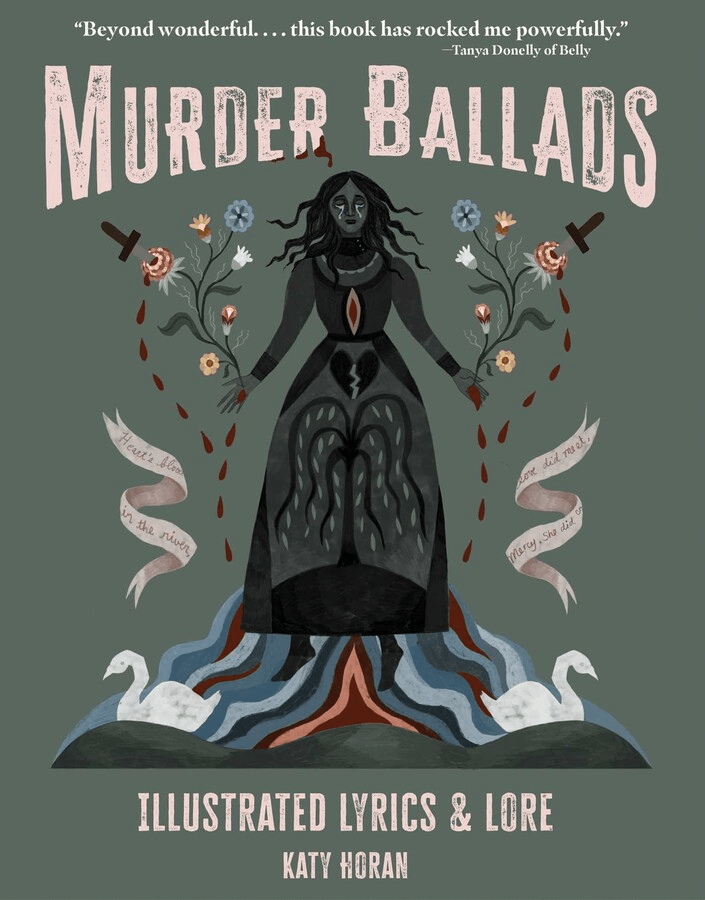
Katy Horan’s gorgeously illustrated and chilling little book compiles twenty traditional murder ballads, some of them well known and others less familiar (at least to me), with insightful analysis of the genre.
She Wore Black, a fun podcast about things gothic, horror, and mystery, has an interview with her that’s worth a listen. Horan talks about Alice Bolin’s collection of essays Dead Girls, which I’m currently reading, and the countless portrayals of white, young, beautiful corpses as the instigation of a plot. Think Laura Palmer and Twin Peaks. But also 90% of the episodes of Dateline. True crime, Horan and the interviewer point out, tends to echo Edgar Allan Poe: “The death of a beautiful woman is, unquestionably, the most poetical topic in the world.”
The book came out a year ago, but I found it in the King’s College bookstore in Halifax, which is a bright and tidy space tucked into a basement corner. I came home with one small suitcase full of books, so I’m only just catching up on my June purchases.
The papers are full of sober editorializing this morning about whither the United States of America on its 250th birthday. But I can’t hear the words “Independence Day” without thinking of the first time I heard Martina McBride singing Gretchen Peters’s powerful anthem of female independence in the wake of intimate partner violence.
It’s not sung in the tone and lyrical tradition of the Murder Ballad: rather than plaintive and poignant, Peters’s song, told from the point of view of the eight-year-old daughter, has a triumphant quality.
Intriguingly, though, Erica Wright argues in a significant analysis of country music murder ballads that includes “Independence Day”, “Goodbye Earl”, popularized by the Chicks, and “The Night the Lights Went Out in Georgia,” that “Murder ballads—at least as they are reimagined in country music—often tap into a fantasy of independence, a world where vigilantes can dole out justice and rarely face the firing squad. Rugged individualism with a violent streak.”
The traditional folk murder ballads are a bit different. They hail from Ireland and Appalachia, from pockets like the English-Scots border that produced “Lord Randall,” the first one I ever came across. In undergrad I had a friend with a gorgeous singing voice and a repertoire of maritime folks songs, like “The Maid on the Shore,” made famous in Canada by Stan Rogers. Musically, murder ballads fit in this tradition, only instead of love, longing, and betrayal the stakes are raised to murder, revenge, and haunting.
I’ve written about Taylor Swift’s “no body, no crime” and Nick Cave’s murder ballads. His haunting duet with Kylie Minogue, “Where the Wild Roses Grow,” is an original ballad in the long tradition of the murdered sweetheart who is killed near a body of water, her beautiful corpse arranged artfully.
This particular song has been criticized for treating femicide in a romantic and aestheticized vein, which is central to the murder ballad tradition.
But this is also the focus of many crime novels, as a New York Times review of Bolin’s essay collection points out: “As Bolin observes, ‘Everyone loves the Dead Girl,’ but, of course, ‘that’s why we love her: because she’s dead, and her death is the catalyst for the fun of sleuthing.’ She’s a blank slate onto which a male protagonist can project his fantasies, mostly about himself.”
Then there’s Cave’s “Henry Lee” duet with the great P.J. Harvey; the video is a weirdly erotic experience: the two had just met, and their fascination with each other comes through so clearly that watching it feels like voyeurism. (Horan’s book apparently had a whole Nick Cave section that was excised as not directly relevant, so it’s fun to hear her talking about him in the podcast episode.)
Seeing the mix of song-stories in Katy Horan’s book has me searching for more examples.
I’m enjoying the musical complexity of Gillian Welch’s “Caleb Meyer,” which is more in the tradition of “Goodbye Earl” and “Independence Day”: Nellie Kane, a married woman, is assaulted by the solitary Caleb Meyer while her husband’s away from home. While he’s pinning her to the bed, she reaches for a jagged bottle neck and slits his throat. “Caleb Meyer your ghost is gonna / Wear them rattling chains,” sing Welch and David Rawlings. “But when I go to sleep at night / Don’t you call my name.” (Welch’s version of “Long Black Veil” is one of my favourites, but Rosanne Cash’s is perhaps even more compelling. The song’s a twentieth-century murder ballad that sounds straight out of the the Appalachian folk tradition.)
Horan includes in her book “The Bloody Gardener,” a grim little tale that she notes is conveyed as sung by a Mrs. McCabe in Conception Bay, Newfoundland in 1929. This is from the Illinois Library’s Rare Book & Manuscript website: the ballad “tells the story of a young nobleman who falls in love with a shepherd’s daughter. Disapproving the match, his mother hires her gardener to murder the young woman. A dove informs the nobleman of the death. He then confronts his mother and kills himself, to be buried alongside the shepherdess. Thwarted love is an often repeated ballad theme and “The Bloody Gardener” appeared in a variety of printings, the first instance being 1754. Ballads such as this demonstrate the mingling of fictional tale and journalistic narrative in the broadside trade.” Here’s a version arranged for the television adaptation of Austen’s Sanditon.
Horan’s analysis of “Delia’s Gone” is especially provocative. It’s a grim little song:
“If I hadn’ta shot poor Delia
I’da had her for my wife
Delia’s gone, one more round, Delia’s gone
First time I shot her
Shot her in the side
Hard to watch her suffer
But with the second shot, she died”
Then we move on to jail and haunting.
The real Delia Green was a fourteen-year-old girl at the time of her murder in 1900, which was committed by a sixteen-year-old; she was shot after rejecting the perpetrator. But as Horan points out, there’s significant misogynoir in the “Delia’s Gone” story and ballad tradition. The young girl was depicted in the wake of her death as a promiscuous adult, rather than as the child she was. That portrayal is then echoed in the ballad form.


Leave a comment