
In March, Canadian crime writer Gail Bowen included in her Newsletter a brief excerpt from her forthcoming–and final–novel in the Joanne Kilbourn Shreve series. It’s entitled Homecoming.
Last night Bowen’s many fans across Canada and around the world learned the sad news that she has passed away.
Bowen published her first novel featuring Regina, Saskatchewan amateur sleuth and widowed mother of three Joanne Kilbourn in 1990, which makes this the thirty-sixth year of one of Canada’s longest-running crime series.
I’ve been reading them since the publication of the first book, and I was grateful to be able to take a crime-writing course with Gail back in 2017, as I was trying to re-launch my life and work after an annus horribilis. She was the perfect teacher: supportive and encouraging in her copious and detailed notes about each submission.
Her work is a significant feature of my current book project, and I’ve visited Saskatchewan twice on research trips to fill out my picture of her work, because setting is crucial in Bowen’s mystery novels. Regina (and in a smaller way Saskatoon) are featured as complex urban environments with an uneasy mix of social classes. Bowen was especially conscious of how Indigenous-settler relationships have been shaped by history and disenfranchisement, and she’s one of relatively few Canadian writers I can think of who includes a substantial number of Indigenous characters in their work. Bowen worked for many years at what was then the Indian Federal College at the University of Regina; it’s now First Nations University. She taught English and chaired her department. She raised her family.
And she wrote these wonderful books: twenty-four in total, including the one that’s forthcoming, as well as several hi-lo novels featuring her compelling series character, Charlie D., as the protagonist. Charlie Dowhaniuk is the charismatic radio host son of Joanne’s close friends, Howard and Marnie. Howard was once the province’s premier and Marnie was his fiercely independent wife and Jo’s compatriot during their shared years of political rallies and potluck parties. Late in the series, Charlie falls in love with his friend since childhood, Jo’s daughter Mieka, who is raising her two daughters on her own while running multiple locations of her popular children’s play centre and café. He becomes part of Jo’s ever-growing extended family, a close and loyal brood.
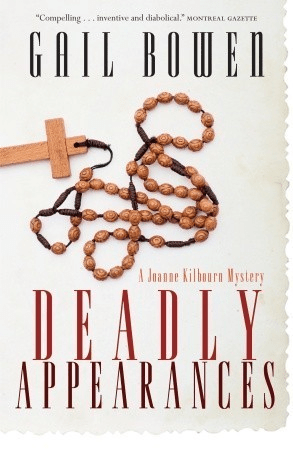
Bowen’s series opens with a novel about a woman who is still grieving the murder of her late husband, the province’s ambitious Attorney-General, who shared with her a deep commitment to the well being of all. In this first novel, Deadly Appearances, Jo is confronted with death again when she loses her close friend, her party’s political leader, who dies at a summer rally. Her investigation nearly proves deadly for Jo, too.
As the series develops, Jo becomes a university professor (and the author of a biography of her late friend, who might have become the province’s premier, if he had lived). She adopts a childhood friend’s daughter after the friend, celebrated and contentious artist Sally Love, is murdered at a gallery opening in Murder at the Mendel, one of my favourites in Bowen’s consistently excellent series. And at the urging of her friend Jill, a media executive, Jo also becomes a panellist on a weekly political debate show.
She also falls in love a few times, finding permanent happiness with the most unlikely of prospects: a “Prince of Darkness” defence attorney who is passionately pugilistic in the courtroom but who grows tender and caring in Jo’s company, becoming a devoted family man and surrogate father to her adult children and a champion of her youngest daughter’s prodigious talent for art.
Through all of this, Jo finds time to run around the lake daily with her dogs, bake breads and simmer stews, and participate in community projects to alleviate the suffering of the most disadvantaged. Canadian social activist J.S. Woodworth’s famous line is repeated several times throughout the series: “What we desire for ourselves, we wish for all.”
Outside of her fiction, Bowen lived this dictum in her own political and community activism. Through friends of friends who worked with her, I’ve gleaned some sense of the important role she played in Regina social and political life.
She seems to have been a tireless person of unquenchable enthusiasms, and that was on display several years ago, when she did a book event in Victoria. A life-long phobia of flying meant that Bowen and her husband travelled everywhere by train, and she made the long trek out to the island to see her fans–and her many friends, who came out in force to the event. Bowen walked around the room, introducing herself personally to each audience member. She seemed absolutely in her element.
Bowen’s novels, in which Joanne is frequently accused of being a busybody, posit that we are responsible for each other. At different points, Jo is forced to confront child abuse and intimate partner abuse, drug use and mental illness, and she does so with profound empathy and care. At a few points, Jo–being human and thus fallible–cannot live up to the trust that someone places in her, and those failures haunt her profoundly.
Bowen wrote novels in which every life has a value, and her protagonist insists that ensuring that we all thrive is everyone’s business.
I look forward–with pleasure and some sadness–to the final volume in the series this fall.
One of Bowen’s novels is entitled The Legacy. How perfectly fitting.


Leave a comment