
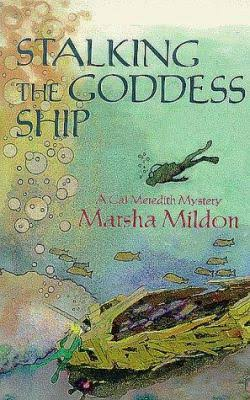
Marsha Mildon’s second Cal Meredith novel, set on the west coast of Vancouver Island and in Victoria where the fictional P.I. lives and works, is a thoughtfully plotted lesbian crime novel with an exceptional sense of place.
Marguerite is an embattled feminist archaeologist in UVic’s fraught (and fictional) department of ancient cultures. Her theories about Crete’s Minoan goddess culture have put her at odds with a male colleague who seeks to discredit her work. And now she’s accused of murder, and a particularly gruesome one: a lively and flirtatious woman in her thirties, Lily, has been chained to an undersea shipwreck and left to die.
It turns out Marguerite may have an excellent motive: when she returned from her summer excavation in Greece, she found Lily living with Marguerite’s own long-time lover, Stephanie, in the tiny seaside village of Bamfield. It’s a marine research centre and fishing destination on Vancouver’s west coast, accessible only by bumpy logging roads from Port Alberni.
Stephanie runs a struggling diving resort, while Lily grew up in a wealthy and privileged Victoria family but has spent the last fifteen years as the wife (and former student) of Marguerite’s irascible colleague. He, too, has good reasons–including a potential financial windfall–for wanting his estranged wife dead.
Cal is pulled into the investigation by her partner, who is friends with Stephanie and has begun working with her on diving expeditions. But Cal finds the prime suspect prickly and difficult to deal with: stunned by her arrest, Marguerite seems unable to participate in her own defence. She eventually confesses to Cal that she and Lily had been at odds for much longer than anyone else realizes, their feud dating back to graduate school days. Marguerite holds herself accountable for having spitefully ruined Lily’s academic career.
And then she escapes custody, further complicating the murder investigation.
This is a very well-written crime novel, and it’s dismaying that it’s received so little attention.
My research on Marsha Mildon turned up only a handful of stories (and the author’s own very helpful website). I don’t think she’s had the acclaim she deserves, and the Cal Meredith series ended with this second novel, which is an unhappy but not-unusual fate for mystery writers.
Mildon spent some time teaching at UVic during her varied and colourful career, which also included helping create Edmonton’s first women’s shelter; working in Peru, where she has set some of her fiction; and a brief stint of homelessness, when she lived in her car with her dog. She portrays academic politics and research with insight and wit.
(And I’m reminded that precarious academic employment often goes along with later-in-life homelessness; several years ago, I met with a former sessional instructor who had abruptly lost her job and then her housing. She was–like Mildon–living in her car with her two large dogs. Landlords wouldn’t rent to her at her income level given her pets. This detail is probably preoccupying me in part because I’m working on an article about contingent faculty in two 21st century novels, The Lecturer’s Tale and The Adjunct, and the fear of losing housing is a prominent theme in both books. But I think we need to insist that there’s something wrong with a system where elderly women live in their cars in part because they were underpaid and tenuously employed while they taught at universities and colleges.)
One of the most intriguing aspects of Mildon’s novel is Marguerite’s passionate insistence that Cretan goddess culture likely disseminated throughout the world via female-crewed ships.
The famous Snake Goddess figurines also play a role in the story. There’s a lot of scholarly debate about the meaning of both these specific portrayals and the broader Minoan culture that was supplanted by the Greeks. Toronto’s Royal Ontario Museum has had a longstanding controversy about a Minoan Ivory Goddess figurine that may be an early twentieth-century fraud.
Inserting Marguerite into these research debates, which the professor is trying to pursue via an idiosyncratic project involving a shipwreck site and replica objects that divers can seek out, is a fascinating way of portraying the character as a fiercely independent researcher motivated as much by feminist ideals as by scholarly concerns.


Leave a comment