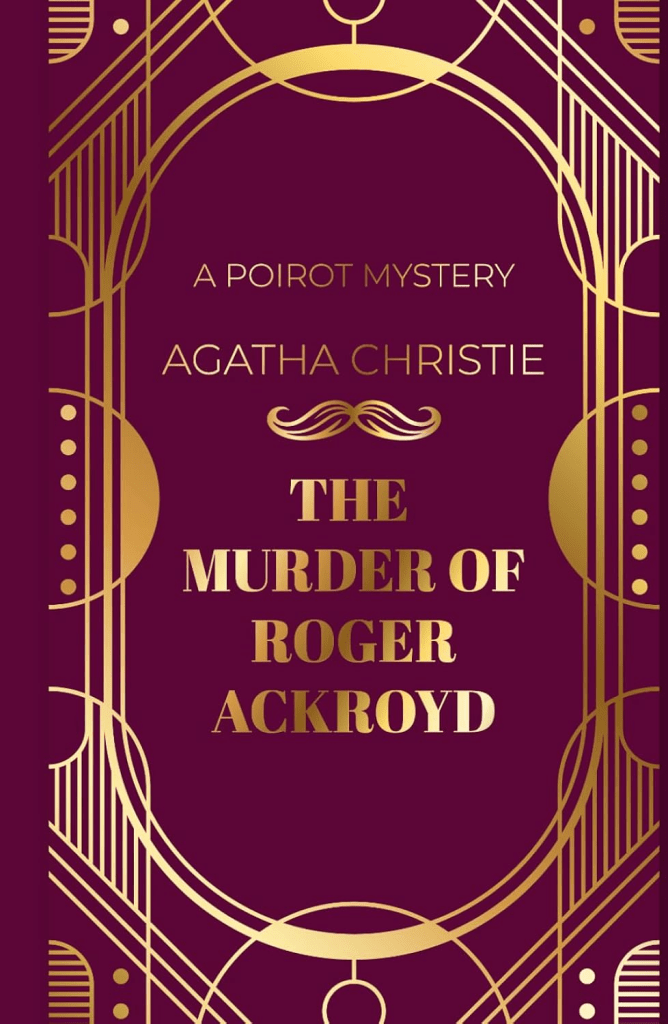
Agatha Christie published her daring and innovative crime novel in June of 1926. This month there are festivities galore to celebrate the centenary.
It’s not like the novel hasn’t already been fêted extensively: in 2013, the British Crime Writers’ Association declared Christie the best crime novelist of all time, and The Murder of Roger Ackroyd the best crime novel.
And now the tricky part: this is not a post intended for readers who haven’t yet had the pleasure of Roger Ackroyd, because narration, plot, and character revelations are exceptionally intriguing, and they shouldn’t be spoiled in advance of the reading experience. And I’m about to spoil them, via hints, in order to talk about why this book is so groundbreaking.
Consider yourselves cautioned.
First-Person Narrators in Crime Fiction
I wrote two drafts of a mystery novel using a first-person narrator; the gentle but firm guidance I’ve had from a developmental editor is urging me towards re-writing in the third person, because I wrote a domestic thriller, but I’m not doing compelling experiments with two or more first-person perspectives. The narrator isn’t suffering from a mental illness, injury, or other condition that makes her recollections and recounting unreliable. There’s not a manipulated timeline, whereby the reader realizes at some point that time has been compressed or expanded, to achieve the narrator’s purpose. And there’s no conveniently-located diary to function as documentation of a marriage as it sours, as in Gone Girl.
It’s just one narrator, with her limited perspective, and she manages to be both naïve and tiresome. Even to me, as I re-read.
So it’s with an excess of admiration that I note that Agatha Christie’s first-person narration in Roger Ackroyd is extraordinarily adept. From the opening pages, when we meet the local doctor, James Sheppard, who lives with his sister, we are drawn into the story. He has just returned from the home of a recently deceased patient. A woman has died of a veronal overdose; it seems likely–although she didn’t leave a note–that she killed herself.
Caroline, the sister, is crowing a bit: she suspected the woman of poisoning her loathsome husband some months earlier, and now she is keen for a first-hand account of the death scene. James disappoints her, but it turns out that Caroline has already gleaned the crucial details from the milkman.
Immediately, then, we meet a narrator for whom professional discretion is a must, and concealing some truths is more politic than telling all. This will prove to be important, because our first-person narrator is ever-so-gently misdirecting readers and withholding information from us in turn.
James is also droll, offering gently biting observations about their village: “Able-bodied men are apt to leave the place early in life, but we are rich in unmarried ladies and retired military officers. Our hobbies and recreations can be summed up in the one word, ‘gossip.’”
Thus rumours abound, and they especially proliferate when it comes to the local quasi-squire, Roger Ackroyd, “a man of nearly fifty years of age, rubicund of face and genial of manner. He is hand and glove with the vicar, subscribes liberally to parish funds (though rumour has it that he is extremely mean in personal expenditure), encourages cricket matches, Lads’ Clubs, and Disabled Soldiers’ Institutes. He is, in fact, the life and soul of our peaceful village of King’s Abbot.” And Roger and the narrator are close friends: the wealthy man relies on the doctor’s discretion and confides in him liberally.
Roger Ackroyd had been keeping company with the Mrs. Ferrars whose death is mentioned in the novel’s opening pages. The doctor (and apparently the villagers) viewed the relationship with equanimity: both were widowed, and their late spouses had been alcoholics, so “It was only fitting that these two victims of alcoholic excess should make up to each other for all that they had previously endured at the hands of their former spouses.”
Ackroyd had a stepson whom he regards as his own and who is recently affianced to a cousin by marriage. While the young man is currently dependent on his stepfather’s magnanimity, he looks forward to a comfortably independent financial future–once he inherits the family fortune.
And on the spot to investigate when Roger Ackroyd is murdered is the illustrious Hercule Poirot, who is finding retirement and the cultivation of vegetable marrows to be less pleasing than he had anticipated. He lives next door to the doctor and his sister, which proves to be inconvenient for James.
How Christie Does It
This is a novel that aspiring crime writers study in order to figure out the how of Christie’s narrative methods. She gives us a likeable first-person narrator who charms and lulls us, in turn, but she’s also shrewdly reliant on the expectation of 1926 readers that a first-person narrator in a crime novel is a trustworthy (if often partial) reporter of information.
And Christie overturns this, albeit not completely: in many regards, James is reliable. He’s not delusional, or suffering from amnesia. But he’s keeping a lot of secrets. So the trick of the text is to reveal and conceal simultaneously, without raising readers’ suspicions.
Of course, once you’ve read the novel, you can never re-read it in the same manner, and many readers will come to the story having already learned of the big reveal about the narrator.
And yet the novel remains interesting. That’s what I’m marvelling at this morning, as I re-read it for what must be the fourth or fifth time.
So Why Does This Work?
For roughly the same reason that Gillian Flynn’s Gone Girl, works, I suspect.
The author isn’t cheating the reader: there are hints throughout James’s narration, if one knows to look for them, that he is keeping some crucial details about events to himself. Focus on time, in particular, and you’ll notice how careful Christie is (as always) with the sequencing of events and the crucial gaps in time that enable violence.
Christie is depending, on part, on her readers trusting the first-person narrator because he’s a doctor who seems to have a wry sense of irony about himself and his place in the world. He appears forthcoming. He has a lovely appearance of frankness.
And he lives with Caroline, his sister, who is made out to be the village’s most accomplished extractor and purveyor of gossip. This nudges readers into thinking he can’t be keeping secrets from her, and thus from us.
But looked at differently, James has had ample experiencing in concealing his most intimate thoughts and acts from the person he lives with, which is also the premise of most of the contemporary genre of domestic noir–but in the context of a marriage. Christie is modelling, here, a precursor of this genre (which we also see, of course, in works like Rebecca and Suspicion, both of them Jane Eyre-influenced). By situating the covert concealment of selfhood within a household as a brother-sister dynamic, however, she renders her narrator-protagonist even more apparently innocent.
Everyone trusts James. That’s Christie’s trick. We, as readers, have no other source of information beyond what he tells us (or, for some exceptionally clever readers, what we can discern that he’s not telling us).
I was assigned Roger Ackroyd in the context of a mystery and detective fiction course that I began with great enthusiasm at U of T. And then the instructor, Week 2, gave away the endings of several of the novels and stories we would be studying. He had his reasons: his focus was narrative technique, and he was diagramming plots on the chalkboard. Revelation was required, of a sort. But I was so annoyed about his approach that even though I’d already read all of the works he was discussing, I dropped the course. I didn’t want anything I hadn’t read spoiled for me. I do thank him for the introduction to Josephine Tey and The Daughter of Time.
Now I’m planning my own crime fiction course for a very different audience, and I’m contemplating what to include. Tey, obviously. And there’s no question that The Murder of Roger Ackroyd will be on the list. But I won’t be saying a word about the first-person narrator’s omissions until everyone has read the book.


Leave a comment