
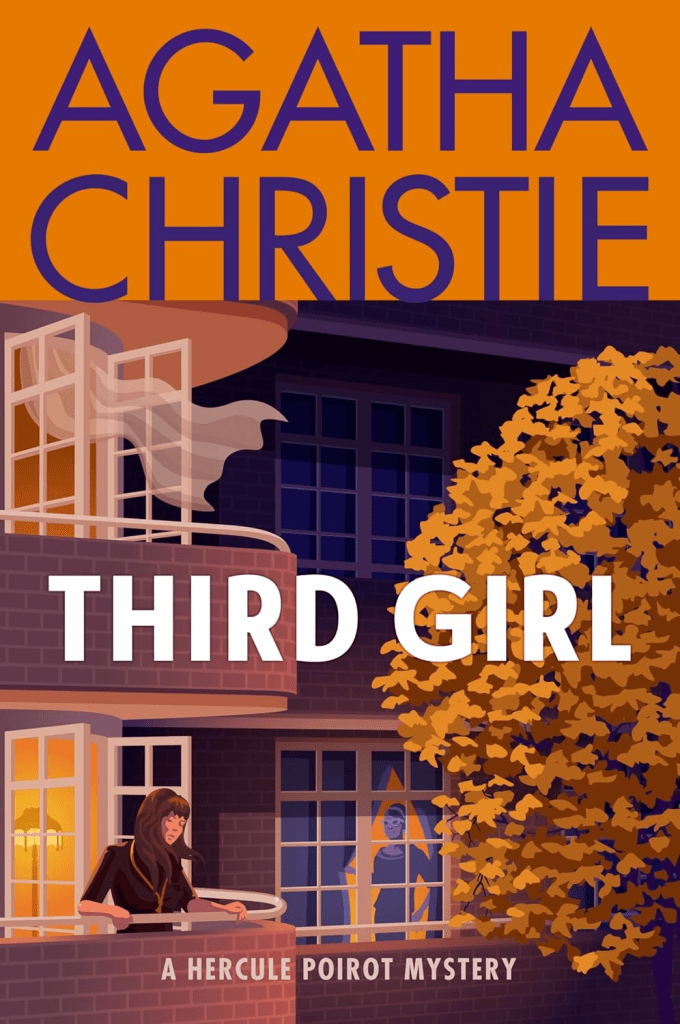
Agatha Christie was in her mid-seventies when she published Third Girl, an Hercule Poirot/Ariadne Oliver murder mystery (of sorts) set in London during the Swinging Sixties. The beatniks and starving artists in velvet pants are singled out for their peculiarities, and there’s a lot of tsk-tsk youth today chatter.
But this book really has everything: World War II secrets that may be leaked in a memoir, foreign espionage suspicions, a missing girl (who seems oddly dissociative), a potential suicide, and various schemes and plots that leave Poirot, along with his readers, wondering why there are so many interconnected threads and yet so little discernible pattern.
The novel meanders. It has several false starts, after a promising beginning: a a young woman, Norma seeks Poirot’s assistance. She’s afraid that she may have killed someone.
But having decided he’s too ancient to be of any use (a judgment she blurts out, wounding Poirot’s vanity), she rushes off. Poirot has to figure out who, and where, she is–and did she really commit a murder?
Ariadne Oliver fills in some context: she herself had casually referred the young woman to Poirot after meeting her at a weekend house-party. And Norma, she explains, is the “third girl” in the sense of news advertisements of the day that sought a “third girl” to share an apartment. Not the lease holder, or the lease holder’s best friend, that is, but an additional person needed to help pay the rent and who usually occupies the least desirable bedroom. As the novel develops, however, the phrase feels more resonant to Poirot, an echo or intimation of something more significant.
The investigation stops and starts. Poirot travels to her family’s country home and speaks to her elderly great-uncle and her stepmother, whom the girl dislikes and resents. But he doesn’t seem to make much progress.
Ariadne Oliver begins to wonder if Poirot really is “too old” to be of any use as an investigator anymore; in turn, Poirot deems that even before mystery writer Ariadne is knocked on the head while pursuing a potential clue, she is woolly and illogical in her thinking.
Coincidences abound. Apparently one can wander around London and just happen to pick the coffee shop in which a missing person is eating beans on toast in the company of her long-haired boyfriend, (who has a taste for women who will pick up the bill).
There’s a lot of going-on about a wig. About some portraits. About inheritances.
But the book can’t seem to decide what it wants to be about until very late in the day.
Then things become clear–or at least clearer–but without the pleasure of discerning Agatha Christie’s uniquely brilliant knack for plotting, once all of the misdirection is revealed.
There are some amusing descriptions as Poirot and Ariadne share their impressions of Youth Today. Their general impression is of wilful filth and self-neglect. And there are lots of mentions of drug use (with Christie appearing to be inventing some of her own pharmaceutical slang).
But there’s also mounds of tedious repetition of information and investigative dead ends; this would work better for readers who take weeks or months off between chapters.
Here’s some comfort, though: no writer can produce an excellent plot every time, not if she produces two books a year for half a century.
So this was an off-day for Christie, in my estimation, but there are dozens of better mysteries by the same author, and I’m looking forward to re-reading several more in 2026.


Leave a comment