
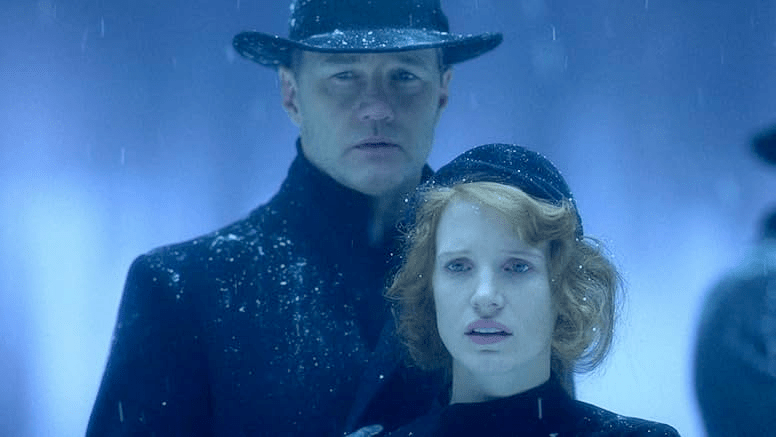
A very young Jessica Chastain with David Morrissey in Agatha Christie’s Poirot: Murder on the Orient Express.
My Christie re-read is zooming along this spring, and I’ve enjoyed the novels so much that I’ve added some Agatha Christie-themed sites to a trip next fall that will mostly focus on researching P.D. James.
My stops will include Torquay, which is Christie’s birth place, as well as a range of places in South Devon, and the Old Swan hotel in Harrogate where Christie was discovered after she had mysteriously disappeared from home.
Christie travelled broadly, across continents (her footsteps recently retraced by David Suchet in the television series Travels with Agatha Christie), but my ambitions are modest.
Today, though, Murder on the Orient Express is on my mind. The Suchet-starring TV adaptation has a splendid cast, including Jessica Chastain as Mary Debenham (who is portrayed by an equally excellent Vanessa Redgrave in the 1974 film adaptation, and then by Daisy Ridley in the more recent film).
But Poirot’s moral and religious struggles are highlighted in a manner that felt un-Christie-like to me; the character’s Catholicism is typically much more retiring. Suchet’s own religious awakening seems to have played a role in how Poirot is depicted in the final season, as a friend pointed out to me some weeks ago.
Christie’s Murder on the Orient Express opens with a scene in Aleppo, Syria, where a character we don’t meet again, Lieutenant Dubose, has the “job of seeing off a distinguished stranger,” Poirot, who had been summoned to deal with a complex military situation.
Poirot is to travel by train to Turkey and then board the Orient Express; Dubose, making small talk, cautions him that the tracks are sometimes adversely affected by snowfall, and the weather reports from Europe are bad. The stage is set for readers to anticipate a snowed-in journey.
But what readers new to the novel can’t possible anticipate is how inventively Christie recreates motive and culprit in this sui generis yet much imitated and oft-parodied story. (My TBR pile includes Sandra Balzo’s Murder on the Orient Espresso.)
SPOILERS AHEAD.
We then switch to the point of view of a young Englishwoman, Mary Debenham, aboard the train and looking down at Poirot on the platform.
She’s exhausted from what has already been a long trip, but she intrigues Poirot the next morning at breakfast: an attractive, efficient young woman who seems well-travelled, but not a beauty.
She is joined at her table by Colonel Arbuthnot, but “True to their nationality, the two English people were not chatty.”
This is about the least offensive of Christie’s ethnic stereotyping in the novel, which is so extensive that it’s spawned multiple academic studies alternately deploring and trying to redeem her chauvinism.
One of the more inventive is an article by Kenneth Eckert in Text Matters that claims the passengers are merely “performing their behaviours,” such that the “deployment of stereotypes as only acted performances destabilizes them as permanent aspects of national or ethnic identity.” Perhaps too ambitiously, he queries, “Can Murder, then, be read as an anti-racist text?”
I don’t think so, given the heavy-handed stereotyping throughout Christie’s fiction.
But Eckert makes an interesting claim. As the various characters assemble to board the Orient Express in Istanbul, Christie highlights their national types and associated characteristics. But each one of them is also acting: their identities have been disguised and they have a grim collective purpose in mind: disposing of a viciously evil man who likely deserves it, for all of the suffering he has caused them and others.
Unless you’re David Suchet’s Poirot, who believes this is meddling in God’s right of judgment.
From quite early on, even before arriving in Istanbul, Christie’s Poirot is aware that people are playing roles.
Mary Debenham and Arbuthnot appear to be meeting for the first time, yet he mutters something to her that indicates much greater intimacy.
“‘Rather an odd little comedy that I watch here,’ said Poirot to himself.”
But why are they acting, and who is the intended audience for their pretense?
As all readers of the novel and viewers of the adaptations are aware, a terrible crime was committed some years earlier. It has left widespread devastation in its wake.
And now many of the people most profoundly affected have gathered to mete out justice.
They hadn’t counted on a celebrated detective in their midst, however; he is shoehorned onto the Orient Express only by virtue of his close connection to M. Bouc, a director in the railway company, who insists on a spot being found for Poirot. The train is–unusually–completely full.
Poirot’s friend Bouc, who is also travelling, waxes rhapsodic about the literary possibilities of writing about the motley crew of passengers, if only he had the gifts of Balzac for description and characterization:
“All around us are people, of all classes, of all nationalities, of all ages. For three days these people, these strangers to one another, are brought together. They sleep and eat under one roof, they cannot get away from
each other. At the end of three days they part, they go their several ways, never perhaps to see each other again.”
This is, at least, the theory.
But these particular passengers have not met by happenstance, and when a violent crime occurs in the middle of the night, and its investigation is hampered by the train being stuck in the snow, Poirot is summoned to help.
Even prior to the event, Poirot had intimations that something might occur: first, he imagines an accident involving a death, and then he is approached by a gangsterish American who offers him a large sum of money to protect him from an enemy:
“Only one enemy?”
“Just what do you mean by that question?” asked Ratchett sharply.
“Monsieur, in my experience when a man is in a position to have, as you say,
enemies, then it does not usually resolve itself into one enemy only.”
And there’s the rub, for Ratchett.
Poirot won’t take his money, incidentally, but he does later agree to investigate his murder, to help pass the hours that they’re waiting for the train to be dug out.
Amateur stage productions of the play are popular, and at first glance one can see why: there’s a large cast, with lots of lively character roles to play, and optional foreign accents for the more ambitious; the work is familiar to audiences; and even if audience members know the outcome, watching Poirot interrogate the suspects is most of the fun.
I’d like to see a production set on a train, say in a train museum, where audience members move from compartment to compartment along with the investigator.
But there would be space constraints. An audience size of six or eight is not feasible.
Film adaptations are tricky for different reasons.
Directors seem prone to the coaxing the hammiest of performances out of the actors, and while this is especially true of Branagh’s production, for me it also hampers the celebrated 1974 version with Albert Finney as Poirot. It’s a pleasure to see Bacall and Bergman in their twilight roles, but the production feels weighty.
The least said about Branagh’s production the better.
So let’s turn to Suchet, because I am ambivalent about the decision to make Poirot grapple with whether to report his findings or withhold them from the police.
Here’s how the novel ends, just after the final revelations of culpability are disclosed:
Poirot looked at his friend.
“You are a director of the company, M. Bouc,” he said. “What do you say?”
M. Bouc cleared his throat.
“In my opinion, M. Poirot,” he said, “the first theory you put forward was the
correct one – decidedly so. I suggest that that is the solution we offer to the Jugoslavian police when they arrive. You agree, doctor?”
“Certainly I agree,” said Dr. Constantine. “As regards the medical evidence,
I think – er – that I made one or two fantastic suggestions.”
“Then,” said Poirot, “having placed my solution before you, I have the
honour to retire from the case…”
And that’s that. No moral qualms whatsoever and Poirot, effectively, shrugs.
I prefer this ending to the sessions with the rosary in Suchet’s depiction.
And so I’m still waiting for a perfect Orient Express adaptation, one that exceeds even the Muppets’ parody with Jason Alexander.


Leave a Reply