“There is only one way to happiness and that is to cease worrying about things which are beyond the power of our will.” Epictetus
While I usually finish reading novels before I write about them, I’m in the midst of a Big Edit of my own mystery novel, and that has me thinking about the problem of The Middle.
In a crime novel, it’s understood by authors that the plot likely sags as you near the halfway point. A boost of suspense and action is required: a second murder, for instance (ideally one linked to the first murder, so it’s not just a digression).
Non-crime fiction, too, benefits from having interesting plot developments near the middle of the book.
But second acts are hard to craft: all of the exposition has been provided in the opening act, with the characters established and the plot set in motion. Now we need something to galvanize the plot and push it through to the climax.
Some crime writers are very good at skilful managing of the second act: both Gillian Flynn and Mick Herron are oft-cited for this.
Revelations about the identity of narrators, or about their unreliability, can help, and Alice Feeney is very good at this.
But the dreaded Second Act Slump is a real thing, and it can take up to half the book: some peg it as running from roughly the 25% to 75% marks in the novel, so it’s where most of the action happens, the themes are developed, and the characters grow. This way of looking at middles is sobering, because it suggests that the middle is the book, effectively.
So before I pivot back to my own marked-up manuscript, a few minutes to consider why I am unhappy with the two novels that I’m reading, even though I suspect that I will conclude my reading experiences with greater appreciation for the authors’ efforts.
Both novels, coincidentally, are about women with PhDs who are not in conventional tenure-stream positions.
And both contain, in their middle sections, an account of an abusive or exploitative relationship that had a profound impact on the protagonist. Using the middle of the novel to explore the characters’ back stories does make sense, although I’m uneasy about the increasingly frequent use of trauma/MeToo stories to generate mid-novel plot.
PhDs in NTT (non-tenure-track) jobs are the norm rather than the exception: tenure-stream positions now make up only a fraction of the jobs available. New PhDs are more likely to find employment as part of the swath of poorly paid contract or contingent faculty teachers (aka adjuncts, sessionals, and term faculty) at universities and colleges across Canada, the U.S., the UK and elsewhere.
A caveat, because over the last year and a half, many institutions in Canada, struggling with abrupt changes to international student visas by the federal government, have implemented deep cuts to contract faculty ranks. The folks in these positions are hired by the year or the term, and getting rid of them only requires not offering them new contracts, with less of the messiness of notice periods and severance pay.
The other track for PhDs who need to eat and don’t have family or spousal largesse is “alt-ac”: alternative (to) academic jobs.
I don’t hear people talking about alt-ac nearly as much, now, as a decade or two ago. Since the majority of PhDs in some fields no longer enter academia, perhaps it makes less sense to view this as the alternative rather than the norm.
But I’ve never come across a job description quite like the role of private philosopher held by the protagonist of Maria Semple’s new book.
My closest approximation was the years I spent as a part-time tutor/governess to Forest Hill’s cossetted private school kids. The curriculum, even at middle-school level, was daunting at UCC and Harvergal: I remember helping one young man memorize the Merovingian royal line, which seems rather pointless, surely? Not even an impressive party trick. But the teachers at these schools were first rate; many of them were PhDs, in fact. My young charges “needed” tutoring far less than virtually anyone attending a Regent Park public school in that era, but they were blessed with braces and summer camps and the likes of me, for several hours a day of earnest tutelage and piano practice supervision.
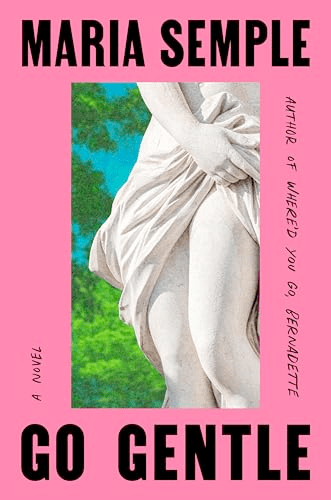
Maria Semple’s Go Gentle
Let’s start with the title, because I thought the Dylan Thomas allusion meant that this was a novel about death, and so far that’s not the case.
Instead, we have a woman in late middle age who is divorced, with a mouthy and charming teenage daughter, and living in Manhattan’s coveted Ansonia building.
She’s plotting to add more women of her type, arty and resourceful, to her floor as apartments empty. The “coven” she has established enables resource sharing (one car; one housekeeper) while holding out the seductive hope of aging in place together. No need to depend on a man for either physical sustenance or caregiving.
(Here’s where I point out that women who are depending on their male spouses as potential caregivers in times of extended debility or disease should consult the research literature: there’s an interesting gender gap. It’s not just that women tend to live longer, and also tend to marry men who are a year or more older than they are. Women are also more likely to stick with a sick spouse, to care for this partner at home (for as long as physically possible), and to make sacrifices in lifestyle in order to support the other person’s needs, such as selling the family home to pay for long-term care.
In short, a wife’s serious illness is much more likely to result in divorce than a husband’s.)
Adora is a philosophy PhD and an adherent to the tenets of Stoicism. Her devotion is even tattooed into her skin in the form of the words amor fati, love of fate. Instead of resisting and resenting life’s myriad indignities, accept them. Stop struggling, because the struggle creates suffering.
So Semple has sent me to Epictetus, which I’m finding soothing.
Instead of teaching undergrads, Adora is the bespoke philosopher for an astoundingly wealthy family, who, after a devastating accident left the husband largely paralyzed, want to raise their young twin sons with moral education that will serve them in life.
The wife, however, has purchased a new statue that may be stolen. And that’s the beginning of a complex art heist and fraud plot.
But this novel, after a very promising beginning, has bogged down, and not through lack of plot developments.
I’m deeply disappointed with the spunky and independent protagonist, who is entering into a relationship with an attractive but untrustworthy man. He’s investigating the art fraud, but he had been keeping an eye on Adora, thinking she might be a conduit to information about the art piece. So she’s dating a private investigator who had her under surveillance, and she seems more okay with that than I would have anticipated.
This is a trait of Semple’s intelligent, well-educated heroines: they do odd and unexpected things, as in Where’d You Go, Bernadette?.
The heart wants what it wants.
And that’s great for plot, and it may turn out to be a way to query Adora’s philosophic certainties, but at the moment I’m flummoxed and uncertain I want to bother continue reading.
I noticed a table at a large chain bookstore yesterday, one known for both promoting Can Lit and attracting protestors, that “Weird Girl Lit” is now a category. Some of the readers of Semple’s new book are situating Go Gentle in that peculiar realm. But it’s not quite working for me.
But then again . . .
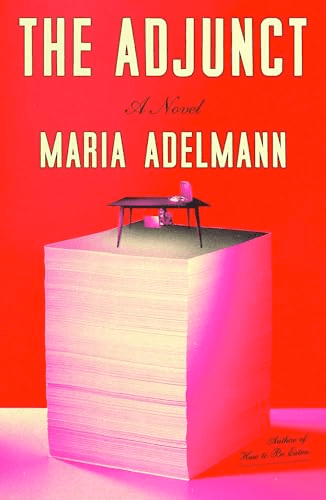
Maria Adelmann’s The Adjunct
I’m also a bit bored and frustrated with the second novel I’m reading.
Politically and ideologically, Adelmann and I are entirely in accord: she paints a bleak picture of the exploitation and immiseration of an entire class of contingent faculty members through her close attention to one recent PhDs adventures in teaching and love (sort of).
Sam is juggling two jobs at very different Baltimore colleges, where she completed her PhD. Her peers have spread around the world, some of them already successful and high achieving, so she’s suffering from both a lack of community and a sense of having failed.
A last-minute position at a fancy private college has her colliding with a former doctoral advisor, a famous writer who, after producing a single novel in his late 20s, failed to follow up with a second novel until decades later. And now his new book appears to be, at least in part, about his complicated not-quite-harassment relationship with Sam, in the MeToo era.
Adelmann has some wonderful lines. Her take on academia is note perfect, and so is her assessment of certain literary trends (autofiction; masculinity studies).
But Sam’s just about the most depressed and depressing protagonist of a campus novel that I’ve encountered. She wants to get back to writing fiction, but dashing between two underpaid jobs and prepping five new courses leaves her no time: every minute of every day is accounted for.
She’s downtrodden but neither angry or resistant, so the slights from her new department chair or from tenured colleagues are absorbed rather than repelled.
I may just not be in the mood for a character who’s a doormat.
On the other hand, there’s a very accomplished meta element that I’m enjoying: one of Sam’s assigned courses is The Campus Novel, with a reading list of all-male authors (because the arrogant old fart who crafted the course before an unfortunate incident sidelined him for the term is decades out of date and doesn’t believe in pandering to student interests or contemporary trends, such as inclusion).
As Sam reads and teaches novels from both this course and her Masculinity class, which includes such gems as Lolita, we are treated to a thoughtful, intelligent assessment of a range of now-contentious or outdated novels that are juxtaposed with contemporary social, sexual, and academic mores.
But I keep wanting Sam to act rather than react, and so far that’s a disappointment in the messy middle of this book.


Leave a comment