
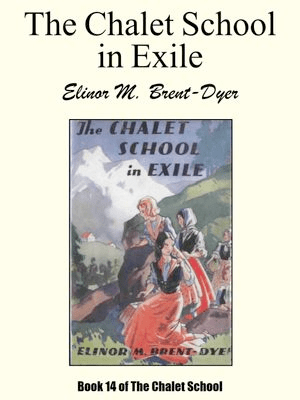
I’ve had a busy week of drafting applications, and one of these (completed! submitted!) required multiple short essays documenting my interest in mountain literature. I resisted citing the Chalet School novels as my earliest immersion in serial fiction in a mountain setting, but it’s hard for me to think about alpine lit without a wistful pang.
I learned a number of useful German words for meal times and food from these novels by Elinor M. Brent-Dyer (1894-1969), just as I picked up helpful theatre and dance vocabulary from Noel Streatfeild (1895-1986) and Ballet Shoes. These lessons stick.
Unlike Streatfeild, who came from an aristocratic background, Brent-Dyer was lower-middle-class, a striver. She became a teacher and a governess. A chance visit to Austria caused her to fall in love with the mountains, and since she had already begun writing children’s books, she envisioned an international boarding school tucked up in the Alps.
During the war, the fictional Chalet School is relocated, for safety, after some of the students (out for an innocent walk) are reported by locals to the Gestapo. There’s a von Trapp-like escape across the mountains to Switzerland.
One of the differences I noticed when my daughter began reading chapter books in the early twenty-first century was that the old classics were hard to find, with a handful of exceptions. She had access to a much broader and, frankly, better array of novels that captured the experiences of contemporary children. But the shelves were no longer stocked with the books I remembered, and I had to seek them out.
The Chalet School books, and boarding school books, in general, never interested her. She didn’t want to imagine midnight feasts with the Upper Fourth at Malory Towers or enjoy vicarious triumph at Maisie’s field hockey win over the self-important Arabella, an Honourable. The same proved true with all of my childhood series fiction, as the Happy Hollisters, Bobbsey Twins, Trixie, and Nancy, in turn, failed to impress.
Instead, her reading introduced me to today’s vastly richer children’s lit landscape. I’m still reading Katherine Rundell, for instance, with avidity.
But the old classics could also be problematic in a way that today’s more rigorously politically appropriate fiction is not.
The Hardy Boys and the Far Right: Passage Editions and the Re-Issuing of the Unexpurgated Novels
1930s and 1940s fiction commonly presents sensibility challenges for contemporary readers: the casual racist and antisemitic epithets are startling to us, and as I’ve described previously, later in her career, Agatha Christie urged her publishers to prune some language and characterizations from her first few decades of fiction.
A right-wing publisher in the U.S., a former adjunct professor in English, has made a very different choice: re-issuing the Hardy Boys books with the racist language put back in, for effect.
Or as a political statement.
Or something.
As Daniel Lefferts describes in The New York Review, the publisher’s overarching goal is “to build a reactionary cultural apparatus that would form an enduring and meaningful counterweight to a dominant left.’”
Teaching in a California English Department for a decade must have been a trial for this poor publisher, an MFA student.
So here’s his new project:
“In two handsome box sets with illustrated covers by Alex Wisner (a comic artist who has published two graphic novels with the press about an anti-Bolshevik Russian general), Passage released the original versions of the first six Hardy Boys novels, which began entering the public domain in 2023.” All of the original text has been restored.
What’s interesting to me (beyond the obvious dog whistling) is that past revised editions of the Hardy Boys series went well beyond eliminating offensive language, as Lefferts explains in his fascinating article:
“Beginning in the 1950s, the [Stratemeyer] Syndicate undertook a radical stylistic and structural revision of the novels to bring them in line with modern sensibilities and readerly tastes. New ghostwriters stripped out dated references (no more automats, no more “roadsters”), simplified the novels’ diction (expunging such vocabularial baubles as “sextette” and “declivity”), and excised passages evincing racial, ethnic, and sexual prejudice, which parents had been complaining about for years. They also seized the opportunity to shorten the books (from twenty-five chapters to twenty), speed them up (eliminating scenes not directly pertinent to the plot), and drastically simplify them, turning what had been atmospheric, moody, and often startingly lyrical narratives into chipper, two-dimensional capers.”
The goal of the corporation behind the Hardy Boys was to provide a more effective, engrossing reading experience for the Television Age.
They assumed young readers now had shorter attention spans.
(And, arguably, by simplifying the fiction that children were reading, they contributed to the problem, just as high school English classes do when they opt to give their students excerpts rather than the full text. I’ve had first-year university students tell me, straight faced, that they never studied a “whole” novel. The mind boggles.)
I can’t imagine there’s a large audience for the newly unexpurgated Hardy Boys novels. At least, I’m hoping that there aren’t libraries clamouring to bring back racist stereotyping and epithets for their young readers.
But next time I’m in Toronto I’m planning to spend a few days at the Lillian H. Smith collection near the university, which boasts an extraordinary children’s lit archive, including the famous Osborne Collection.
They seem to have a lot of Chalet School novels and I’m keen to re-read how the Chalet School girls outwitted the Nazis.


Leave a Reply