
Resilience Discourse
In several contexts over the past few weeks, references to resilience have irritated me. My re-immersion in trauma theory for a book chapter has me thinking about who is expected to be endlessly resilient, and how this call to demonstrate strength becomes an excuse to ignore pain, abuse, and systemic inequalities.
Resilience discourse is a siren song to cash-strapped systems. It’s cheaper to coach people to buck up than to provide in-depth, tailored mental health care. Or grief support. Or substance use rehabilitation.
And it can be a smug gesture of generational self-regard, with those of us who are older congratulating ourselves on how independent we were, back in our early 20s, while today’s young people flounder, move home after university, fail to launch.
I don’t think today’s young adults, who are more open about mental health needs and treatment, are less resilient. I think they’re experiencing ongoing concurrent crises of climate, economics, and social justice. They’re a lot more aware than I was, and thus (and appropriately) more anxious. And they’re anticipating a planet that may become uninhabitable in their lifetimes, so the climate grief is profound.
Kintsugi at the Art Gallery of Greater VIctoria
Our local art gallery is excellent: it boasts an extraordinary collection of work by Emily Carr, who grew up in Victoria and lived here between painting and study stints; her difficult and financially strapped decades of life, when she couldn’t afford canvas and painted on brown paper, are heartbreaking to contemplate.
Carr was, no doubt, resilient.
She also broke down, during her European sojourn in her twenties, and had a lengthy period of recovery. She dealt with family crises, financial insolvency, and profound loneliness.
Her art is one of brokenness as well as repair.

Emily Carr, Trees in the Sky
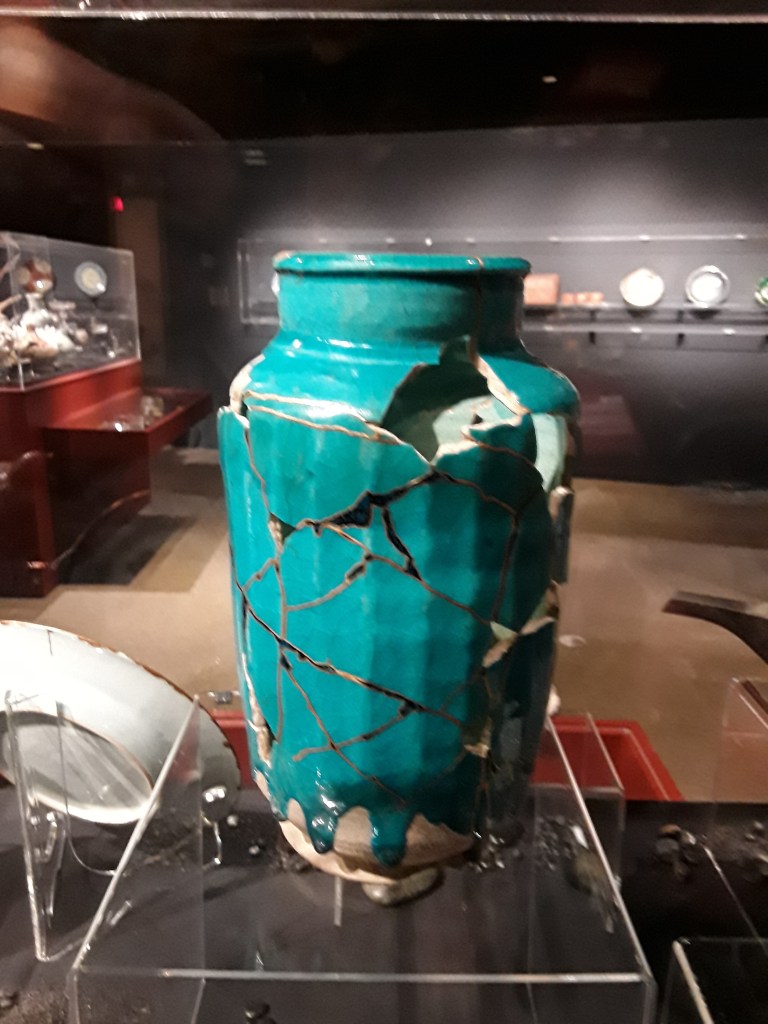
Last year, I visited the gallery several times to see their gorgeous Beauty of Mending: Kintsugi and Beyond exhibit.
The image at the top of this page, of a deliberately imperfectly mended vase, is from that show. (And I should have recorded the exhibition label, but I neglected to do so.)
The gallery quoted Leonard Cohen, the line that is also cited in a Louise Penny title: “There is a crack, a crack in everything. That’s how the light gets in.”
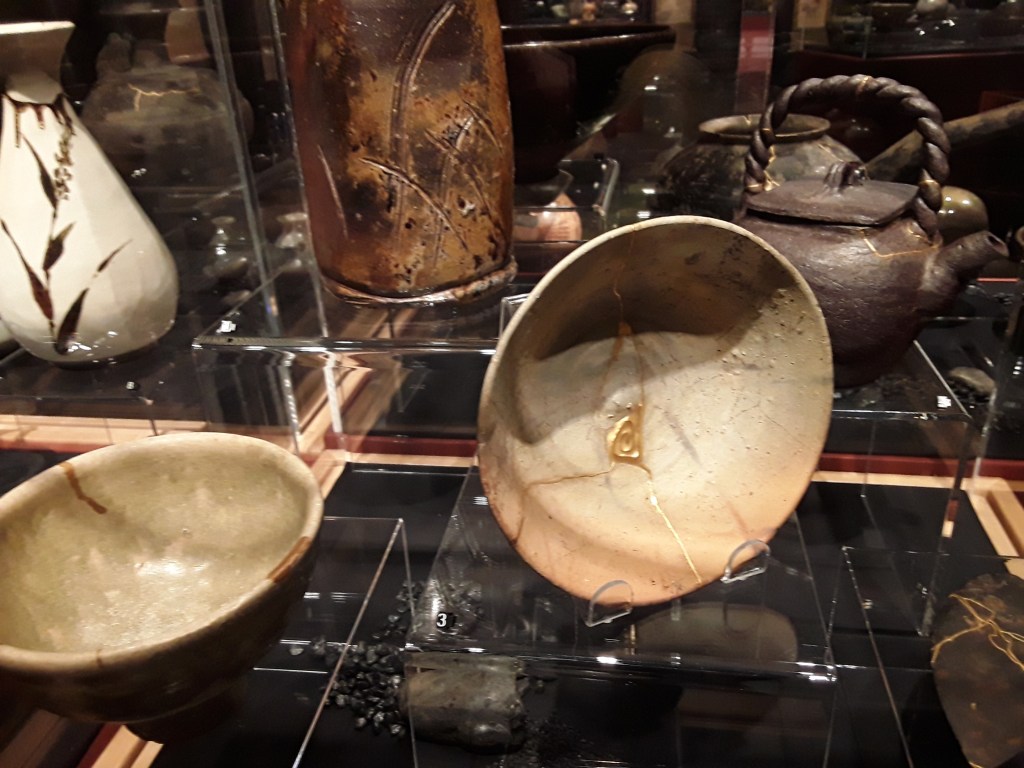
My worry is that resilience discourse prevents us from appreciating the value of the crack where the light gets in, unless it’s seamlessly repaired. Kintsugi, of course, espouses a different ethos: a focus on visible mending with molten gold. A crack that calls attention to itself as damage that has been (not perfectly) repaired.
Kintsugi and Crime Fiction
A challenging issue that I’m working through in my writing about crime fiction is the tendency to gloss over the damage that occurs in the wake of violent acts.
Too often, violence is described in graphic terms, not to horrify but to titillate.
In Penny’s novels, both Armand Gamache and Isabelle Lacoste are profoundly attentive to the murder victim, treating the loss of human life as a rupture that is irreparable. At different points, we see both kneel next to victims and pray over them, or promise them care and justice.
But while Penny is not alone in crafting a crusading investigator who attends to the dead, in a lot of crime fiction the body–and this is especially the case with women’s bodies–is a site of sexualized excitement, of forensic fascination.
Here’s Elisabeth Bronfen in Over Her Dead Body: Death, Femininity and the Aesthetic on how artists and writers have conventionally treated women’s corpses:
“On the one hand, focusing on the violence engendered by the move from a real body to a sign makes one blind to the aesthetic issue of representation, which involves only the relation between various clusters of signifiers. On the other hand, focusing exclusively on representations of violence engendered by the relation between signifiers, on the aesthetic rendition of violence severed from any real body, makes one blind to the concrete physicality of someone else’s dying.”
I may be oversimplifying, or misrepresenting her point, because it seems to me that the crucial issue here is that ethics and aesthetics are in conflict.
We can’t treat a female corpse as a beautiful object without denying the subjectivity of the life that has been forever lost.
Yet crime fiction, especially in televisual forms, also invites us to treat the body as an object. The bodies of young, beautiful women are shown in images that linger on their long limbs, their flowing hair.
Conversely, mourning is truncated. The immorality of the act of murder rarely reverberates throughout the novel, or film, or series, as it ought to, and the devastation of losing a uniquely loved person is not conveyed.
So while crime fiction focuses on both (personal and societal) damage and repair, with the moral order restored when the culprit is identified and punished, along the way women’s bodies are used, in fiction and film as in life, for the gratification of a male or voyeuristic gaze. This needs to change.


Leave a Reply