Another storm, this one with hail, and some more Raymond Chandler thoughts as I listen to Robyn Hitchcock play “Yesterday’s Rain” in an online concert.
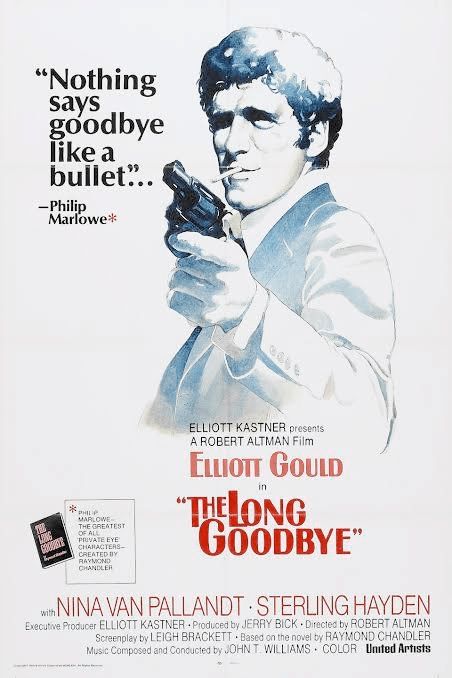
We’ve been watching Elliott Gould as Philip Marlowe in Altman’s The Long Goodbye this week.
It’s a deliberately paced work with oodles of groovy atmosphere, transposed, as it is, to the early 1970s in Los Angeles, where hash brownies and corrupt cops are de rigueur. Only Marlowe’s vintage car seems like a nod to Chandler’s own era.
Intriguingly, the screenplay is by a woman, Leigh Brackett, Howard Hawks’s long-time collaborator. She also wrote mystery and science fiction novels and did some work on an early draft of The Empire Strikes Back.
Along with William Faulkner (!) and Jules Furthman, she wrote the screenplay for The Big Sleep, one of my favourite movies. So she was a very good choice, nearly three decades later, for another Chandler adaptation.
The Long Goodbye is a bit of a mishmash. In Nina van Pallandt’s scenes with Elliott Gould, where she plays the flower child wife of a missing alcoholic novelist, they seem to be acting in different films entirely.
And the plot meanders, back and forth between L.A. and Mexico, with Marlowe drifting more than directing the action.
Gould’s Marlowe is a vulnerable and downtrodden pessimist, not a hardened cynic with an eye for gorgeous dames.
The New York Times reviewer, Vincent Canby, was smitten with the film, declaring, “It’s so good that I don’t know where to begin describing it.”
I can’t concur.
The long opening scene featuring Marlowe and his cat is a lot of fun, especially for those of us who enjoy feline antics, but the film as a whole feels leisurely and a bit disjointed.
And I like Elliott Gould, but he doesn’t seem like Marlowe to me. Per Canby:
“Gould’s Marlowe is not especially tough. He’s a bright, conscientious but rather solemn nut, a guy who hopes for the best but expects the worst, having experienced the social upheavals, the assassinations and the undeclared war of the sixties.”
That’s interesting, but it’s not noir.
Pauline Kael thought it was Gould’s best performance, to date: “Gould’s Marlowe is a man who is had by everybody — a male pushover, reminiscent of Fred MacMurray in Double Indemnity. He’s Marlowe as Miss Lonelyhearts. Yet this softhearted honest loser is so logical a modernization, so right, that when you think about Marlowe afterward you can’t imagine any other way of playing him now that wouldn’t be just fatuous.”
A half century later, however, I’d like to see a Marlowe comeback for our own fraught and fearful era.
Not Neil Jordan’s 2022 Marlowe which, despite the presence of Liam Neeson, was merely okay.
Something closer to the spirit of the original novels.
Raymond Chandler, incidentally, spent some time in Victoria, BC, after joining the war effort to fight on behalf of Britain. He had previously sought an exemption from fighting for the U.S., on the basis of his mother’s dependency on him. He indicated his fathers location as unknown.
The Tyee published an article by Tom Hawthorn several years ago about Chandler’s time in the backwater provincial city:
“The cadet underwent three months of basic training at Willows Camp, a staging area established on fairgrounds in Oak Bay, just east of Victoria. Years later, he wrote a letter to the journalist Alex Barris reminiscing about his time in the B.C. capital. “If I called Victoria dull, it was in my time dullish as an English town would be on a Sunday, everything shut up, churchy atmosphere and so on,” he wrote. “I did not mean to call the people dull. Knew some very nice ones.””
Nice and dull are not necessarily incompatible, of course, but that was a gallant correction by Chandler to an off-the-cuff insult that had hurt Victorians’ feelings some years earlier.
We prefer “bucolic and quiet” to “dull and churchy,” even today.


Leave a Reply