
The premise of my book project is that place is central to storytelling in Canadian crime fiction. The novels I analyze are set in locations as diverse as tiny fishing villages in Newfoundland, the Foothills of the Rockies, and Vancouver’s bucolic UBC campus (very thinly disguised). In each work, the physical locale, including climate, landscape, and population density, shapes the plot.
Elisabeth de Mariaffi’s The Devil You Know
Although she has lived in Newfoundland and Labrador for a number of years, Elisabeth de Mariaffi was raised in Ontario. Her first novel, The Devil You Know, features a young reporter living alone in Toronto. It’s 1993 and a serial rapist has been terrorizing women in the nearby suburb of Scarborough; Paul Bernardo has just been arrested on charges of murder, and he’s also a suspect in the string of sexual assaults.
When the protagonist, Evie, was a child, her friend was abducted and murdered, and now she seems to have a stalker who follows her while she conducts an investigation into the long-ago slaying.
De Mariaffi published an acclaimed book of short stories before the first novel, which appeared in 2015.
She explained the thriller’s genesis:
“The original idea for The Devil You Know came to me years ago, and it was the image of the girl inside her bachelor apartment and the stranger outside on the fire escape, looking in. What intrigued me was the idea that the girl isn’t sure he’s really there. Is there really a stalker out on my fire escape, or have I been so trained in anxiety that I’m making this up?”
“There was another story I’d been carrying with me, too, a news item from 2007 about a little girl that had gone missing in Quebec. After she went missing, other girls came forward and reported that they’d been approached by a man who asked them to help him find a lost dog. (The missing girl, Cedrika Provencher, has never been found.) I thought about those other girls a lot, and their parents, the girls who didn’t get in the car, who didn’t go with him. That near-miss. That feels close to home for me, because when I was nine, my own friend Sharin’ Keenan was abducted and killed, and her murderer has never been caught.”
A couple of years after de Mariaffi’s novel was published, the Toronto Police appealed for help from the public in the cold case of Keenan’s murder; they have a suspect, the man in whose apartment the young girl’s body was found. To this day, he has not been located.
The novel’s setting in Toronto is not incidental. The urban landscape and the city’s architecture are central to the sense of terror that de Mariaffi develops as Evie struggles to learn the truth about her friend’s murder and understand her own sense of imminent threat.
As reviewers including James Grainger in Quill and Quire described, this is a book that plays both with and against crime fiction tropes, refusing to allow readers a voyeuristic pleasure in imagining women’s vulnerability.
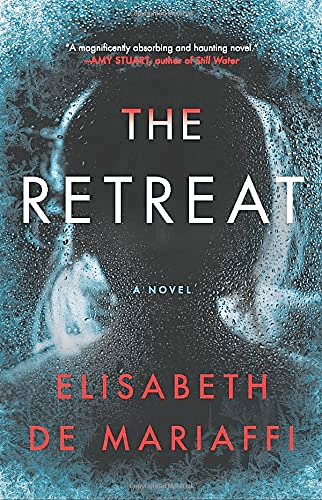
Elisabeth de Mariaffi’s The Retreat
Her recent thriller, set in the Rockies, is very different and, in some respects, more conventional. I didn’t think it was nearly as successful, perhaps because it tends to fall into familiar suspense thriller tropes rather than counter them, as in her earlier novel.
Maeve is a retired dancer who is hoping that her weeks at an isolated artists’ retreat that resembles the Banff Centre will help jump start her comeback. She is thrilled to have time away from her children to focus on her work, and she’s trying to put her painful history with her abusive former spouse behind her.
The setting is sketched in beautifully. When the inevitable storm begins and an avalanche cuts the motley crew of artists and staff off from the rest of the world, de Mariaffi creates a vivid portrait of growing distrust and anxiety.
There are some issues with characterization and structure. Maeve is traumatized, and she doesn’t trust her own perceptions, but we’re not invited into the stories of the other characters with much depth, so the conflicts she experiences feel forced and artificial. De Mariaffi is a terrific writer, but the structure of the long chapters, with each covering a single day, slows down the pacing.
But no matter, because I’m approaching the novel with an interest in place and setting, and those elements are achieved exceptionally well here. I’d love to see more writing from de Mariaffi set in her new home province of Newfoundland and Labrador, because she has a distinctive gift for capturing both the physical environment and the cadences of speech of characters in different locales.


Leave a Reply