My unwieldy title is attempting to yoke together several disparate observations this morning.
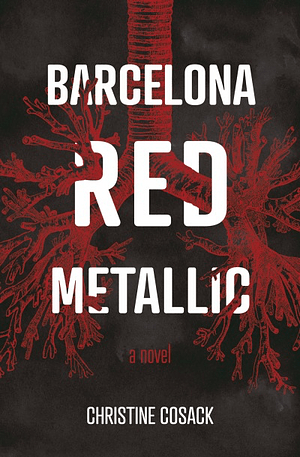
I’m re-reading Christine Cosack’s Barcelona Red Metallic, a first novel, which I read initially in manuscript as one of Christine’s beta readers. These kinds of test audiences for a work-in-progress are crucial; mine have been generous with feedback and guidance. And they provide a level of editorial scrutiny that publishers can’t always afford, when it comes to new authors, in particular.
Here’s where we are in Canadian literary publishing in 2025. We have a substantial number of surviving, if not thriving, small presses that publish the bulk of each year’s Canadian poetry, belles lettres, drama, and fiction. They subsist on federal and provincial government subventions intended to shore up Canada’s cultural sovereignty, a notion that my Canadian Studies classes tend to find rather quaint.
These recent students, the product of this century (egad), have grown up with a comfortable belief in Canadian culture. One so rooted that they are willing to entertain debates about such things as de-funding the CBC, confident that it will never come to pass. To be fair, the students who sign up for Canadian Studies courses are already either believers in Canadian culture/society, or international students keenly interested in learning more. I hear from friends, teaching political science and economics, that they have skeptics about these topics in their student population.
But our literary small presses are experiencing strains and New Star, one of longstanding contribution, is closing. New Star Press recently ceased acquisitions, and to quote this PW article: “Don Gorman, board chair of publishing trade association Books BC, wrote that New Star’s closure ‘stands as a sobering reminder of the critical need for sustained support–by the industry, consumers, and government–for arts and culture.’ Gorman noted that ‘this loss is profoundly felt by all who value independent and thought-provoking publishing.’”
Last February, I attended a wonderful Writing for the Public humanities workshop, at the Jackman Institute at U of T. I’m still drawing (here, among other places) on the advice of Irina Dumitrescu, who is a wonderful writer. And a generous mentor to those of us who would like a wider audience for our literary critical and other endeavours, which are too frequently scanned by readers who number in the single digits.
Then they’re mostly assessed hyper-critically by scholars re-working the same turf, looking for weak arguments and faulty observations that they can rail against in their own writing. The fundamentally agonistic nature of writing in the humanities is a longtime bug-bear of mine, because the appreciative approach of building on fascinating insights appeals to me far more. But those articles, when I draft them, don’t find a home. Intriguing.
So we have scholars who want to write for the public, small presses like New Star producing dozens of books a year that merit reviewing, and the Globe & Mail, which no longer has a Books section.
I’ll go further. The Globe & Mail‘s current book coverage is scandalously inadequate, for what purports to be a national newspaper. When they do have a feature or a review, it often reads like product placement for a novel that one of the handful of big publishers (now mostly part of global conglomerates) is trying to coax readers into purchasing.
There’s a recent example that I’ll refrain from citing, having read it pre-publication and decided against posting a review, not wishing to knock an eager new author for a work that felt half-baked. But according to the G & M‘s breathless coverage, it’s the voice of a generation. Am reminded of Lena Dunham in Girls.
What the G & M no longer seems to do, after a period of a terrific series of first-novel reviews by Jade Colbert, is cover the books published by small presses. And that is a disaster for them. I learned about a lot of fascinating books from Colbert, and I miss that.
Which takes me back to my neighbour Christine Cosack’s Barcelona Red Metallic. I’m partial, so please accept this as biased, but it’s a great book. Read it. You won’t regret it. For some bolstering of my subjective stance, I will note that it has garnered several very strong reviews. Unusual for a first novel by an author who wasn’t previously famous, or infamous, in another realm.
In what is now called the British Columbia Review, Trish Bowering notes that “A beautiful Sunshine Coast setting, an exploration of lichen-themed art, and a compassionate portrayal of chronic illness contrasts with the horror of a terrible act of violence and a growing realization that bad things happen to those we love despite trying so hard to control every outcome. Barcelona Red Metallic is both a mystery and thoughtful character study that satisfies on several levels.”
The Vancouver Sun review is nearly as flattering. “Somewhere between a cosy mystery and Sam Wiebe, Barcelona Red Metallic keeps readers riveted, curious, and unnerved–just the things we crave from a murder mystery.” Not that many books garner a review in the Sun anymore. Brett Josef Grubisic’s heroic efforts have kept the intelligent, thoughtful book review alive in their pages for some years.
The rest of us, including those who were paid handsomely decades ago to review books for national newspapers, weep in dismay at how reviewing has been outsourced to GoodReads. The site has so many issues that I’ll tackle them in a separate blog post. Suffice to say, in my estimation GoodReads is not good for writers and readers of literary fiction, poetry, drama, or most other genres. It’s okay-ish for popular fiction, but there it suffers from severe reader biases and, sometimes, preconceptions about not-yet-published-or-read works. More on that soon.
But congrats to Christine, who deserves all of the praise that Barcelona Red Metallic–published, crucially, by the wonderful Second Story Press–has been receiving.


Leave a comment