I typically discover new (to me) crime writers in a range of ways: through newspaper and online reviews; from friends who foist favourites on me; and as fortuitous discoveries in Free Little Libraries.
But this is my first time finding a terrifically interesting crime writer by happenstance, while arranging to rent her home during my forthcoming fall research trip.
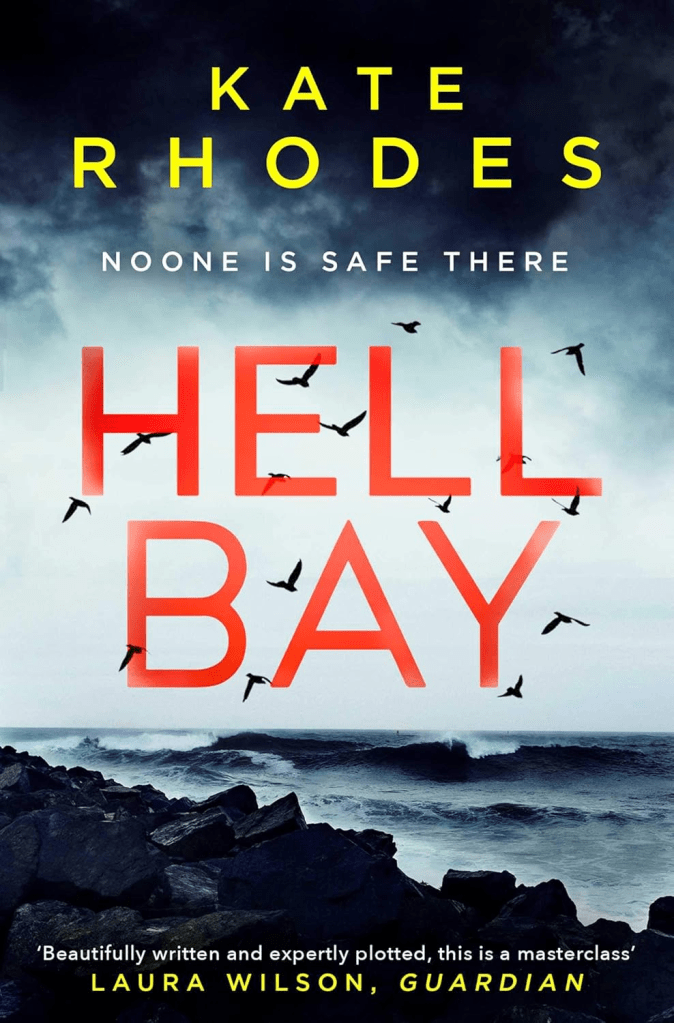
And now I’m hoping that Kate Rhodes’s complete works will be available for browsing on her shelves, because Hell Bay was one of the best mystery novels I’ve read this year.
Coincidentally, my other mystery read of the week is also set on an island. It’s just out.
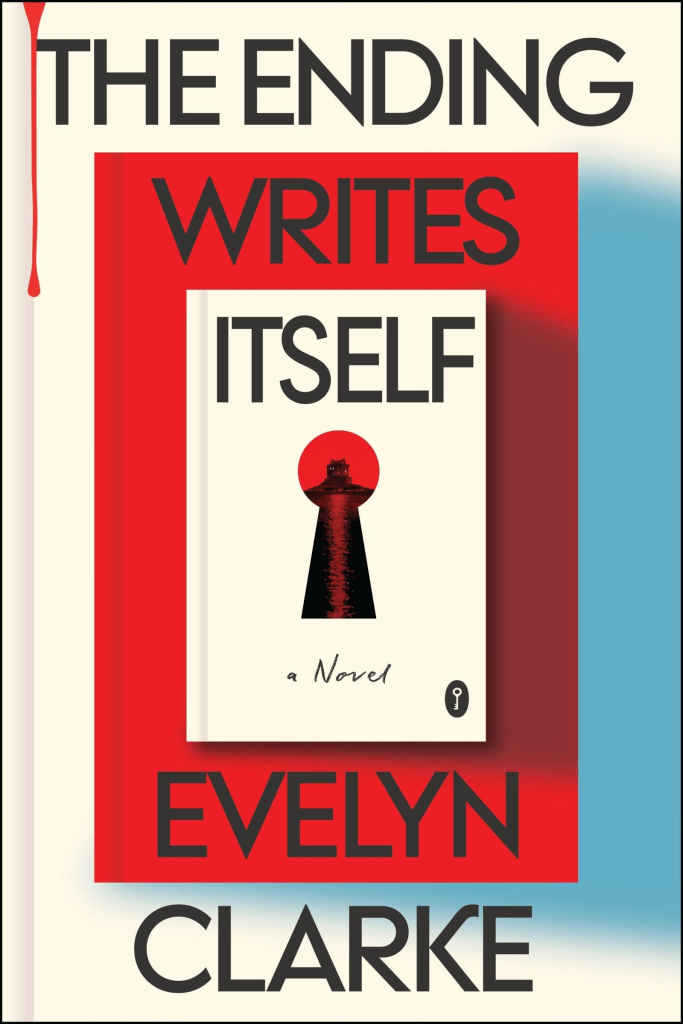
The Ending Writes Itself is a collab between long-time friends and fellow authors Cat Clarke and V.E. Schwab; they settled on Evelyn Clarke as their pen name. And they even include in the novel a pair of (married) writers and co-authors of a crime fiction series, although one suspects that Clarke and Schwab collaborated more equitably than their feuding fictional creations.
The isolated Scottish island where the book is set is owned by an eccentric millionaire thriller writer, Arthur Fletch. The final novel in his most celebrated series is overdue, and he’s been having trouble with the ending.
But it turns out that the famous (and famously difficult) author will not be making an appearance, having recently drowned in the sea near his home, although the news has not been made public. Instead, a desperate plot has been concocted to finish his novel without him.
The Ending Writes Itself is proving to a lot of fun, and there’s an insider baseball quality in all of the digs about life in the writing and publishing world.
But I’ll start with Kate Rhodes’s Hell Bay, the first volume in her Isles of Scilly series, which now numbers six books.
I ordered it without peering too closely at the series title and was thus under the vague impression that it was set in Sicily.
So an important correction, for others who are as geographically challenged as I am: the Isles of Scilly are an archipelago off the coast of Cornwall, and most of the 140 or so islands are uninhabited. Only just over two thousand souls inhabit the islands in total, with most residing on St. Mary’s and a small number distributed across three other islands.
On the island of Bryher, the chief location of Hell Bay, there are fewer than a hundred people present the morning a teenage girl is stabbed and then pushed off a cliff. Others are away working, since scrabbling together a living on the island requires multiple jobs.
(Literary readers may be struck by the name Bryher; the island, it turns out, was a favourite childhood haunt of the modernist writer, and she borrowed the name when she set out to be an author, to limit the scandal for her status-conscious relations.)
Bryher is beautiful and generally serene. DI Ben Kitto, of the London Metropolitan Police, has come home, along with a dog recently foisted upon him, to think.
His parents are both dead, his father in a shipwreck when he was a teenager and his mother more recently, after an illness. But his childhood friends and godmother still live on the island, and Ben might have relaxed and begun to recuperate from the recent loss of his (professional) partner in London if a young girl hadn’t gone missing.
Although he’s been contemplating quitting the profession, Ben’s conscientiousness propels him to offer to take on the investigation. The local police grudgingly agree, even while it’s clear that they’ll claim his successes but blame him if he and the very young assistant they loan to him fail to identify a culprit.
Like her parents were before her, the murder victim, Laura, is a golden girl: beautiful, athletic, and gifted.
But while they remained on the island and grew increasingly embittered at their misfortunes, Laura is determined to get away to drama school. She plans to take with her the son of the local real estate scions: the pair are deeply in love, despite the concerns of both of their families. Tragically, days after Laura disappeared, her boyfriend is the one who discovers her corpse. But perhaps he had an inkling of where it might wash up on the beach?
Other suspects include Laura’s once-promising father, who is mired in anger and is known to lash out.
Even more inconveniently, Ben can’t immediately rule out the man who has been his closest friend since childhood: the friend had been become smitten with sixteen-year-old Laura, his family’s babysitter.
Add to the mix several odd and reclusive islanders, including an artist and a woman reputed to be a witch, and Ben Kitto has his hands full.
This is a well-paced, character-driven crime novel. The sentence-level writing is a delight. And there are some particularly unexpected twists. I really enjoyed this one.
And I’m not quite finished The Ending Writes Itself, but I can concur (so far) with the excellent reviews that the novel has gleaned.
Several authors receive an invitation to attend one of the famous artistic salons of a celebrated author; they’re all a bit surprised to be included, as midlist authors who haven’t yet had a break-out publishing triumph. One invitee hasn’t even had her first book published.
But when they arrive, their host is nowhere to be soon.
They soon learn that he is, in fact, recently deceased, and the last chapter of his final book in a series remains to be completed. The author had struggled with the ending. Now the invited guest writers are offered the opportunity to do the same: a 72-hour writing marathon to complete the novel, with their efforts to be judged anonymously. The winner will receive both a handsome reward and a three-book contract.
Jennifer Harlan, reviewing the novel for the New York Times, is a bit less impressed with all of the book world trivia:
“in leaning so heavily on their insider knowledge, Clarke and Schwab risk alienating a broader audience. Even I, someone well versed in the book world, got a bit weary of all the references to genre tropes and signing lines and the looming threat of A.I. I worry that someone who’s never heard of a slush pile or stumbled upon the term “midlist” might not have nearly as much fun — nobody likes to be the odd one out at a dinner party where the rest of the guests keep talking shop.”
But this particular metaphorical guest was delighted to be invited to Evelyn Clarke’s table. I’m in the midst of reading a dozen books on writing craft, editing, and publishing, including daunting advice about agent representation and contracts. One month into my MFA in Creative Nonfiction, I’m completely thrilled to have embarked on a new venture. So bring on the publishing trade gossip in the form of a murder mystery.
But I do take Harlan’s point: this book might not be for everyone, although I think the authors also provide a tidy locked-house/isolated island mystery, with sharp characterizations and very funny dialogue. A lovely touch is a dollhouse miniature of the castle that is placed in the library: it reveals a secret or two in the design of the home.
But I haven’t yet reached the ending, and (as the authors point out), that’s the most important bit.


Leave a Reply