
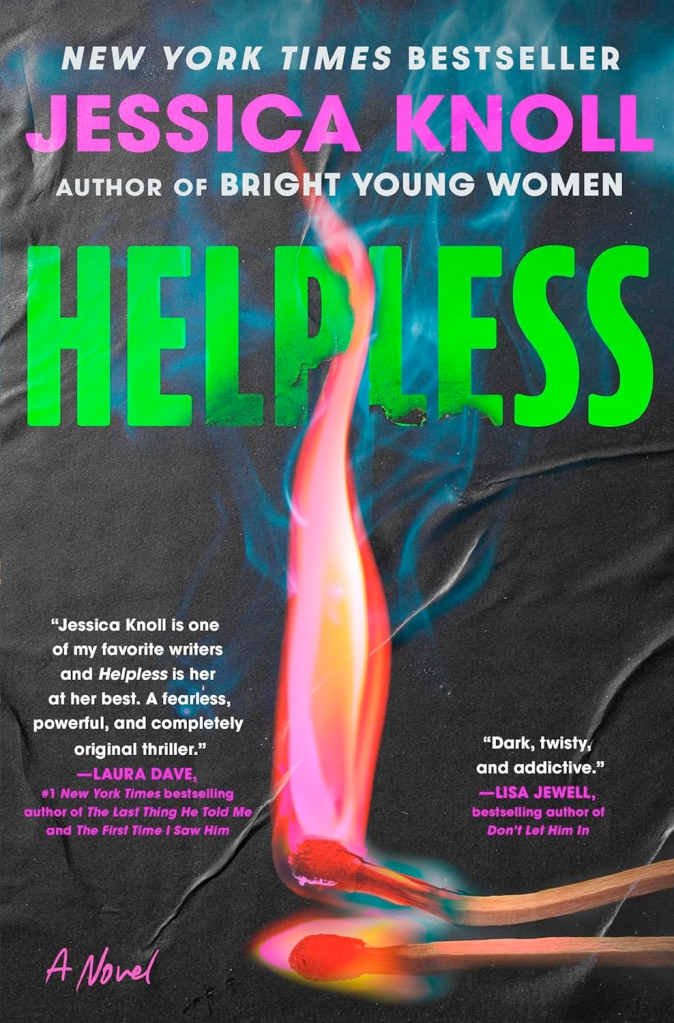
According to her new book’s publicity, Jessica Knoll’s Helpless, due out in July, is a “smoldering erotic thriller with a singular, mind-bending ending.”
Many thanks to NetGalley and the publisher for an advance look.
This is the third Jessica Knoll novel that I’ve attempted to read; I’m going to try the The Luckiest Girl Alive again.
Her stories are a lot: Knoll doesn’t spare her readers discomfort. She’s a terrific writer and her plots are well-constructed, with ample suspense and intriguing twists and turns. Her characters are intriguing. But the level of violence is high, and in the most recent novel, the sex is graphic and frequent, which is not to say that the novel felt erotic, at least to this reader. For all that the protagonist tells us that she is aroused, the way these scenes are written is so disquieting that one is more inclined to suggest therapy than ask for sex tips.
Faye is a successful but not yet a powerful Hollywood screenwriter, which is fair enough: she’s still in her early thirties, and the projects that she and her husband produce (and which she sometimes directs) are doing well, just not stratospherically well.
But her new screenplay may change that. An A-list Hollywood actress suddenly has some free time between commitments and she would like to read Faye’s new work. After she spends a dutiful few days in the small town where she went to college, attending a favourite professor’s memorial service, Faye anticipates a completely free week to herself to finish the script.
Enter Henry. He was Faye’s college boyfriend and still exerts a sexual magnetism for her, but he’s now a husband and the father of two children. Henry was deeply in love with her, and their break-up broke his heart. Worse, Faye used their relationship as material for a groundbreaking television episode about coercive control. His appearance for the memorial unsettles Faye.
Faye’s also confronted by the needs of a scholarship student who is entitled to her writing mentorship, just as Faye once benefited from the support of a school alum and donor who set her on the path to Hollywood.
But the young woman’s script tells a story that some would like to suppress.
I’m not giving anything away when I tell you that Henry, in the guise of catching up, drugs and abducts Faye, taking her to a remote cabin. But what does he have in mind?
The rest of the plot chugs along, and there’s a twist, of sorts, at the end.
Along the way, there’s a lot of sex and lengthy conversations about the past. Sometimes the pacing drags a bit.
What bothered me more, though, was that while readers are given some indications of the source of Faye’s troubled relationship to sex, the character remains largely unknowable, a set of traits rather than a fully developed person. And other characters are even more thinly drawn, including both Henry and Faye’s husband, who’s off on location shooting another project.
Class privilege and status are key themes; so is authorship. But for me this wasn’t a book that fully gelled.


Leave a Reply