
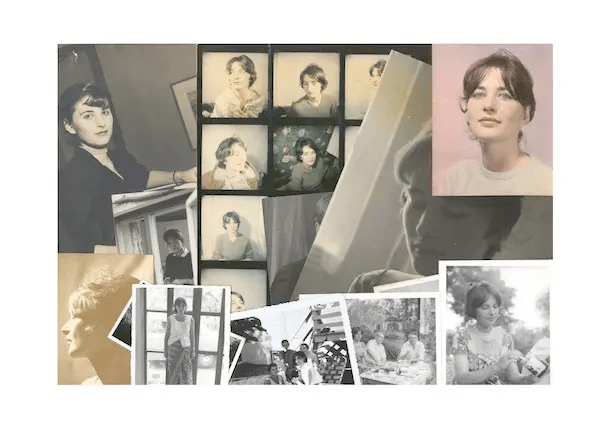
Image credit: Bonhams, The Roy Davids Collection
Content Warning: Suicide and Child Murder
Today would have been Assia (Gutmann) Wevill’s 99th birthday; she was only 41 when she died in 1969, in a murder-suicide alongside her daughter Shura, who had recently turned four.
I approach writing about Wevill with deep ambivalence, worrying that my own efforts become part of the glamourizing of a child’s tragic murder. There are no good words for this terrible story.
In recent years, there’s been more intense critical interest in Wevill’s own writing and art, after decades where she was known mostly as the other woman in Sylvia Plath and Ted Hughes’s lives.
Her life had fascinating twists and turns: the daughter of a Jewish father, she was of German-Latvian ancestry and fled Europe with her family at the outset of the Second World War, settling for a time in Israel. Not long after, in 1946, she emigrated to Canada with her first husband, an Englishman, living with him in London and then Vancouver and studying at UBC. While it’s not well documented, they also spent time in Victoria, and Wevill worked at the Art Gallery of Greater Victoria.
Her second husband was a Canadian economist; the third, David Wevill, a Canadian poet, whom she met during a ship crossing across the Atlantic. It was this connection that introduced her into the lives of Hughes and Plath.
By the time she encountered the poets, Wevill was a spectacularly gorgeous thirty-something, a successful copywriter at an ad agency, and a friend of novelist Fay Weldon. (In Down among the Women, Weldon includes a very thinly veiled portrayal of Wevill, who is treated more sympathetically than in most accounts; in the wake of Plath’s suicide, an unfair amount of blame settled on Wevill for having lured Hughes away from his young family.)
Plath became aware that Hughes and Wevill were conducting an affair shortly after it began. She and Hughes separated, after some spectacularly dramatic gestures (like burning his work in a bonfire). And Plath settled in a flat with their toddler and baby in London, in a home where Yeats had once lived.
Wevill was pregnant at the time of Plath’s 11 February 1963 suicide; Plath may even have been aware of the fact, although after Plath’s death Wevill had an abortion.
Some recent scholarly work is critical of Hughes’s editorial interventions in the work of Wevill as well as that of Plath, even linking editorial control to physically coercive and abusive behaviour.
The death of Assia Wevill and his young daughter was devastating for Hughes; he believed that the news even precipitated his mother’s final, fatal thrombosis, when she was already very ill. But “the press refrained, for some mysterious reason, from reporting the tragedy.”
Wevill’s geographical displacements, her obvious gifts in writing and art, and what is described as her fierce love for her child, as well as the care she showed Plath and Hughes’s two children, make it seem incomprehensible that she chose to kill Shura.
Her relationship with Hughes had been unstable for years, despite their efforts to live as a family after Plath’s death, even moving into Plath’s flat to care for the children. Her depression was deep and unrelenting. But many accounts of the murder-suicide also claim that Wevill felt both haunted by Plath’s place in the world of letters and in Hughes’s life. She remained the interloper, always on the outside.
In an online post, the only surviving Hughes sibling, Frieda, includes a painting she did to accompany her “For Shura” poem.
 The Landscape of Canadian Women's Crime Fiction
Leave a comment