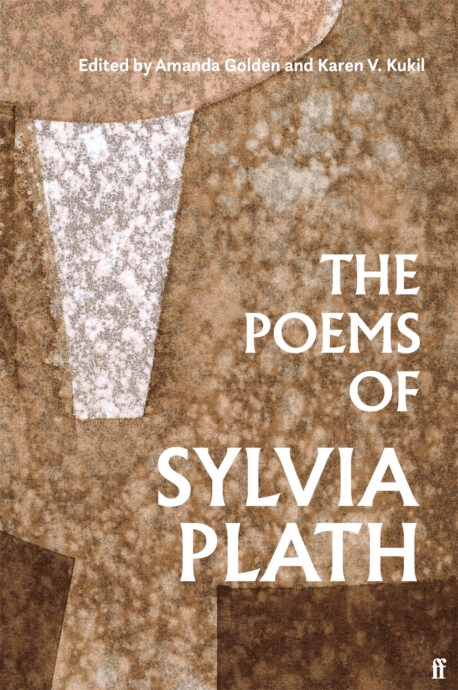
The collected poetry of Sylvia Plath has just been published in a Faber edition by Amanda Golden and Karen V. Kukil; an edition of the collected prose is to follow.
There hasn’t been a comprehensive edition since the 1981 Collected Poems, which appeared less than two decades after Plath’s death by suicide, when she was only thirty. At that time, her literary estate was very much in the hands of her estranged husband, Ted Hughes, and his sister Olwyn Hughes. Since Plath and Olwyn had a fierce antipathy, and Hughes was keen to shape Plath’s life and work for his own ends as well as in service to her poetic achievements, this was not ideal.
Just to re-visit some of Hughes’s contentious choices, briefly:
The posthumous publication of Plath’s most famous volume, Ariel, did not follow Plath’s own careful arrangement of the sequence of poems, and it omitted several that she had intended to include.
Plath’s Colossus had appeared in 1960, the only book of her poetry published in her lifetime, and between the two books there is an enormous shift from a more formalist, controlled poetics to the confident posturing of dramatic monologues like “Lady Lazarus” and “Daddy.” Elegy, in Plath’s hands, becomes a vehicle for both reclamation and condemnation of her father, who died when she was a child.
The father-lover/husband fusion is deeply disquieting, and one imagines that reading some of these poems would have been gutting, for Hughes.
But crucially, the poems, while deemed Confessional, make meaning in a broad political context that goes well beyond Plath’s individual life–or Hughes’s life.
Publishing them in Plath’s desired order, and as a comprehensive collection, should have been an easy choice. Instead, he elected to arrange them in a manner that implies Plath was moving towards her doom.
My copy of the new book has been “dispatched” from the UK and will now make its slow way across the Atlantic and most of a continent, so it’s not expected until early June. The American edition will be published on June 16th, but I was impatient.
So my comments here are leaning heavily on the free partial preview available online and the comments of Plath scholar extraordinaire Peter K. Steinberg.
Editors Golden and Kukil note that while the Hughes-edited 1981 Collected Poems included 274 poems, their own volume features 542 poems. They explain that they began the collection with her “mature” poems of 1953-63, followed by editorial notes and then her earlier work, which includes a much more extensive array of Plath’s juvenilia than in Hughes’s earlier selection.
Steinberg suggests that a strictly chronological approach might have been preferable, but his review is favourable, praising Golden and Kukil for their “meticulously transcribed and forensically researched” editorial efforts.
I think it’s fair to assume that, going forward, this will be the definitive edition of the poems.
Generously, the editors note that they had access to a range of biographical and critical sources that were not available to Hughes, which has enabled them to be more precise in dating individual works.
The editors also highlight their inclusion of the crucial “authorial copy-text” of each poem. And they have “sought transparency in all decisions” related to the collection.
Scholars and readers will benefit from this rigorous and respectful approach to Plath’s art.
Sylvia Plath in Fiction and Film
Some biographers are keen to turn Plath’s life and death into a crime story, and novelists have also taken up Plath, and her relationship with Hughes, in their own ways, which are sometimes elliptical.
I’ve written about Alice Walsh’s Analyzing Sylvia Plath: An Academic Mystery.
Other examples include two very good books, Emma Tennant’s Sylvia and Ted and Kate Moses’s Wintering: A Novel of Sylvia Plath.
There’s a film that I recommend avoiding, and an acclaimed new novel that is due out next month in North America: Helen Bain’s The Daffodil Days.
Work on Plath, in biography, criticism, or fiction, has been subject to complaints of impropriety and sensationalism since at least the early 1970s. Hughes described himself as harassed by feminists, who turned up at his public readings (especially in the U.S.) to harangue him.
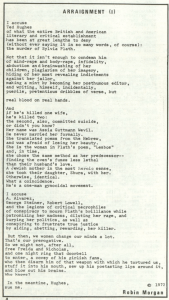
Robin Morgan’s 1972 poem “Arraignment” is a famous example of the kind of Plath tribute that the Hugheses (and sometimes the Plaths) objected to, an over-the-top accusation of murder that opens with the lines “I accuse / Ted Hughes”:
Suicide is a bomb thrown into an unwitting crowd: even if the target is the self, the bystanders are wounded, some fatally.
The circumstances of Plath’s death and its aftermath, which included Hughes and Assia Wevill moving into her home in order to care for the two young children she left behind, were painful for many.
Hughes made complicated editorial decisions in fraught circumstances. Some, like destroying or carelessly losing at least one volume of her journals and the draft of her second novel, still seem unforgivable to me.
Perhaps they will still turn up.
But the last word should perhaps go to poet and artist Frieda Hughes, the surviving daughter of Plath and Hughes; her younger brother died of suicide after living with bipolar disorder for many years and forging a successful career as a biologist.
Frieda Hughes has been a thoughtful commentator on her parents’ poetic and personal legacies. She opposed the bio-pic, and she has sometimes been as scathing as her father was about the appropriation of Plath’s life and art. From a profile in The Guardian by Donna Ferguson:
“She has written several moving poems about her parents in Alternative Values, her latest collection of paintings and poetry. This, she says, is her way of reclaiming her parents’ very public relationship: “When I was younger, I used to feel my parents had been a bit stolen, by being reinvented by other people … My parents are my life. Not yours, not someone else’s, they are mine. If I want to write about them, it’s my prerogative.”
But there’s also this: until she was fourteen, Frieda Hughes didn’t know how her mother had died; her father had shielded her from the truth.
As a parental decision, that may have been wise (although it’s horrifying that Hughes learned the truth from a classmate). But the circumstances of Plath’s death, and the prior breakdown of their marriage, left Hughes in an unenviable position as her literary executor, and as her editor.
I’m making a mental note that I’ve barely mentioned Olwyn Hughes here, but her role in shaping Plath’s literary and biographical legacy deserves attention.
 The Landscape of Canadian Women's Crime Fiction
Leave a comment