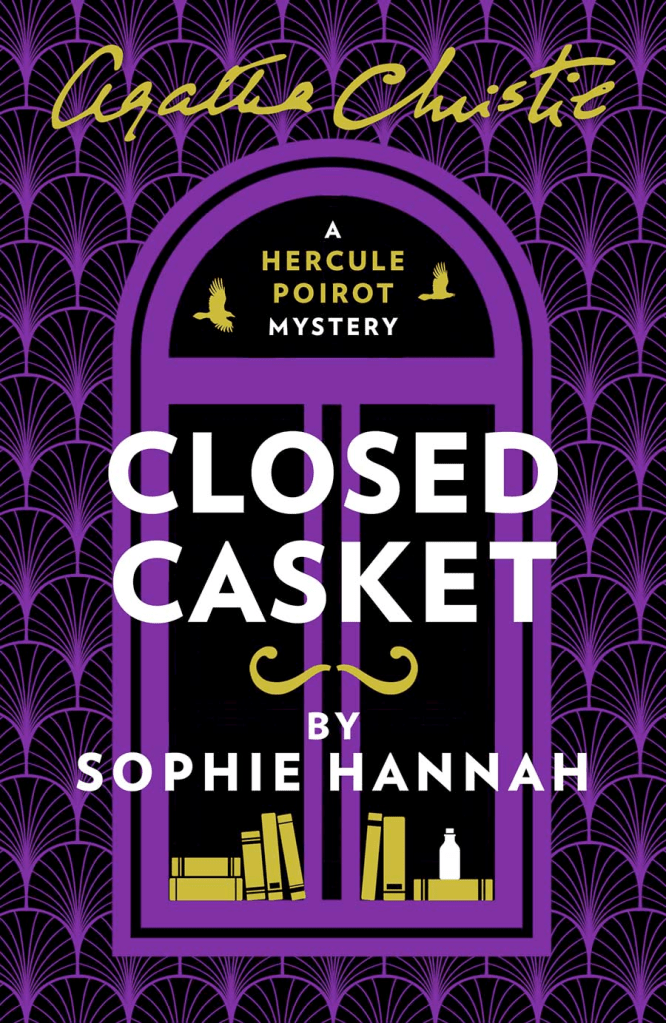
As I was reading Closed Casket (mostly with pleasure) last night, it occurred to me that my dissatisfaction with Sophie Hannah’s take on Hercule Poirot stems from a possibly intractable problem. In short, Hannah is a much better writer than Christie. And a very good writer trying to mimic a worse one produces challenges.
I’m not talking about plot. Christie is the mistress of the simple-yet-complicated concealment of the culprit, relying on such strategies as unlikely people working together (Death on the Nile; Orient Express) or a body double for a corpse (Evil under the Sun). Her novels abound with poisons and last-minute substitutions of drinks (Mirror Crack’d). Her plotting is impeccable, even when (on closer examination) improbabilities abound.
But her prose style is basic. Banal, even.
Characters are sketched in quickly, and she relies more on caricature than deep development or growth. The racist stereotyping I’ve deplored elsewhere is one off-shoot of this approach.
For her novels, that works just fine: they’re relatively brief and action-oriented, rather than studies in psychology. Unlike some of her peers, Christie did not use her mystery fiction to probe philosophical or political questions of the day, such as women’s status in higher education. She told stories. Ripping good yarns.
But for a contemporary writer who is an accomplished prose stylist, such as Sophie Hannah, this presents a decided difficulty in bringing Hercule Poirot back to life.
Closed Casket is Hannah’s second book in this series. It features Poirot in a story about an elderly famed children’s author, Lady Playford, who gathers her family and her lawyers to make a dramatic announcement: her enormous fortune, which includes the large Irish estate where the book takes place, will be left to a dying man, her devoted secretary. Her children will inherit only if he predeceases her.
Havoc ensues.
This is a fun book, and Hannah is leaning heavily on Christie-esque caricature in her portrayals of the viciously self-centred daughter and daughter-in-law, the intellectually stunted adult son, and the wealthy and besotted fiancé, a doctor. The dinner party set piece is perfect: a chaotic scene of frenzied personal attacks and rebuttals.
But by Christie’s standards, the plot is moving along fairly slowly. Time has been discussing Irish nationalism, literature, and the landscape. All of these make for a richer reading experience, but the pacing flags.
Worse, Hannah can’t help but be interested in psychology. Her own non-Christie fiction is rich in depth of characterization. So Poirot and the novel’s narrator, his old friend, a Scotland Yard investigator who chafed a bit after Poirot was credited with solving his own very challenging case, are left to ponder motives and means with far greater subtlety than Christie typically allows.
Was the dying man in on his employer’s plan to discomfit her children? Was he genuinely upset, as he seemed to be, when she announced her bequest at dinner?
These are interesting questions, but he quickly turns up as the murder victim, and now the unexplained invitation to Poirot and to Inspector Edward Catchpool makes more sense: their hostess appears to have been anticipating a crime that would need investigating. Whether she actively precipitated the murder is a crucial question.
Some Christie tropes are checked off here: a country manor, isolated from its neighbours, with a set cast of characters and a plethora of motives; class consciousness and snobbery, with an Upstairs Downstairs focus on both masters and servants; Poirot working his little grey cells in the company of a police investigator he easily outwits.
And there are some fun lines. The son-in-law-to-be once studied English literature, intending a professorial career. But he discovered that he disliked debating the merits of King John with other Shakespeare scholars: “The study of literature is for those who enjoy speculation. I prefer to know.”
Hannah is sending me to King John today, as a welcome break from course prep. But I’m not at all certain that these projects of continuing the series of beloved dead authors should be continued, although I’ll be intrigued to see what Lucy Foley does with Miss Marple in the Alps. That’s due out next fall.


Leave a comment