
“Perhaps Adam Dalgliesh is an idealized version of what I’d have liked to be if I’d been born a man.” P.D. James, quoted in an interview by Julian Symons, NY Times, 5 October 1986.
“Almost always the idea for a book comes to me as a reaction to a particular place and setting. Sometimes it’s East Anglia, where I love the wide skies, the marshes, the estuaries, the little villages. Not pretty, but full of character. I like to create in books some kind of opposition between places and characters.” P.D. James, from the same interview
“I don’t feel that I should complain about it [my childhood]. It always seems to me that with three-quarters of the world’s children going hungry, I haven’t a lot to complain about, really, but it was quite a traumatic one. Someone has said that a writer should have as much trauma in childhood as they can bear without breaking, and I have a feeling that an unhappy, or a less than perfect childhood, is very good for a writer.” Interview with Elinor Wachtel, Writers and Company, CBC, 1999.
“P.D. James will be missed, but she will be remembered. Adam Dalgliesh fathered many literary children, Armand Gamache among them. And the 13-year-old girl holding Cover Her Face now holds her own novels, thanks to a woman she never met – but admired greatly.” Louise Penny, on the occasion of P.D. James’s 2014 death, in the Globe & Mail.
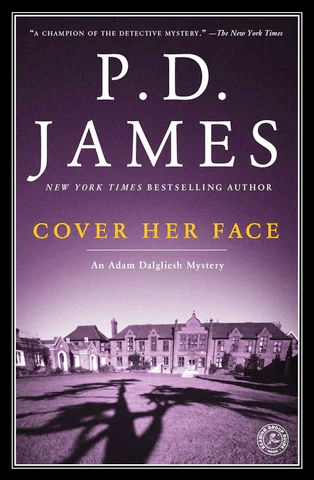
Adam Dalgliesh, a widowed poet and police inspector, is introduced in P.D. James’s 1962 crime novel Cover Her Face.
With her title (drawn from A Duchess of Malfi) and her protagonist (whose last name is borrowed from her high school English teacher), James announced her intentions: to craft highly literary mysteries featuring a sensitive Scotland Yard investigator who is deeply restrained, even cool, in his romantic life.
Having lost his young wife and newborn son during childbirth, Dalgliesh conveys an impression of world weariness even in the earliest novels in this series, which continued until 2008’s The Private Patient.
At the time of her death, P.D. James was working on an idea for a new Dalgliesh novel, but the ending of the final book she published is rather perfect: after years of coolly transactional and polite relationships, her investigator has fallen desperately in love. Now his Emma, a Cambridge English professor who needed a bit of persuading that he could combine his two vocations with a personal life, has agreed to marry him. In the novel’s final scene, after some misunderstandings, they are reunited. Readers are confident that this is a good match for both.
By 2008, James was a formidably accomplished peer in the House of Lords, a magistrate, and a career civil servant who had helped shape the NHS’s approach to mental health care. She was also, herself, bereaved, after the tragic death of her husband, who returned from wartime duties with profound psychiatric problems and spent a decade and a half mostly in residential care. With the help of her in-laws and boarding schools, she raised two young daughters while fully supporting her family.
There’s a wonderful interview on CBC with Elinor Wachtel, for Writers and Company; the occasion was James’s publication of her quasi-autobiography, Time to Be in Earnest, which is a sort of diary-record of a year of her engagements as a public figure, with occasional reminiscences prompted by what she’s doing that day.
By American standards of memoir, it’s a model of reticence and non-disclosure. A critical biography would be a wonderful project, unless all of the figures in James’s life are equally restrained about personal revelations. James makes the important point, however, that she didn’t want to revisit her life’s tragedies and traumas, including the war years, or her husband’s health, and that sets a challenge for potential biographers, who may wish to defer to her wishes.
What is even more remarkable is that James accomplished all that she did despite the fact that her education at the Cambridge High School for Girls ended when she was only sixteen; her family couldn’t afford to pay the fees any longer, and she went straight into the work force while helping to raise her younger siblings. Her mother was already institutionalized with her own mental health issues.
James was an extraordinary autodidact, and after working in a clerical role for a tax office for a few years she spent time as a stage manager (theatre, notably, also plays a significant role in her crime fiction). She married and had two daughters, then in 1949 began her work in health care administration after taking night classes to qualify for the civil service.
Not surprisingly, medical and especially psychiatric issues are central to James’s complex and nuanced character portrayals. Several of James’s novels include hospitals or clinics as settings: the plastic surgery practice of The Private Patient and the nursing students in Shroud for a Nightingale are accompanied by the depiction of Dalgliesh’s own recovery in hospital from serious illness in The Black Tower and a chilling description of a psychiatric clinic in A Mind to Murder.
To my mind, she’s the best crime writer ever.
Like her own favourite writer, Jane Austen, she combined a careful dissection of social class and the idiosyncrasies of personality with thoughtful assessment of morality. Austen’s novels are, of course, not mere Regency romances: they are explorations of how to be in the world, especially as a young woman with limited resources whose major source of financial security is marriage. Marriage looms less large in James, because her heroines, including the protagonist of her two-novel series about a young female investigator, can earn their own living. In a late novel, Death Comes to Pemberley, James gives us a delightful Austen-themed crime novel.
My contention is that Louise Penny’s beloved Armand Gamache, the moral investigator at the centre of her mystery novels, would not have been possible without the example of P.D. James’s Adam Dalgleish.
Dalgleish is, of course, already in a line of gentleman-scholar-investigators, as many have noted. He has Lord Peter Wimsey’s courtly manners and respect for female intelligence and accomplishment, but without the foppishness or, until later in life, the fortune. And he has some traits of both Sherlock Holmes and Margery Allingham’s Albert Campion, although Campion is, of course, understood to be a quasi-parodic rendering of Lord Peter.
The key distinction is that Dalgleish is a professional police investigator, not an amateur or private detective. Like Penny’s later Gamache, he is empowered by the state to do his work. At various points in the novels, characters (mostly female, intriguingly) object to the grubby and intrusive nature of his chosen profession. There’s a tension between Dalgliesh’s personal fastidiousness and the grubbiness of his investigations. Similarly, Gamache is the moral center of Penny’s novels, a good man in a fallen world.
Louise Penny has cited James as a significant influence on various occasions, but her most extended tribute in a 2014 piece in The Globe & Mail: “How P.D. James changed my reading habits – and my writing.”
A sample:
“I never met James, but she had a profound effect on my reading habits, and on my writing. She made it clear that writing, and reading, crime fiction was not for the simple. For lesser lights. It was not a step along the way, until one day I might be good enough to read, or write, a ‘real’ book.
Those unfamiliar with the works of James and many other crime writers insist on labeling mysteries as a sub-genre of literary fiction, with the emphasis on ‘sub.’ James would have none of that. She was a passionate, vocal, reasoned and thoughtful defender of crime fiction as being every bit as good as any other writing.
It allowed her, as she said, to investigate what it means to be human. And what better way than to watch what happens when well-ordered lives are shattered?
James served notice that crime fiction is no more a training ground for ‘real’ writing than haiku is a training ground for those aspiring one day to write poems with more than 17 syllables.”
In an article I’m working on, I trace stylistic, thematic, and character development elements in Penny’s fiction to some key models in James’s earlier novels. These elements shift over the course of Penny’s work: her sentences, notably, becomes briefer and more clipped, and dialogue is increasingly the vehicle for storytelling.
Like James, Penny is not afraid to take artistic risks, shifting between sub-genres and settings.
So as I set to work, in earnest, on this piece, I’m looking at how the two authors choose cloistered settings for their fiction (much, if not all, of the time): colleges and monasteries, in particular, enable the exploration of a small group of closely linked characters who are effectively stuck with each other. Things can easily become murderous.


Leave a comment