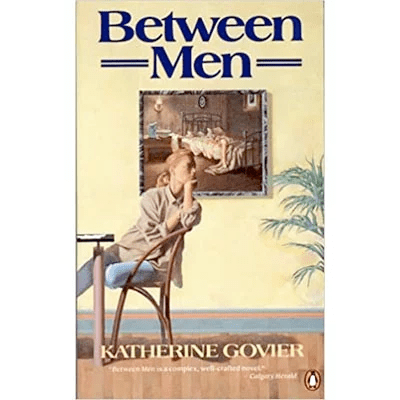
Katherine Govier’s Between Men
Canadian literature has a fair number of internationally-acclaimed women writers, including in crime fiction.
I’m puzzled that Katherine Govier’s work is not more famous, and I think she should be counted in the company of Atwood, Laurence, Gallant, and Munro, although she’s about a decade younger than Atwood. While her first book, Random Descent, came out in 1979, her work belongs to the 1980s and on, rather than the slightly earlier era ,when Atwood and company were becoming justly renowned for their stories of women’s lives.
Govier’s fiction is terrific, as well as diverse in setting and theme.
Only one of the books, Between Men, has a crime at its heart, and it’s a historical one, so I’m analyzing the novel in a chapter about how contemporary Canadian crime writers like Maureen Jennings treat the criminal past.
Years ago, I lived on Brunswick Avenue after reading a collection of linked short stories by Govier entitled Fables of Brunswick Avenue. Published in 1985, several years before I moved to Toronto, it included lines that, in the early 1990s, resonated with me as I walked the tree-lined streets of solid brick home in the Annex, the comfortable neighbourhood just west of the university:
“Everyone lives on Brunswick Avenue sooner or later…
Some longer than most. If you’ve never actually found the apartment of your dreams on this downtown street where anything is possible, then you may do so yet.”
Dutifully, I located a dark basement apartment with an entrance down a flight of crumbling concrete steps at the rear of the building. A friend, worried about the pale flickering light above the stairs, which was supposed to be motion-activated, proposed installing a red light for greater visibility at night. But then he cited the Police’s song “Roxanne” as his inspiration, and I gently pointed out that the red light signals availability for sex work in those particular lyrics.
Govier’s Between Men is, in part, about a young women perceived as a sex worker.
A history professor, Suzanne, lives in Calgary and is researching a historical crime: the violent death of a young Indigenous woman, Rosalie New Grass, in the late nineteenth century.
Because her murder took place around the time of the Jake the Ripper slayings in London, and there’s an apparent similarity in the manner of her death, the newspaper accounts are more plentiful than in most instances of the deaths of young Indigenous women during that era.
It was a period, in Canada, of rapid colonial incursion and usurpation of traditional lands. The industrial and residential school system was used as a tool of colonization, separating children from their families and cultures. In this context of the transformation of what are now the prairie provinces in Canada, there was resistance (notably by Riel, Dumont, and their supporters), but there was also the crushing military might of the North-West Mounted Police, the precursors of today’s RCMP.
The identity of Rosalie’s murderer was easily established, but the colonial legal order of the day was reluctant to hold him to account.
Suzanne is frustrated by how thin the historical record is when it comes to documenting the perspectives of Rosalie and her family; she begins to imagine, filling in the interstices between known facts with her own reconstruction of Rosalie’s life and death.
As Maureen Garvie’s review describes, “Suzanne discovers that Rosalie New Grass was no prostitute. A convent-educated ‘good girl,’ she worked for a family in town. Suzanne also learns that Rosalie had a lot of money on her person when she died. Where did she get the money, and what was it for? And why did she ever go into a low- down place like the Turf Club?”
This is a really interesting book that merits attention, but with the exception of a handful of thoughtful reviews and one 1996 article, I’m not finding much critical engagement with Between Men. Conversely, a novel I’ve always found similar in preoccupation, Guy Vanderhaeghe’s The Englishman’s Boy, is much discussed. Perhaps his more overt historical metafictional strategies give literary critics more to say?
It’s also possible that Govier’s blend of literary novel, campus fiction, romance (Suzanne’s relationships takes up a lot of space), and mystery causes consternation. But this is a fascinating book about early Calgary, and I’ve added a few days to my fall research schedule to spend at U of C, learning more about Alberta history.
Nora Bernard: Renaming and Remembering
Each of Canada’s provinces has been grappling with reconciliation in different ways that are dependent on local histories.
In British Columbia, where I live, the United Nations Declaration on the Rights of Indigenous Peoples was adopted into a provincial law; now the province, alarmed by some recent court cases, wants to back off from its commitments.
(The province might not agree with this characterization, having stressed that this is about ensuring certainty for landowners: guaranteeing that privately-held property can be held without worry about title in B.C. My rejoinder would be that this concern was well-known at the time that the province brought in the reconciliation legislation, and its keenest legal minds weighed in at the time. Backsliding now because judges are interpreting the law as granting (finally) more emphasis to Indigenous legal orders and pre-existing Indigenous title is disingenuous.)
In Nova Scotia, and particularly in the city of Halifax, which has long had fraught racial divides, there’s been a significant commitment to reconciliation. This work has included re-naming streets, as it has in Victoria, where the former Trutch is now Su’it Street. The same has happened in Vancouver.
In Halifax, Cornwallis Street is now named in honour of residential school survivor and long-time activist Nora Bernard. As a CBC piece notes, “The renaming honours the Mi’kmaw activist who was a driving force behind a class-action lawsuit against Canada on behalf of residential school survivors that was settled for upwards of $5 billion in 2005.” Conversely, “The street was previously named for Edward Cornwallis, the former British governor of Nova Scotia who issued a proclamation in 1749 promising a bounty of 10 guineas for each Mi’kmaw person killed.”
A tragic note is that Nora Bernard was murdered in 2007, a decade and a half before the street was renamed to commemorate her crucial efforts to hold the government and the churches to account. Her grandson served 15 years for manslaughter. His life, too, is part of the long shadow of colonial violence, not because he wasn’t legally accountable for what he did, but because his actions were shaped by hundreds of years of history that included intergenerational and personal trauma.
Her grandson went to Bernard seeking money. Shortly before her death she had received her compensation payment: $14,000.
When I was attending meetings and then TRC hearings about the residential schools, survivors begged for assistance in structuring payments from the legal case. They worried about the effect on their often-impoverished and desperate communities and families of a sudden influx of funds. I later heard stories about survivors who gave all of their money away to family, or bought expensive consumer goods, and were soon broke. Canada did not serve the needs of survivors, and this created, for some, a new harm.
As a non-Indigenous Canadian-American who has Indigenous relations, I struggle with how much of the painful legacy of colonialism is mine to write about.
I’m sitting with that as I write about Bernard, whom I never met.
I’m thinking of the grace and kindness that have been extended to me by Indigenous peoples, including residential school survivors, at reconciliation sessions across the country. I attended these while researching a book project I ultimately realized was not appropriate–yet another non-Indigenous take on residential schools and their legacy in literature.
But this work, which had been packed away in boxes, is newly relevant as I work on Govier’s novel.
I’m still not quite sure what to do with it. It doesn’t feel like my story to tell, but as the province I live in inches away from commitments to reconciliation, it also feels like necessary work to do.


Leave a Reply