
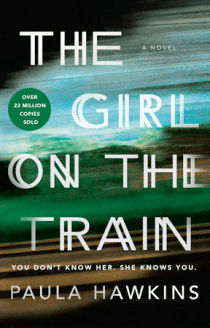
I’m re-visiting Paula Hawkins’s 2015 Girl on the Train, which was adapted as a slightly shaky film starring Emily Blunt.
Blunt is perfectly cast and holds most of the movie on her very capable shoulders, but the film version exposes a few weaknesses in the novel’s plotting while flattening out Hawkins’s more nuanced characterizations of the two other women, Anna and Megan, who act as foils to the protagonist, Rachel.
I really like Hawkins’s fiction, including her recent novel, The Blue Hour. The books tend to fall somewhere between thrillers and literary fiction, but The Girl on the Train, her breakout book, is a more straightforward suspense story with three first-person female narrators who all hide secrets. The men in their lives are no more transparent.
Rachel and Tom have recently divorced. He’s moved on, acquiring a new wife, Anna, and a baby daughter who live with him in the home he used to share with Rachel.
Rachel’s train trip into London each weekday takes her past their home. Cautioned to leave Tom’s family alone, Rachel chooses to fixate, instead, on a neighbouring house and the attractive thirty-something couple who seem to be so happy together. Rachel has endowed them with invented names, occupations, and dialogue.
But as she struggles to deal with the chaos of her own life, propelled by her alcohol dependency and memories she can’t bear to confront, she is also dangerously drawn into this couple’s lives–as well as those of Tom and his new wife, Anna.
The woman in the other couple, Megan, disappears; her husband is the obvious suspect. But Rachel may have vital information about an alternate perpetrator, having glimpsed Megan kissing another man from the train window.
Rachel’s story is fractured and inconsistent, which makes her an untrustworthy witness. The police would like a more detailed account of her own movements on the night that Megan disappeared, as well as a promise to stay away from her former husband’s cozy new family. But Rachel reaches out to Megan’s husband, convinced he’s not culpable and concerned he may be blamed.
Then a connection between the missing woman and Tom raises worrying questions about Rachel’s own potential role in Megan’s fate. Since Rachel has a significant memory gap and a head injury, she can’t even trust her own recollections.
Most readers likely know that this is a story featuring an unreliable narrator, but it’s also about coercive control and gaslighting.
That likeable and long-suffering ex-husband?
He cheated. He lied. He persuaded Rachel that she had jeopardized his job and his friendships. And worse.
The film adaptation shifts the setting from London and its environs to New York and tony Westchester County. Emily Blunt gets to keep her English accent.
Other changes in the adaptation are more problematic, although I’m not quite as critical as The Guardian‘s Peter Bradshaw, who declared that “this hottest of literary properties lands with a lukewarm splat on the movie screen: a guessable contrivance with a biggish plothole.”
He’s especially unhappy with the proximity of the houses to the railway line (which I think would work better in a UK setting than in American suburbia):
“Maybe the property prices are lower to reflect the fact that sexually obsessed commuters will be eyeballing you every night. And in one startling scene, you see them in their Martha-Stewart-perfect kitchen preparing to have vigorous sex up against the fixtures and fittings. We cut back to find Rachel doing hardly more than gazing sadly at them. In real life, you’d have loads of pervy commuters of all ages crowding around Rachel, gawping with their noses pressed up against the window, filming it on their iPhones.”
There’s a lively quality to British film criticism.
Bradshaw even grumps about Emily Blunt, suggesting that she’s burdened with a “whingy, relentlessly weepy role in which her nose hardly ever resumes its natural colour.”
Here’s where we part company: I think Emily Blunt does depressed and despondent just as well here as she performs high-strung hyper-perfectionist in The Devil Wears Prada. There, too, a red nose is her sad fate, with her virus causing her to flub the all-important Met Gala introductions, which loses her a coveted Paris Fashion Week trip.
But sometimes one needs a good whinge and a reddened nose, before one returns to the business of being mature and accepting about life’s curve balls. Hawkins is perfect company on those days, and the novel has some surprises along the way.
For those seeking out more Girl adaptations, there’s apparently a very interesting theatrical adaptation, published by Oberon.
An intriguing academic article by Jennifer Musial considers how fertility and reproductive health issues inform both GIrl and Gone Girl. Musial coins the term “Gynaenoir” to describe their shared fixation on the disruption of domestic happiness by failures of reproduction, such as the multiple miscarriages and stillbirths that Amy’s mother, in Gone Girl, suffered before she finally produced one living, healthy daughter.
In The Girl on the Train, Rachel blames her own failure to conceive a child for the breakdown of her marriage; Tom’s new family demonstrates, in her eyes, that she was the problem. And without the glue of a child to keep him at home, Tom drifted into an affair with the woman he later married.
But the flip side is that leaving a marriage without a child is more straightforward than escaping with an infant in tow. And as Hawkins’s chilling novel describes, Tom has been a danger to more than one woman in his life.
A colleague recently emailed me the most recent statistics about Canadian women killed by their male domestic partners, and it’s grim. Looking at femicide, more broadly, 30 women and girls have been murdered in 2026 by the middle of March.
Most of those slayings are by people close to the victim, as the research points out, but Indigenous women are more acutely vulnerable than non-Indigenous women to being murdered by non-family members:
“Like the situation globally, women and girls in Canada are at greatest risk of being killed by male partners. Indigenous women and girls in Canada are killed at significantly higher rates and are more likely to be killed by acquaintances and strangers than non-Indigenous women and girls. Their experiences, referred to as genocide and starkly highlighted by the National Inquiry into Missing and Murdered Indigenous Women and Girls (2019), highlight inadequate state responses and the frequent impunity of their killers. As is the case internationally, Canada has little systematic knowledge about trends and patterns in femicide or an understanding of its own accountability in preventing femicide.”
I’m heartened by the amount of research that’s being conducted.
And parliamentarians don’t mock spousal abuse, as they once did. The police are more inclined to investigate.
But we also don’t seem to be making a lot of progress in reducing the incidence of violence. George Brown College recently paused their acclaimed program to train counsellors for assaulted women and children, citing both budgetary pressures and a drop in enrollment.
In this context, stories of domestic terror, like Hawkins’s novel, play a vital role in raising awareness about how insidious abuse can be, and how quickly it can escalate, especially when there is no effective means of intervention. Hawkins’s Rachel, for all of her flaws, is also a feminist heroine.
But in re-reading the novel, I had the sense that the threads uniting the three narrators, of vulnerability to male abuse and guilt and shame related to their own poor choices, were tenuous. Musial’s academic analysis proposes something more interesting: pregnancy and fertility failures connect them more deeply, and this is a crucial way for Hawkins to make them Everywomen.


Leave a Reply