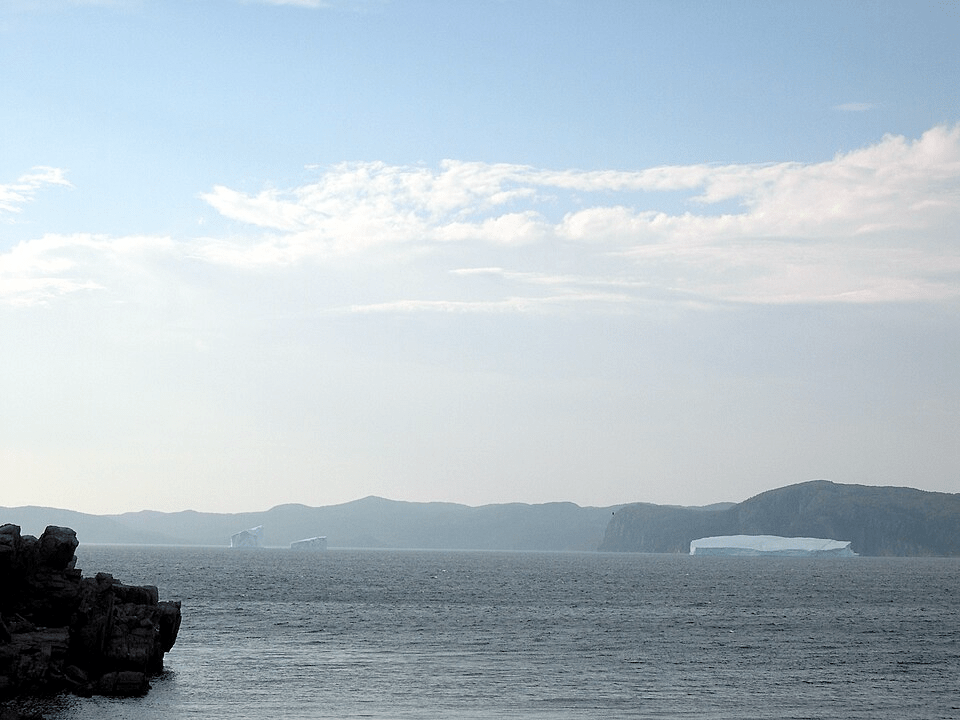
Photo credit: Dylan Kereluk from White Rock, Canada; used under a CC license. Description: Newfoundland coast and iceberg.
I have a word length problem.
By May 1, I need to chop a minimum of 26, 232 words from the second draft of my first mystery novel.
On that May Day, a very good developmental editor will receive the manuscript for review. Our shared goal will be to streamline plots, characters, and word length, down to a slim and manageable 80K or so words.
The time available for my first big cuts will fall across my two weeks of post-term vacation, but I’ll need to leave time for layoff meetings (sigh) and prepping my summer courses.
To set myself up for success, this weekend I set myself the goal of reading and reverse outlining on a schedule of 100 pp per day.
A not especially ambitious goal, but one I still found impossible to meet, because within a few chapters I had defined multiple issues that needed fixing:
- Some big structural problems, including the fact that the first-person narrator’s limited perspective fails to convey some key past plot events. I have lengthy sections where she finds documents that she reads, or engages in conversations with people who were present at events decades ago. She sits and listens, which makes her less active. Boring.
- Many small but difficult-to-fix issues, where plot points need sharpening, the number of characters needs to be reduced (in some instances, through combining them), and the setting of the school in the first eight chapters takes on far more weight than it ultimately merits. A friend who read my first draft scribbled a kind but prescient comment in the margin of one of these chapters: “Do you need all of this world-building?” And since that friend is a Famous Writer who has published twenty books, I should have heeded this question sooner. I enjoyed developing a gothic campus filled with privileged teen girls, but it’s almost entirely irrelevant to my plot.
- Most of the important events took place thirty-five years earlier, and while my first-person narrator has some awareness of the past, she knows too little, and for too long. She’s not credulous, precisely, but she’s out of her depth. I’m not sure how to fix this.
- Other things to fix: a few cringey “If I had know then what I know now” passages; portrayals of contemporary adolescents that suggest I haven’t spoken to a teen in a decade; a dark Byronic husband, in turns brooding and tender, who is way less Rochester than Harlequin Romance.
- My novel is one of hundreds of contemporary gothic-tinged domestic thrillers about how we can never really know the person we married. This trope and possibly the genre itself have grown tired and shopworn while I’ve been writing and then setting the book project aside for a few years. I need to make this fresher.
It was discouraging to realize that my own MSS had become a DNF (Did Not Finish) for me this weekend.
I’m even more grateful, now, to the friend who diligently laboured through hundreds of pages and left helpful notes when we traded drafts a couple of years ago.
But I’m not sure what to do next.
On Saturday night I stayed up late and invented a new focus for the novel as well as a different narrative structure, involving alternating first-person present-day narration and a third-person narration focalized through two specific characters to convey the past events.
This could work. It will be a lot of work.
And I’m not sure I can pull it off.
This is the final week of term, so my last Written Lecture for my online Creative Nonfiction students is titled “Visions and Revisions.” I encourage the student writers, who have done terrific work over the past twelve weeks, to really lean in to their revision process to try to get to the core of their writing project.
Last week’s mini-lecture title, used a bit carelessly, was from Eliot. This is the time of year when I re-read “Burnt Norton,” but I warm up with “The Love Song of J. Alfred Prufrock”:
There will be time, there will be time
To prepare a face to meet the faces that you meet;
There will be time to murder and create,
And time for all the works and days of hands
That lift and drop a question on your plate;
Time for you and time for me,
And time yet for a hundred indecisions,
And for a hundred visions and revisions,
Before the taking of a toast and tea.
I love “to murder and create,” because that nicely captures the “kill your darlings” school of fiction editing while yoking it to the process of creation.
But I’m short on the time.
And I’m starting to wonder, uneasily, if this manuscript is worth revising.
It’s precious to me, because it’s mine. I finished writing a novel, and that matters to me, even if it never sees the light of day.
It’s also a product of my life, five years ago, immediately after a near-fatal illness.
Some of my–frankly–loopiness from being on high doses of steroids for a few months, which coincided with starting to write, comes through in the carelessness of some plotting. I was full of vim and vigour and light on logic, during that odd period, when I did things like visit Newfoundland on a whim.
Now the province is my most favourite one, along with Quebec, and I’m looking forward to returning this summer for a piece I’m writing about Come from Away. I can’t wait to see Gander. I’ll be too late, alas, for the icebergs. I keep missing iceberg season.
But other products of those strange, lonely months, including this novel draft, may not be salvageable, so I’m trying to figure out how to move forward.
 The Landscape of Canadian Women's Crime Fiction
Leave a comment