
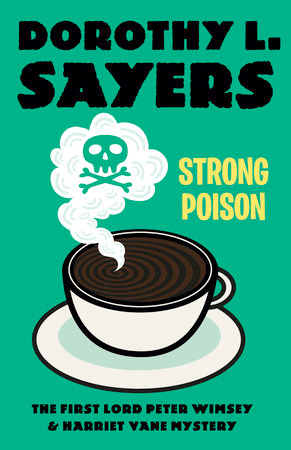
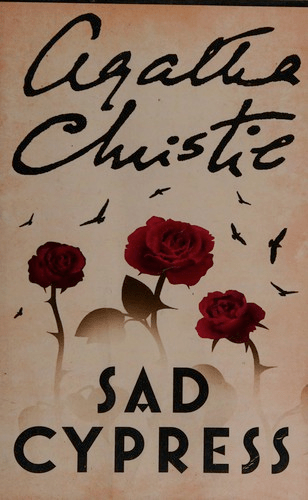
I was halfway through Sad Cypress before I realized that the young doctor who had sought Hercule Poirot’s assistance was named Peter Lord.
Lord Peter. A nice tribute to Dorothy L. Sayers in a book that follows the broad outlines of her earlier novel, Strong Poison.
Sad Cypress was published a decade after Sayers’s book, and there are some interesting connections between the two very different writers including, unfortunately, their shared use of causal antisemitic epithets. Those turn up on the first page of Sad Cypress in the versions of the text that adhere to the original.
In Strong Poison (1930), the novel that introduces crime writer and proto-feminist Harriet Vane, she is accused of poisoning her former beloved after their breakup.
He was something of a cad: a successful writer, but also a proponent of free love. He had talked Harriet into living with him, sans marriage. This affected her reputation, of course, much more than his own.
And then, after the end of their relationship, he proposed. The offer of marriage was an insult, not a concession: it undermine the entire philosophical foundation of his purported beliefs, as well as Harriet’s own submission to them. A humiliation, not a triumph.
Lord Peter attends the high-profile trial which results in a hung jury. Riveted by Harriet, he then has but days to prove her innocence before she goes on trial again, facing the prospect of the gallows if she is found guilty.
Harriet is grumpily, grudgingly grateful. Having a complete stranger devote himself to you is discomfiting, especially when your life is on the line.
In Christie’s Sad Cypress, a woman is also on trial for her life, accused of poisoning a romantic rival who threatened her inheritance. Because it’s Christie, this is a dialogue-heavy novel with little of Sayers’s characteristic intellectual musings or depth of character development, but it’s fast-paced and effective.
Women, Spousal Abuse, the Carceral System, and Capital Punishment
While fewer women than men were subject to capital punishment during the hundreds of years that it was a legal penalty in the UK, there were some celebrated cases, including the final execution of a woman: Ruth Ellis, in 1955. Her family is seeking her posthumous exoneration based on a hasty trial and the failure to carefully consider her defense of provocation:
“On Easter Sunday – distraught at Blakely’s refusal to speak to her – she walked into the Magdala pub in Hampstead, where Blakely was drinking.
She was accompanied by Desmond Cussen, a man with whom she had had a brief relationship – and who, fatefully, had given her a gun. Ellis proceeded to use that gun to shoot Blakely twice as he left the pub, before standing over him and shooting him twice more as he lay on the ground.”
Their relationship had been toxic and she had sought medical treatment several times due to his physical abuse. But the victim’s treatment of Ellis was not deemed to support a reduced charge of manslaughter.
When I was fifteen, I took a one-week March break course on Canada’s prison system; the following year, I spent a lovely week at Carleton U. taking about Canadian poetry and the TISH poets. My preoccupations were formed early.
But the prison course, taught by an excellent criminologist, included a guest visit by a woman who had spent a decade in the notorious P4W, Kingston’s grimly aged and crumbling Prison for Women. It was the subject of a number of investigations due to vociferous complaints and advocacy by the Elizabeth Fry Society. Not a good place, to say the least.
Our guest speaker described life in P4W. The daily routines of meals and work and boredom; the social relationships between women (in what was likely a sanitized version for our secondary student audience–it was much more peaceful and collegial than Orange Is the New Black, say).
And then during the question period that followed, one of my bolder classmates posed the question that I already knew from crime fiction was verboten: What crime had she committed?
“I killed my husband.”
He had been abusive for years, and she had been in fear for her life. She was found guilty of second-degree murder.
This would have been the mid-1980s, so right around the time of Farrah Fawcett’s riveting performance in The Burning Bed, which brought public attention to women who kill abusive spouses, believing the threats that they can never leave without being hunted down.
I don’t remember if our guest speaker mentioned the film; she had been on parole for a few years, and we moved on to a question about parole restrictions and rebuilding her life, which included salvaging relationships with her children that were largely shattered by her incarceration, hundreds of miles away.
There are cuts in the works to federal prisons’ libraries. As of April 1, all prison librarian positions have been abolished. This will harm literacy and increase recidivism. It is mean-spirited and spiteful.
Shame on the government for taking away librarians from some of the most vulnerable people in Canada, including female federal prisoners.
The execution of Ruth Ellis helped end capital punishment in the UK. But the mistreatment of female prisoners continues to this day, and it includes the disproportionate impact of separating mothers from their children; the vastly overrepresented number of Indigenous women in federal custody; and the failure to develop effective rehabilitation, including educational supports, to help women re-integrate and thrive after a custodial sentence.
Prison for Women has been gone for decades. The punitive ideology that built it is still with us.



Leave a comment