
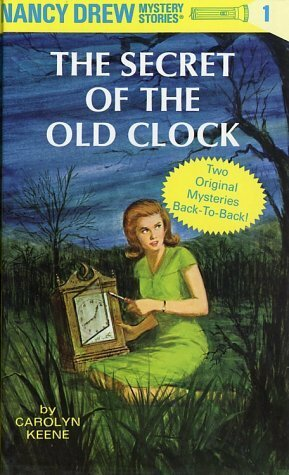
Ninety-five years after their original publication, the first four Nancy Drew novels (all published in 1930) have just entered the public domain in the United States. Without having glanced at them in more than four decades, I can still picture all of the covers and conjure up some plot details from The Secret of the Old Clock, The Hidden Staircase, The Bungalow Mystery, and The Mystery at Lilac Inn.
A close friend–an only child, which seemed exotic back in the late 1970s–had bedroom bookshelves stuffed with the full Nancy Drew and Trixie Belden series. We spent hours reading in companionable silence on her bed until her mother, an older Dutch immigrant with harrowing war stories, would summon us for apple dumplings, or the jelly she’d canned on fresh baked bread. This, too, was exotic in the late ’70s, when few of us had full-time stay-at-home mothers who baked daily after-school treats.
People can now publish their own stories featuring Nancy Drew, but they can’t incorporate the cast of characters who joined the titian-haired sleuth (a phrase I loved, even though I didn’t have a clue what it meant) later in the series. That means that Nancy’s friends George and Bess, as well as her boyfriend Ned Nickerson, are off limits to eager writers.
As most readers will already know, Nancy Drew authorship was collective rather than singular: the Carolyn Keene pseudonym was used by a number of writers from the Stratemeyer Syndicate, although the amazing Mildred Benson wrote 23 of the first 30 books.
Much ink has been spilled describing the impact of the girl sleuth on young readers, American feminism, and other crucial topics, so I won’t re-cap that literature here, although it is interesting. I’m inhibited in part by a flood at the local university library, where I’d intended to gather up research sources today for my next few blog posts and in anticipation of next week’s MLA Convention. Alas, A-PR is currently off limits.
For me, motherless Nancy with her warm, loving housekeeper and her attorney father, who encouraged her investigations, was an idol. She was community-minded and devoted to justice, and she was physically brave. She had an array of unusual skills that helped her navigate the adult world, although in the original novels she is only sixteen (upped to eighteen, later).
But the greatest pleasure was that when I finished one novel, I could continue to the next. Nancy Drew was my introduction to serialization in fiction, and there’s a consistency across the novels–despite the multiple authors–in tone and characterization.
As the piece I linked to above notes, two other fictional investigators are now in the public domain (in the U.S.):
“The middle-aged(-ish) sleuth Sam Spade, who debuted via the full-book version of Dashiell Hammett’s ‘The Maltese Falcon’ . . . [and] the elderly sleuth Miss Marple, who solves her first mystery in Agatha Christie’s ‘Murder at the Vicarage.’”
So new takes on these characters may appear in the U.S. but not elsewhere–although the Christie Estate is protective, and as a previous blog post describes, there’s an authorized new Marple novel awaiting us in 2026, by the wonderful Lucy Foley.
 The Landscape of Canadian Women's Crime Fiction
Leave a comment