For a few months now, the Sondheim line “You gotta have endings. Or there wouldn’t be beginnings!” has been going through my head. I spent several years waiting out a . . . process, so that I could return to the job I love. Much of that time was spent productively, teaching elsewhere and writing many a thing.
But then I was back, and in a permanent position, for less than a year before the news that we’d be facing devastating cuts. Recently upgraded to apocalyptic cuts, representing an “existential threat” to the college where I teach. Effectively I’m back at the beginning, because we’re seniority-based, and I have little of it.
I’ve been thinking about the relationship between beginnings and endings.
Initially, my thrill-less thriller opened with a prologue, a look towards the novel’s climactic events. Two of my three beta readers objected, both on principle–because prologues can seem like a cheap way to begin in media res–and because I was giving away too much.
So I started over.
The challenge is that my inciting incident doesn’t occur until Chapter 3, and no reader is going to wait that long. Way too much exposition and scene setting. Something needs to happen, and quickly, that pulls one into the story and makes one care about the stakes.
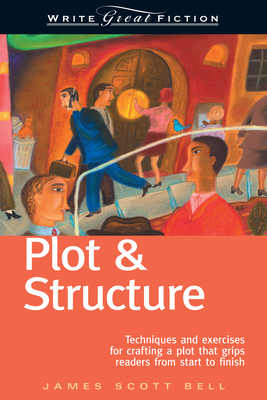
The helpful Plot & Structure by James Scott Bell made me consider how satisfying it is when re-reading a crime novel demonstrates that all of the events, and much of the character development, were anticipated in the early chapters. And not because a Prologue gives them away. As a reader, I appreciate symmetry.
Attempting to achieve this in my own draft has produced a whole second storyline, based on past events that I’d intended to incorporate only as summary. A character who died twenty years before the novel begins has wrested narrative control, and is telling her own story, which is not at all what I’d had in mind.
But it seems to be working.
“There is a double narrative in lots of crime fiction,” notes writer Nicola Upson in this piece about how to plot a mystery novel.
That may be because it helps solve some structural issues, while potentially introducing others, so I’ve been contemplating how to do this. Two first-person narrators? One first-person and one third-person limited omniscient? I’ve tried writing exercises using both approaches, and I think I’ve settled on the latter. I’d like readers to have a more intimate, even claustrophobic relationship with the narrator in the present, while the character from the past should be distanced by something. She needs to remain a bit elusive.
Back to beginnings and endings: the beginning of 2025 has been tough for a lot of us. It’s an endless month of February, and in my part of the world that means day after day of grey mizzle, which has me wishing for snowstorms and hail.
Ungrateful, yes.
But also, weather is plot. It’s atmosphere and setting, of course, but in addition it makes things happen.
A novel I just finished reading stalls on the rail tracks when a storm halts the progress of the train. I mean this literally; the plot seems to sputter to a stop, in marked contrast to how briskly it was moving along during the first few chapters. What could be exciting (snow! locked train-carriage doors! conflicts between passengers!) becomes merely tedious as the hours pass and random events occur, largely unrelated to the unexpected storm.
The book made me realize one of the things my thriller needs is more weather that incites events, and is closely connected to them. I had almost no descriptions of weather in my first draft, and that’s one of the issues.
Ending, here, with my hope for all of us. That we weather the storms, small and large, and find ways to cope with unwelcome plot developments. That we muddle through the messy middle of the next few years, and figure out solutions to the big problems.
And that writing helps.
 The Landscape of Canadian Women's Crime Fiction
Leave a comment