
It’s inconvenient that one can’t visit fictional places, except in imagination. As a young child, my daughter was devastated to learn that the “building of 20” in the 20th Century Fox logo was not a locale one could explore. I myself wanted to travel to Narnia but not Wonderland (which seemed anxiety-provoking), Avonlea but not Lowood School (although I shivered along with Jane and the other quasi-orphan ministers’ daughters, consigned to mortifications of the flesh).
In the spring of 2023, I did my first post-COVID-ish travel as a person with a suppressed immune system, so it required some careful prep. A friend accompanied me on the trip, and was even agreeable about learning how to administer the emergency shot that I have (knock on wood) never needed. He could drive, which meant the complicated bus route I’d plotted from Montreal through the small Eastern Townships wouldn’t be necessary. Thus we effectively visited Three Pines, because unlike Narnia, the origin/inspiration of Three Pines is a very real place: Knowlton, Quebec.
Penny has lived in the Townships for decades, in both Sutton and Knowlton. She drew on those communities, as well as adjacent locales such as the Brome Lake Agricultural Fair, the Manoir Hovey, and an Abbey, in various novels. That’s part of what makes the books’ settings feel so real, and rooted in local geography and history.
I’m always disinclined to be ferried around, unless by an obliging friend who will stop for meals whenever I’m hungry, so our trip was less ambitious and comprehensive. But I had a lot of fun and took a number of photos. Because it was the middle of April, many of the local attractions were closed. I need to go back in the summer when the museum can be toured, and I’d love to see the Fair. We toured the grounds on a windy day, and it’s rather enjoyable to be at a deserted exhibition ground, like stumbling into the amusement park in Miyazaki’s Spirited Away.
My impressions? Knowlton is TINY. The layout is not identical to the novel’s depiction of a village green/common, encircled by the homes of the major Three Pines characters, but there is one small commercial road with a cluster of businesses. The bakery is in nearby Sutton, and it’s terrific. I ate much too much cheese and bread.
There’s an old auberge that used to be a stagecoach stop, but fearing traffic noise, we stayed at a rental on the brackish shore of Lac Brome. I’d looked forward to duck, but there had been a recent cull due to a bird disease.
The water is a more prominent feature, somehow, than the novels convey. Interesting that Penny hasn’t used the lake extensively as a setting. One might anticipate multiple drownings and boat fatalities that only appear to be accidents.
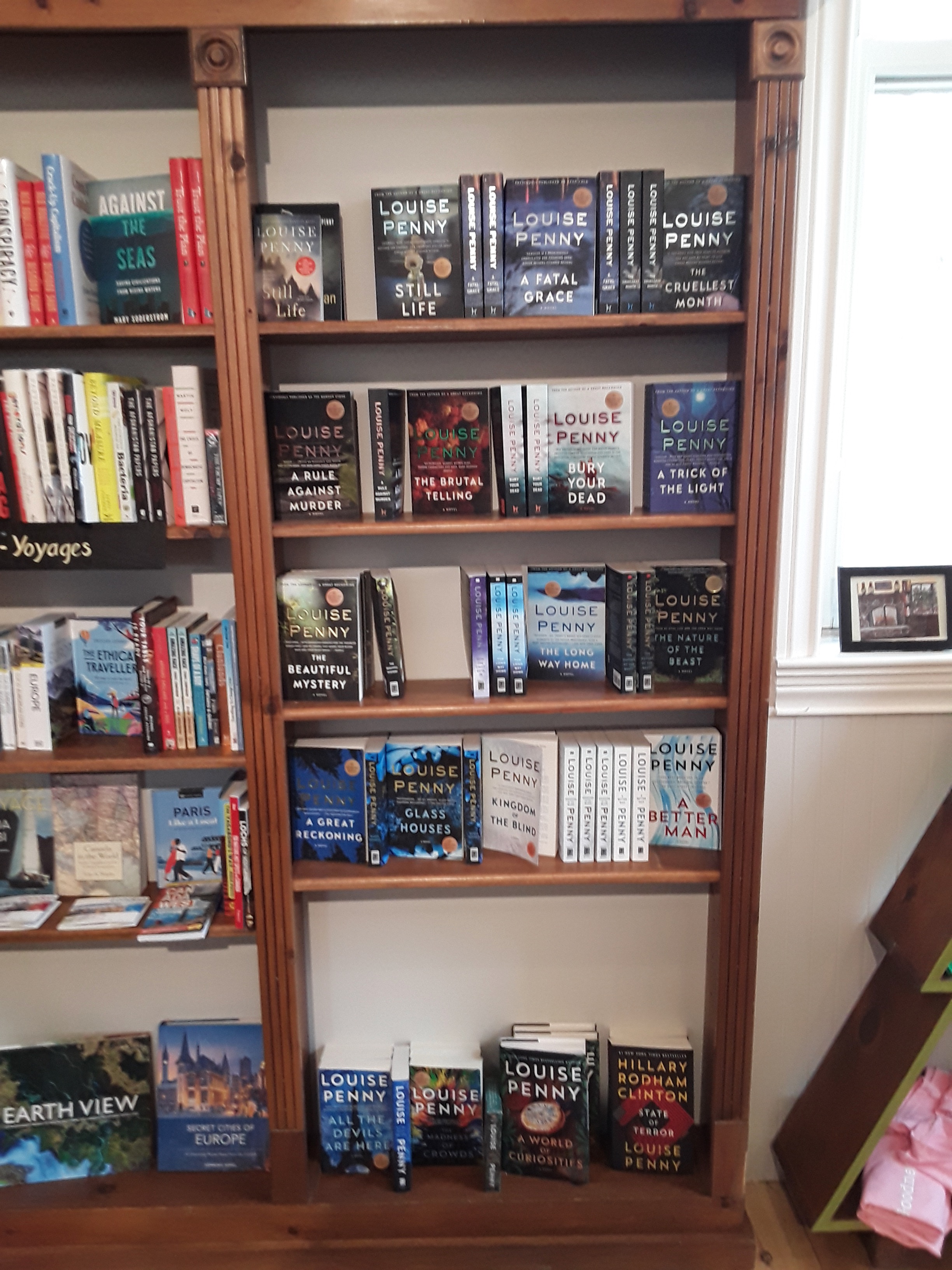
And Brome Lake Books is fabulous. They’ll ship some amusing Penny merch across the country, as well as books. Photo below of the Penny display.
But the main thing I took away was the casual bilingualism. Knowltonians switched back and forth between French and English, which was a pleasure, and the food was uniformly good. I could have happily stayed for a week longer. We had commitments in Montreal, where the sense of Penny’s presence is much harder to capture. I should have made more effort, perhaps, to wander Gamache’s home neighbourhood, the francophone enclave of Outremont.

 The Landscape of Canadian Women's Crime Fiction