
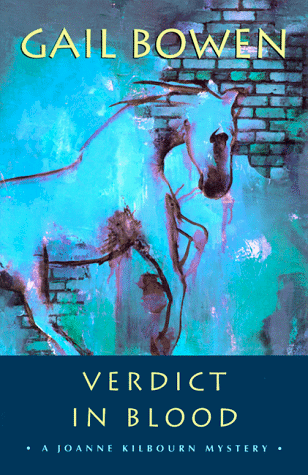
Gail Bowen’s 1998 novel is the sixth in her Joanne Kilbourn series featuring an intrepid amateur investigator-political science professor in Regina, Saskatchewan.
In this volume, Joanne is drawn into the murder of a formidable local judge, Justine Blackwell, who died the same night she was being honoured for her decades on the bench, her head bashed by the set of decorative scales she was awarded earlier in the evening.
And there are lots of potential culprits.
In the last year of her life, Justice Blackwell’s reputation as a hanging judge has undergone a thorough rehabilitation. She has been revisiting her own judgments and recognizing how lacking they were in empathy or kindness; she has even sought to make amends to the prisoners who once stood before her bench.
But some of people with whom Justine now keeps company are unsavoury, to say the least, including a local advocate for the dispossessed. He has an eye on Blackwell’s estate; so do her three daughters: a psychiatrist, a former musical star, and a one-time television news anchor who has been discarded by her local network because she has aged unforgivably, and her effort to repair time’s ravages with plastic surgery have gone tragically awry.
Joanne knows Justine Blackwell only by reputation, but their mutual friend, Hilda, was once the judge’s landlady. As Jo’s houseguest, octogenarian Hilda has been put in the unenviable position of trying to figure out if during the last months of her life Justine was losing her mind. Jo helps her fend off the daughters as well as her lawyer and longtime family friend, who all hold negative views of Justine’s transformation into a social activist.
This is one of the best of Bowen’s series novels. The mystery is carefully plotted and the well-developed characters are distinctive and engaging. While Joanne Kilbourn has her usual domestic responsibilities to contend with during the early fall months as her two youngest children, still at home, return to school, she is also in a tense time in her personal life. Her lover, police officer Alex Kequahtooway, has been distant, distracted by his responsibilities for his teenaged nephew, Eli. Jo wants to help, but both Alex and Eli, at different points, retreat: the spectre of anti-Indigenous racism has a potent impact on their ability to trust a well-intentioned but privileged white woman who has only limited understanding of their own context.
One of the crucial strengths of Bowen’s series is her commitment to depicting Indigenous characters and storylines. While at times in the series there is a falling back on tropes of tragic inevitability of Indigenous destruction(especially in the very strong but problematic The Last Good Day), here Bowen’s portrayals are more subtly nuanced. Eli’s personal history is filled with trauma, but his strengths are also highlighted. As Jo discovers, however, his psychiatrist, one of the late judge’s daughters, may not have his best interests at heart, and all three ungrateful daughters are hiding secrets.
This novel is a nice companion piece to P.D. James’s novel about a female judge, A Certain Justice (1997). Both point to the struggles that women faced in the legal profession during the 1980s and 1990s, and the ways in which sexist expectations shaped the efforts of very determined litigators to achieve a success that few of their female peers had known.
 The Landscape of Canadian Women's Crime Fiction