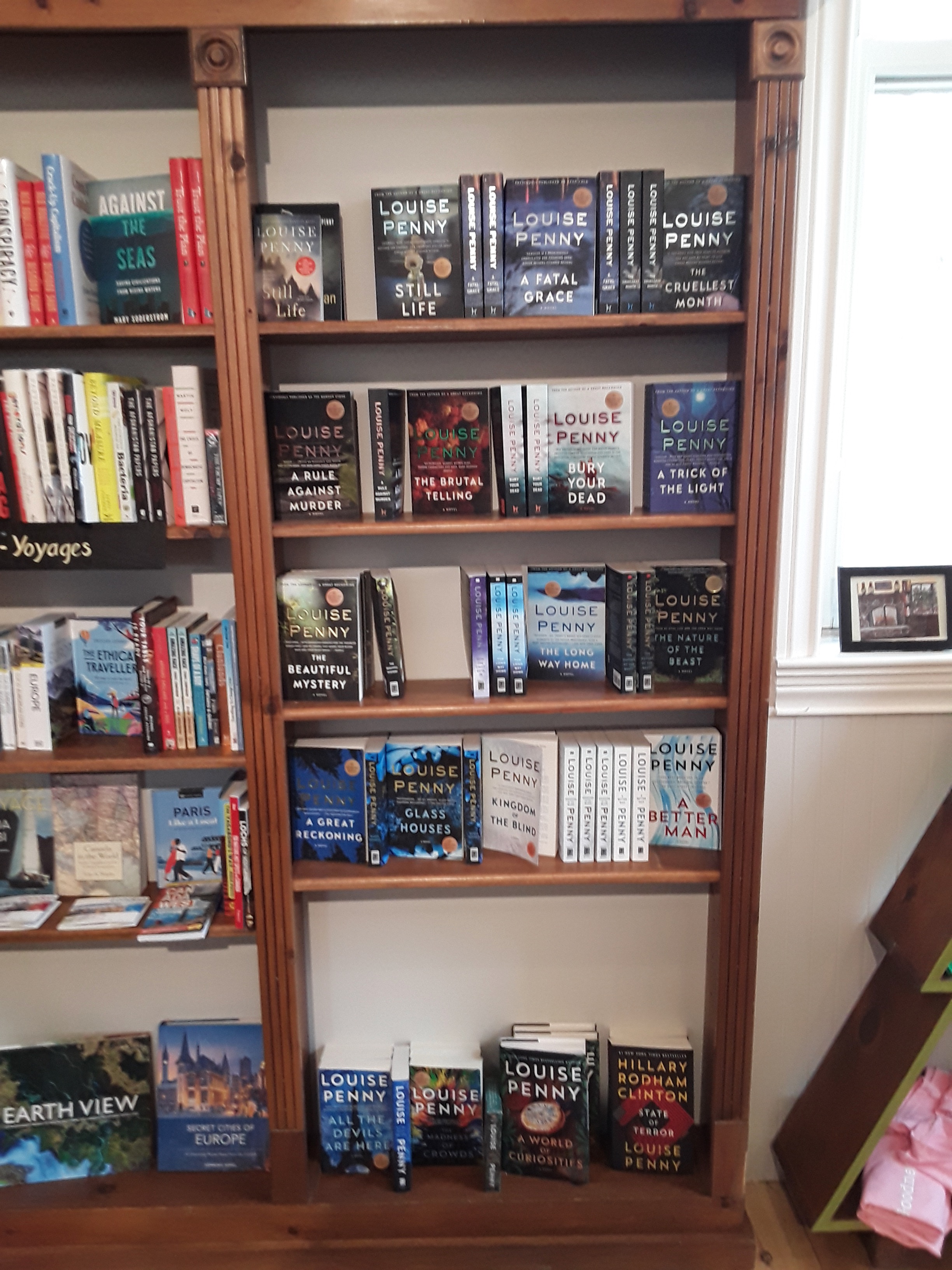
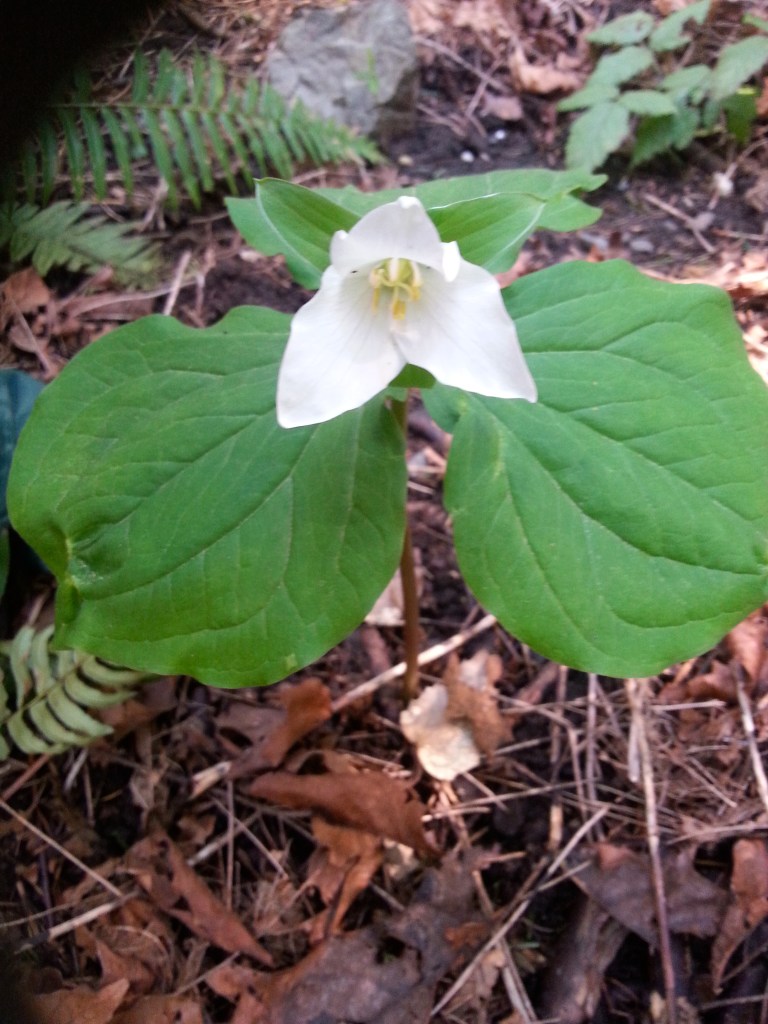
Louise Penny’s Still Life is her first novel, and it’s intriguing to compare the choices of cover art for different editions. The St. Martin’s imprint used an oddly pastoral image that feels more Rebecca of Sunnybrook Farm than murder mystery. Other choices strike me as more apt.
And then there’s the title. I’ve now read at least three books titled Still Life, the other two by A.S. Byatt and Val McDermid, and there are more! But it’s a good title for the novel and it reflects the focus on visual arts, which are crucial to the plot and the resolution of the mystery. This emphasis, of course, showcases the talents of Clara and Peter Morrow. Clara in particular is a perceptive, curious interpreter of her late friend Jane Neal’s idiosyncratic art practice.
Still Life has a fascinating publication history, and Penny has been more candid than most authors who struggled to find a publisher for their first novel. She shares her experience, and some helpful advice, in a characteristically generous post on her website.
I think that Clara Morrow’s long struggle for public and critical recognition may reflect Penny’s own experience. She sent out her work dozens of times without success, before finally receiving a publishing contract after coming second in the UK-based Minotaur writing contest.
Back to Still Life, because Jane Neal (a septuagenarian retired teacher with a peculiarly private approach to her art, which extends to her unwillingness to allow people in her home past the kitchen) is murdered because of art. There will be spoilers, I’m afraid; impossible to assess Penny’s achievement in a broader context without them. But there is also a terrible error on the part of her murderer, an error of interpretation.
My read of this is that Penny, right from the first novel, is emphasizing two aspects of art: the shifting perspectives brought to any work by viewers with different aesthetic needs and judgments, and the slippery nature of interpretation. Even fatally slippery, perhaps.
One of the pleasures of this opening book in the series is that, from the beginning, several key aspects are conveyed with confidence.
Armand Gamache is consistent throughout the books–empathetic, sensitive, morally and physically brave but repulsed by violence, and willing to stand up to bullies. He is a doggedly tenacious and astonishingly successful investigator, which often inspires professional jealousy and resentment, as opposed to admiration. Penny has written that she modelled Gamache on her husband, a pediatric oncologist who believed in goodness. Might that explain how assured the narrative is in portraying him, right from page 1?
Similarly, the town of Three Pines, a forgotten hamlet in the Eastern Townships of Quebec near the U.S. border, is depicted with tremendous appeal and consistency from Still Life on. And it’s crucial that readers, and film/television adaptations, understand what Penny is striving for here. This is an inclusive, utopian (see Bedore’s analysis) community where the arts, food, and friendship are valued and celebrated. It’s a place that welcomes in rather than shoves out, and adaptations have unfortunately tended to indicate the latter, by portraying the small town as insular.
A final element that’s so effective from the beginning of the series is the terrific depiction of Clara Morrow, a painter struggling to achieve her own vision in her art. With her food-strewn hair, her haphazard clothing, and her tendency to dreamy forgetfulness, Clara seems oddly paired with her husband Peter (at least to his mother, we’re told in Still Life). He’s a patrician Westmount-raised artist whose work is substantially more successful than hers, and he is handsome and tall, to boot. But he has found his home in Clara, and when we meet his repugnant family members in later books, we better understand what a blessing she must have seemed when they first met at OCAD in Toronto.
A quick note about the television film adaptation from 2013. To my mind it is not especially successful, but still better than certain aspects of the recent Three Pines series on Amazon, which was not renewed for a second season despite Penny’s and her fans’ protests.
The adaptation Still Life: A Three Pines Mystery captures some elements in a thoughtful and nuanced manner, including the community of friends. But it suggests that the town is resistant to Gamache’s investigation of Jane’s murder, which is not at all what the novel conveys. And the casting is . . . interesting.
In terms of casting, I think the attempt at a Three Pines series did a better job with several key characters. It was admirable that the producers/writers incorporated a storyline about MMIW, and cast Lacoste’s character as an Indigenous woman who grew up outside of her culture. These are important representations and we need many more of them.
But there were a few oddities. They elected to begin Three Pines with an adaptation of A Fatal Grace, under yet another generic title, “White Out”. It makes sense that they avoided re-doing Still Life, but I think they started with one of the weakest of Penny’s usually strong novels. The murder victim is so unlikable that her death is hardly mourned, while the culprit is far more sympathetic. This is a tragic story, but one that relies on just about the most convoluted murder in the series, next to The Murder Stone.
As the show continues, it picks up. There are some brilliant performances, notably Tantoo Cardinal as Bea Mayer and Clare Coulter as Ruth. Rossif Sutherland plays Beauvoir and since the show wasn’t renewed, he was available to sign on to this past fall’s adaptation of L.R. Wright’s first series, featuring RCMP officer Karl Alberg. Love the books, but the adaptation is a minor and discouraging disaster. More on that soon.

 The Landscape of Canadian Women's Crime Fiction