For another project, I’ve been thinking about the intensity of friendships between young women. I recently read a gorgeous set of lyric essays by Lilly Dancyger which capture the delicate dance of intimacy, the complexity of love that is marked by rivalry and comparison.
Dancyger’s First Love includes some deeply troubling interludes, including the murder of the author’s cousin. But the moment that will stay with me is from their shared adolescence, when Dancyger (truculent and reluctant to be dragged away from her New York City friends) is unceremoniously dumped on her aunt and cousin, hundreds of miles away in Philly. Her younger cousin’s excitement at seeing her begins to thaw the adolescent chill of her own, angrily distant, stance.
I’m writing about my own cousin who died at age 13, of a rare autoimmune disorder that’s still poorly understood, and so I over-identified, as I so often do, while reading about women’s passionate connections during adolescence and our early 20s. The TV show Friends was pitched as “that time in your life when your friends are your family”, the post-college era of hustling to make a living and create a life. But for me, the more intriguing friendship chapter came slightly earlier, from roughly my mid-teens to early twenties, when my romantic relationships heaved dramatically but my friendships were a fixed star.
Until they weren’t. Not everything can last; not everyone remains.
Gail Bowen writes about this passionate intensity in her portrayal of Joanne’s friendship with the nearly-always present Jill Oziowy, who talked herself into a job with Joanne’s husband just after she graduated from Journalism school. Jill, whose romantic relationships are the stuff of nightmares, clung to Ian, Joanne, and their kids. Decades later and long after Ian’s death, Joanne learns that through the years when her husband frequently failed to show up for his kids, he was having a long affair with, of all people, Jill.
And Joanne is understandably crushed.
Bowen’s made some intriguing choices throughout the series, filling in back story about Joanne’s childhood and family life that both fleshes out and, in crucial ways, re-writes the history she presents in the early books. An enduring series may require this kind of revisionism.
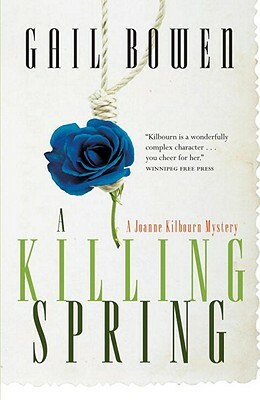
But the way Jill has been portrayed is disquieting. She is the victim of intimate partner violence in more than one novel, after her romantic longing pulls her into an intense whirlwind of a relationship with an unpredictable man. In A Killing Spring, the fifth novel in the series, Jill is at risk of losing her identity as she merges with her new lover, a brash journalist who brutally assaults her near the novel’s conclusion.
This is not the only occasion when Joanne finds her friend broken and bleeding. Even when Jill briefly appears to find happiness and plans to marry, it’s the stepdaughter she’s welcoming into her life whom she adores, rather than the girl’s father: a filmmaker who has been subjecting the women in his life to a unique form of emotional torment and invasion of privacy.
There are multiple novels where Jill’s romantic life recedes, and the focus is on her professionalism and ambition as a journalist who climbs the corporate ladder. Yet even as she becomes increasingly accomplished, Jill is portrayed as fundamentally frail around aggressive men–drawn to them, and apparently needing to punish herself. It’s troubling, then, that the ultimate revelation of Jill’s past affair with Joanne’s late husband is used to signal that the character has at least one reason for her intense self-loathing, and willingness to subject herself to abuse.
And I’m thinking now of some close calls. The times I pulled an inebriated and underage friend away from a man at a frat party, or was, in turn, confronted by friends who’d witnessed the man I’d fallen in love with slap another woman at an event. Those moments are indelible, in my life. What I’ve taken from them is that female solidarity includes those times when we show up to protect each other. As Jo and Jill do, imperfectly but repeatedly, throughout Bowen’s decades-long series.
I don’t know if Bowen will return to Joanne Kilbourn; the last few years have been exceptionally difficult ones for the author.
But my fingers are crossed for a happier ending for Jill.
 The Landscape of Canadian Women's Crime Fiction