Carolyn Heilbrun (AKA mystery writer Amanda Cross) has been on my mind as I’m thinking through Canadian academic mystery fiction, in particular the series by Nora Kelly and Gail Bowen. Kelly’s books are mostly set at a fictional Vancouver-area university that feels rather a lot like UBC; Bowen’s books are set in Regina, Saskatchewan. The ones I’m most attached to, from the early-to-mid period of the series, are campus novels, with a strong sense of the University of Regina and related cultural institutions in Regina and Saskatoon.
But these books would not have been possible without their American and British precursors by Amanda Cross and Joan Smith, among others.
Joan Smith is a terrific writer: a British feminist literary theorist and now journalist who explored parallel ideas about language and power in her series of Loretta Lawson novels, starting with A Masculine Ending in 1987. And there’s an adaptation that I’m trying to track down. (I’m noticing, as I update my research notes, that Smith’s recent work on trans people is at a vast remove from my own views. It’s been disappointing to see the advent of so-called “gender critical feminists” in the UK, with views that are less than generous in their inclusion of trans women.)
More than two decades before Smith’s books, there was another feminist sleuth across the pond. Kate Fansler was endowed by her creator, Carolyn Heilbrun, with a private income, urbane wit, and taste for expensive alcohol. Under the pen name Amanda Cross she published a series of mystery novels, nearly all with a campus setting, until 2002, which is an extraordinarily long-lived sequence of books that Gail Bowen will soon rival.
Heilbrun was still working on the series, albeit intermittently, when I heard her give the Alexander Lectures at U of T’s University College way back in 1997. They were subsequently published as the slim volume Women’s Lives: The View from the Threshold.
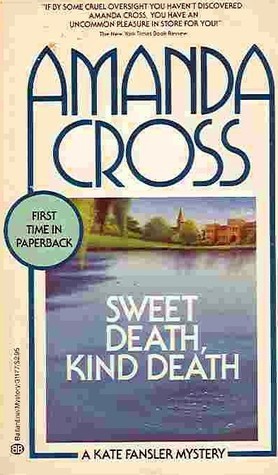
And Heilbrun’s preoccupations in this book overlap substantially with the concerns of a fictional feminist historian, the murder victim in her novel Sweet Death, Kind Death. I came across a copy in a second-hand bookstore in Victoria a couple of weeks ago, and re-read it over the past few days. It’s an important novel for thinking about Heilbrun’s life and work, because this accomplished historian (a woman in her fifties, whose fiction is achieving mainstream popularity that irritates her colleagues at the small-minded women’s college where she teaches) shares Heilbrun’s views about suicide.
This is a bit complicated to explain without resorting to biography, so here are the facts: Heilbrun had long adhered to the belief that one has the right to end one’s life at the point that one is no longer useful. The stilted-ness of my prose here reflects some of Kate Fansler’s verbal pomposity, as well as the challenge of discussing suicide in theory when Heilbrun elected to act on her beliefs and, without advance warning to family and friends, ended her life when she was 77 and in apparently good health.
My first quasi-academic publication, in undergrad journal Acta Victoriana, was on feminist detective fiction with a focus on Amanda Cross. It stemmed from a course with the wonderful Heather Murray, and she suggested the inclusion of my revised paper. It’s a piece I’m rather proud of, much prouder than my negligent stint as editor of Acta, when I let the photo editor have free rein–to general chagrin, after he elected to sprinkle images of gorgeous women throughout our feminist-themed issue . . . Baffling.
And the news of Heilbrun’s death shocked me back in 2002, because I’d enjoyed speaking with her while she was at U of T, and I loved her work as a feminist literary critic and the parallel novels. By then I was teaching at U of T, in a contractually-limited term appointment that was supposed to eventually become TT. Still waiting on that one.
But to return to the point: what Heilbrun/Cross does in her mystery novels is really important. Here are some key elements:
- she gives serious consideration to the need for Women’s Studies programs and the increasing influence of feminist literary criticism, as well as the backlash against both
- she gives her heroine a happy life, filled with pleasures of the mind and the flesh, suggesting that choices don’t have to be made between them (although, unlike Heilbrun herself, Fansler does not have children, and thus has rather more time and disposable income for pursuing far-flung murder investigations)
- she provides carefully plotted stories that still play fair with the reader, using subtle and often literary clues
- she writes snappy dialogue of the Nick-and-Nora style, particularly in Kate’s repartee with her dashing lawyer-husband
For a range of additional reasons, though, the Amanda Cross novels were important to me as an undergrad student contemplating grad school and a life of the mind. This was a serious concern for me that now seems rather puzzling; what was the big issue? But I came from a family that had sharply divergent views about reading books and writing, and I was uncertain I could justify doing work that didn’t have the clear social value of, say, high school teaching.
As I turn back to Gail Bowen, whose books have seen me through my entire academic career (since they begin when the protagonist is writing a dissertation, in the wake of being widowed and needing to support her family), I’m thinking about how much trailblazing academic women did that benefited my own generation.
And it was no doubt arduous work, so it’s not surprising that these campus mysteries are riddled with some corpses and casualties.
 The Landscape of Canadian Women's Crime Fiction