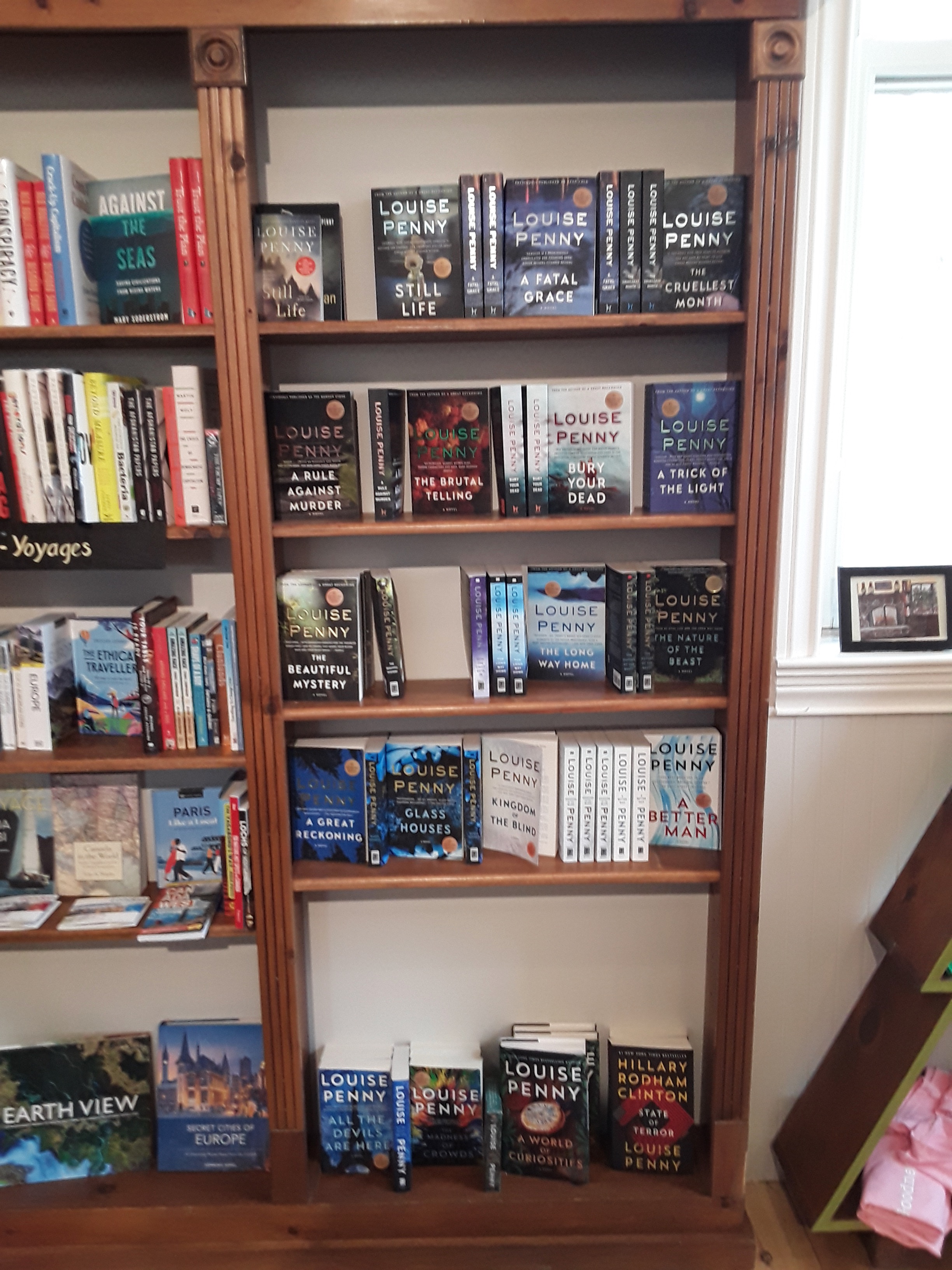
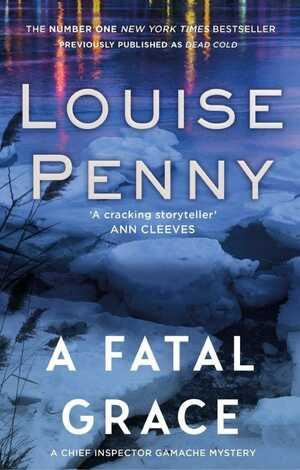
Penny’s second novel is a significant departure from Still Life, and it’s not a work that I’m deeply attached to. In fact it was the first Penny novel I read, and for several years after that, I didn’t feel the need to try any more volumes in the series. It matters where you start reading!
The novel has two titles in its English publications, and yet a third in the recent Three Pines adaptation, where the episodes are known as “White Out.” I’m a bit baffled by the three equally generic, uncommunicative titles. Penny has some terrifically eloquent ones including The Cruellest Month, The Brutal Telling, and How the Light Gets In. But now I’m noticing that all three of those are quotations, from Eliot, Emily Carr, and Leonard Cohen. So perhaps A Fatal Grace would have benefited from an allusive literary title, too.
To get to the point, there’s much that is interesting here. My favourite detail is that the murder victim, about whom no one much cares given her miserable disposition and selfishness, has re-named herself C.C. de Poitiers and claims as her parents Eleanor and Henri. Thanks to a youthful passion for historical romances, I recognized these as, respectively, Eleanor of Aquitaine and Henry II. It took the investigators a bit longer to get there, and I do wonder about that. Is French history not taught in Quebec high schools?
The novel’s mode of murder is innovative. C.C. dies via public electrocution facilitated by her unique footwear, and careful plotting by someone close to her who really hates her. Now, inventiveness is to be congratulated, but this seems “extra”. During a Quebec winter, there are much easier murder modes at hand. The timing had to be particularly finicky, and thus prone to failure. But it works quite well in the TV adaptation, in terms of imagery.
Few other elements are as imaginative. There’s a dismayingly neglected adolescent daughter, with a glorious singing voice and a weight problem (Penny rather harps on fat people in a way that I find worrying). There’s C.C.’s business/book idea, which is risible but fun. A philosophy of minimalism, it’s borrowed from a crucial episode in her own life that appears key to solving the mystery, but ends up being mostly beside the point. What else? A photographer-suspect and several important photos; a belittled husband; the Three Pines gang. I really enjoyed a scene of an exercise class. But this isn’t, I don’t think, one of the best in the series.
A note about the TV adaptation: it’s perfectly fine. Some aspects of the story actually seem to work better in a visual medium.
 The Landscape of Canadian Women's Crime Fiction