
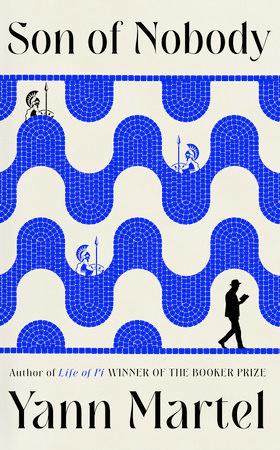
This is not a crime novel, except in the sense that Homer’s Trojan War epic The Iliad incorporates (sometimes with casual horror) a series of war crimes, often carried out on women’s bodies.
Last fall, I had the great pleasure of seeing classicist and Homer translator Emily Wilson give a talk and recitation at U of T. Her new Iliad and Odyssey bring a feminist sensibility to the depiction of sexual violence and women’s roles in these largely-masculine epic stories.
So I was intrigued to see that Martel’s new novel is about a plodding classicist at a Saskatchewan university whose dissertation is jump-started when he receives a coveted fellowship in the UK. (Let’s ignore how unlikely it is that he would be selected for this honour, although reviewers have enjoyed skewering the narrator’s earnest explanation that he’s been selected for his skill in Ancient Greek, which apparently makes him a rare and valued commodity at . . . Oxford.)
He discovers a lost Trojan War epic by a previously unidentified author, and the text of the novel juxtaposes his translations with his lengthy footnotes: commentary about his translation choices and a gloss on the text that is woven into his address to his young daughter (named Helen, of course), left behind in Canada.
Here’s an excerpt, courtesy of The Walrus.
I’m enjoying the novel. Martel’s audacity in constructing his own Greek epic is also impressive, although I’m hoping for a bit more plot development, sometime soon. And his contemporary female characters are so thinly developed that they might as well have been crafted in Greek epic.
 The Landscape of Canadian Women's Crime Fiction
Leave a comment