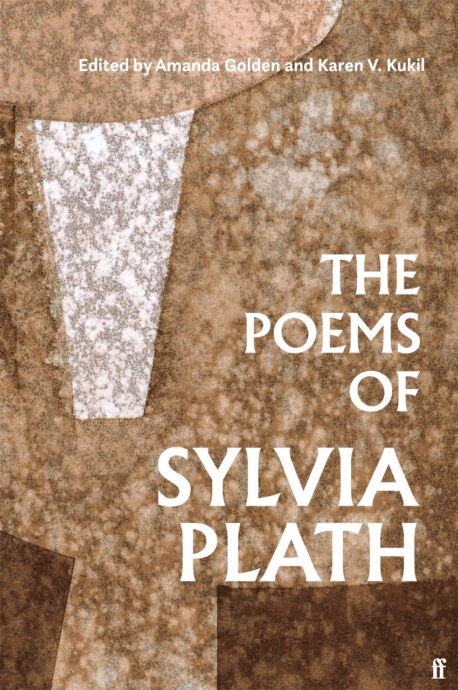
Cover image of Faber’s forthcoming edition of The Poems of Sylvia Plath, edited by Amanda Golden and Karen V. Kukil.
Because I write about crime fiction most of the time, I’m acutely conscious when I’m writing about real-life tragedies linked to literary figures that this is a very different matter. There is real suffering and loss, and it extends over decades.
Lowther died of murder, inflicted by her husband; Plath died of a suicide whose circumstances have been dissected in minute detail, with significant blame cast on her estranged husband.
Pat Lowther and Sylvia Plath have living children, and the fact that so much of the critical and popular discourse about their poet-mothers has been lurid is excruciatingly unfair.
Ted Hughes described many of his editorial decisions, including apparently careless losses of original manuscripts and diaries, or excisions from Plath’s work, as the consequence of his profound care for his young son and daughter.
The final volume of Plath’s journals went missing; so did the draft of her third novel; the second Falcon Yard, set at Cambridge, where Plath and Hughes met, was apparently burned by Plath herself.
Hughes used the passive voice when he wrote about these losses, and I’m mirroring that here, but there is an ugly truth: a writer who was very conscious of his own literary legacy and the value of his complete archives, including his drafts, was careless or destructive when it came to Plath’s own literary remains. He and his sister, Olwyn Hughes, sought to exercise significant control over how literary critics wrote about Plath; the disputes with Jacqueline Rose were especially protracted and peculiar. (The Haunting of Sylvia Plath is a very very good book, but it’s a psychoanalytic reading that both Hugheses insisted on reading as literal biography.)
Some years ago, Plath and Hughes’s son died from suicide; he lived with depression, and he forged a successful career as a biologist in Alaska over many decades. Frieda Hughes is a talented artist and writer. Their lives, and even Nicolas Hughes’s death, were not determined by their parents’ art or the tragedy of losing their mother, but they were shaped in significant ways. Frieda Hughes makes this especially clear in some of her poems.
Pat Lowther’s children,too, are creatively gifted. They have been generous with their assistance as I figure out ways to write about Pat Lowther’s legacy.
When I write about Plath or Lowther, I’m imagining as part of the readership their own children, and I think this is important to do: not so that the critical analysis is softened or tempered, but because there is an ethical care that is needed. Both poets wrote about their children, with love and affection. But they didn’t get to raise them.
I’ll be spending the end of this week at SFU and at UBC, working on Pat Lowther materials. I’m looking forward to being back in the archives.
A big story this spring has been the expansion of the Plath archives at Yale and at Smith College. Plath’s late brother, Warren, who died five years ago, is the source of some materials. And a Plath biographer (of sorts), Lois Ames, had a lot of family photos and papers, perhaps improperly in her possession, and those are now available to researchers. All of my information about this is at second-hand, with thanks to the critics who are sharing their work and new Plath photos so generously online.
Some of the attention, though, feels distasteful: remnants of Plath’s life, like her prom dresses, offered up for public inspection.
When I work in the archives, I have duelling sensations: the thrill of access accompanied by the discomfiting sensation of rummaging through someone’s drawers. Letters that seem objective and professional suddenly take an intimate turn; scraps of paper reveal family stories. It’s messy and intrusive.
My ambition is to pull together a Pat Lowther book that is part tribute and part rigorous analysis (because her poetry has received robust critical attention, but not enough of it). These two aims may not be complementary. I’m hoping to figure out more from my immersion in the SFU and UBC archives.
 The Landscape of Canadian Women's Crime Fiction
Leave a comment