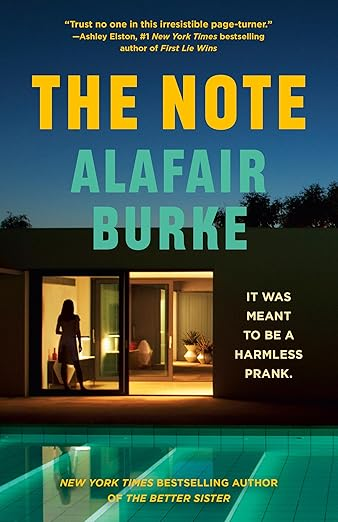
I’m nearly finished Alafair Burke’s new novel, The Note, which starts a bit slowly but then picks up, in a big way.
And since I’ve never written on here about how much I enjoy both Burke’s fiction and (in a more moderate way) the prolific literary output of her father, James Lee Burke, this seems like the right moment for a tribute.
More of you are likely familiar with the venerable figure of James Lee Burke, author of several dozen mystery novels, including his popular Dave Robicheaux series, which I’ve periodically dipped into, with mixed pleasure and unease.
The atmosphere conjured up in his crime novels is terrifically effective: southern gothic set in Cajun Louisiana, replete with descriptions of food and swamp lands. His novels are populated with the kind of quirky characters who turn up (usually in a lighter vein) in Elmore Leonard’s books, but there is a profound grappling, here, with moral questions.
Race and history, family legacies and intergenerational disputes are all treated with a lush style in gorgeous sentences, and with lots of allusions. These are literary mysteries, and they’re long and dense.
But my experience is that being immersed in this environment for hundreds of pages starts to feel oppressive: it’s not my landscape, somehow. Beautifully done, but not quite for me. Maybe it’s because I don’t tolerate heat well? Hearing about oppressively hot and humid climes starts to make me anxious.
So it was with some surprise that I discovered that a far more more austere crime novel series set in Portland, Oregon that I’d been reading, some years ago, was by Burke’s daughter Alafair, a lawyer. Nary a hint of a southern accent in these west coast novels.
I enjoyed her first three novels starring Assistant D.A. Samantha Kincaid, with her crusading zeal and passion for justice for the most vulnerable.
I was a bit taken aback when Burke moved both herself and her novels to New York series and started writing an equally terrific series about police investigator Ellie Hatcher.
And then she went further: she became the co-author of several new Mary Higgins Clark books. And Burke also wrote some stand-alones, including The Better Sister, adapted as a rather maudlin and meandering television series.
This is a writer with range. Alafair Burke does not get hemmed in by geography or genre.
The premise of The Note is that three old friends, who have at times been separated by geography or interpersonal conflict, are gathered for a weekend at a fancy beach house.
All three, at different times, have been victims of “cancel culture.” They’ve decided to make a joke of it.
The reasons for their social opprobrium are doled out slowly.
We learn first about wealthy and gorgeous Kelsey, a suspect in the murder of her late husband. On the face of it, Kelsey had little in the way of motive or opportunity: they were on the verge of a divorce, with a prenup in place, and she and her high-profile businessman father had iron-clad alibis for the time of his death. But that hasn’t suppressed the rumours that a murder-for-hire was going to ease Kelsey out of her marriage.
The story’s inciting incident is a drunken night out in the Hamptons during their slightly tense weekend reunion. The bad manners of an attractive couple who steal their parking spot prompt the women to brainstorm petty revenge after they’ve gulped cocktails. A provocative note is left on the windshield of the couple’s car, and when the man goes missing, the friends wonder if this prank is to blame for setting violence in motion.
May is by far the most interesting character in the novel: Asian American on her mother’s side, she was raised by a hardworking single mother who instructed her to focus on school and piano practice. When she met Kelsey and Lauren, who is several years older than the other two, at a summer music camp, they helped her develop a sense of fun and daring. Tragically, one night at camp that spirit of adventure was linked to a death that saw Lauren banished from the camp.
Burke uses topical themes: anti-Black racism, and the upsurge of anti-Asian American prejudice during COVID; the gossip and rumour-mongering on which social media thrives, but which can wreck lives.
But there is sometimes an oddly hollow quality to the characters, perhaps because narrative attention is divided between them. Both Kelsey and Lauren remain a bit shadowy to me, but I still have fifty pages to go.
I’ll read anything that Alafair Burke cares to write, although I am a wee bit sorry, after all of these years, that her Portland-set series didn’t continue. But do have a look for her series, and I like several of her novels quite a bit more than this one: try a Kincaid or Hatcher novel, to get a feel for her writing. Or jump write to The Better Sister, which is terrific in its original novel form.
 The Landscape of Canadian Women's Crime Fiction
Leave a comment