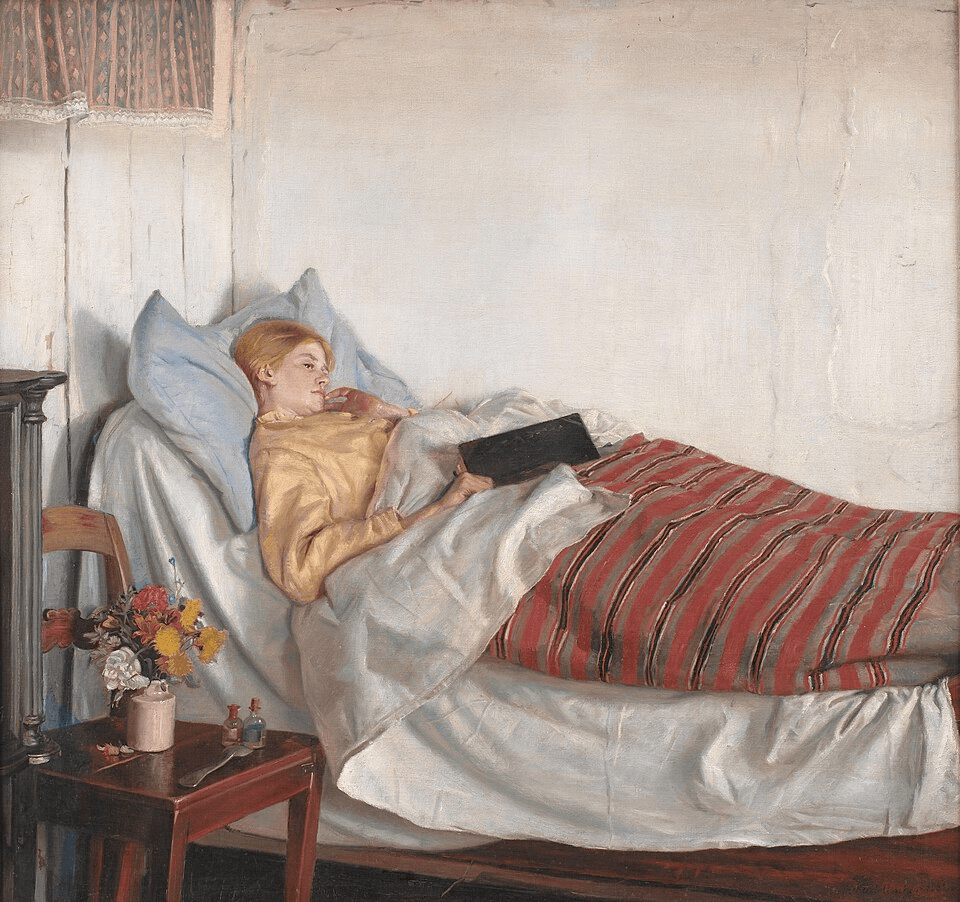
Michael Ancher, The Sick Girl, Statens Museum for Kunst, Copenhagen, Denmark; used under a CC license, with thanks.
I’m at a mountain lodge (drawing on a loose definition of mountain), about an hour from home.
Since I’ve come down with a bad cold, I’m here for an extra day or two, to avoid transporting germs back to my people. The hotel staff are leaving trays outside my door for me to collect. There’s a spa bathroom, with glass shower stall and sunken tub.
It’s all quite lovely and cozy, except for the coughing and chills.
Yesterday we had our final class in a writing course taught by Kate Gies, who is brilliant and amazing. Read her book.
The course was delivered online, but synchronous, so we had a sense of community and of being together. I’ve come to feel that all entirely asynchronous courses are missing a bit of human connection, and I’m trying to figure out how to fix that in a course I’m teaching this spring.
This course’s title was “Our Bodies, Our Lives: A Memoir Workshop for Writers with Disabilities.”
I wasn’t sure, at first, that I was eligible to sign up.
I debated whether what I have counts as disability; it’s more of a chronic some-days-are-good set of autoimmune disorders. My same struggle when I have to complete disability paperwork, of any kind: a sort of imposter syndrome, coupled with shame and grief about the things I fail to do for my employer.
It was fine. It was more than fine: I fit right in, with a lovely group of people who have experienced a range of maladies and medical interventions. They are bawdily (and bodily) funny and fiercely brave and it was a pleasure to have four weeks in their company.
I felt at home in their midst, just as I’m feeling at home now, tucked in bed with tissues and tea and throat lozenges.
In both contexts, it’s about care: we were a group who really cared and we built connections. And at this hotel, my brother is on another floor and found a pharmacy down the mountain that meets all my needs.
Not being alone in illness is everything.
The same is true of bereavement, which is on my mind, because people I love are losing their beloveds: parents and dogs; homes and marriages and jobs.
The loss of a child is affecting friends of friends. The loss that of all losses I would bargain anything to avoid.
But two of my aunts have lived through this, even though I am the oldest cousin the family: we lost my baby cousin in a car accident, and then my thirteen-year-old much loved Susan, my dear friend, to a rare autoimmune disorder that even the Mayo Clinic couldn’t pin down precisely.
Elizabeth Bishop’s “One Art” is perennially relevant:
The art of losing isn’t hard to master;
so many things seem filled with the intent
to be lost that their loss is no disaster.
*************
The speaker, at the end of the poem, can’t quite persuade herself.
Loss is, of course, a disaster, small or large.
And as I contemplate some losses of my own, which are impending or in progress, I’m pausing to be grateful for the people and pets and places who have filled my life so richly. Thank you, all.
My thoughts are with a fluffy brown-and-white Australian labradoodle, not mine, who became so dear to me that we would dash across the street to greet each other. We were both yelled at, for not paying sufficient attention to traffic; his excuse was that he wasn’t accustomed to being off-leash in the road.
His family worried that their pup thought I was a fellow dog and treated me accordingly, because I tended to get down on the ground to cuddle him. He would wrestle with me for a ball or a bone. Or chase me around their apple tree. I will miss him so and he has been such A Good Boy.
Because of Fergus, I understand why Gail Bowen populates all of her mystery novels with a menagerie of dogs and cats.
These things we hold dear.
Book Recommendations
I’m working through my NetGalley list of neglected books; I have dropped to a 70% reviewing rate, and 80% is recommended, so I’m trying to raise my B to an A artificially, here. It’s that time of year.
My challenge is that I don’t want to review books I didn’t like; it seems pointless and gratuitous.
These are my recent favourites, all forthcoming this spring:
Literary Fiction
Christine Fischer Guy’s The Instrument Must Not Matter
Emily McBride’s Queen Mab
Mary Moloney’s The Philosophy Friends
Crime Fiction
Meredith Allard’s The Professor of Eventide
C.B. Everett’s The Final Chapter
Louise Penny and Mellissa Fung’s The Last Mandarin
Margrét Ann Thors’s Freya
Life Writing
Theresa Kishkan’s The Art of Looking Back
Deborah Lutz’s This Dark Night: Emily Brontë, A Life
Eliza Reid’s The First Lady Next Door
 The Landscape of Canadian Women's Crime Fiction
Leave a comment