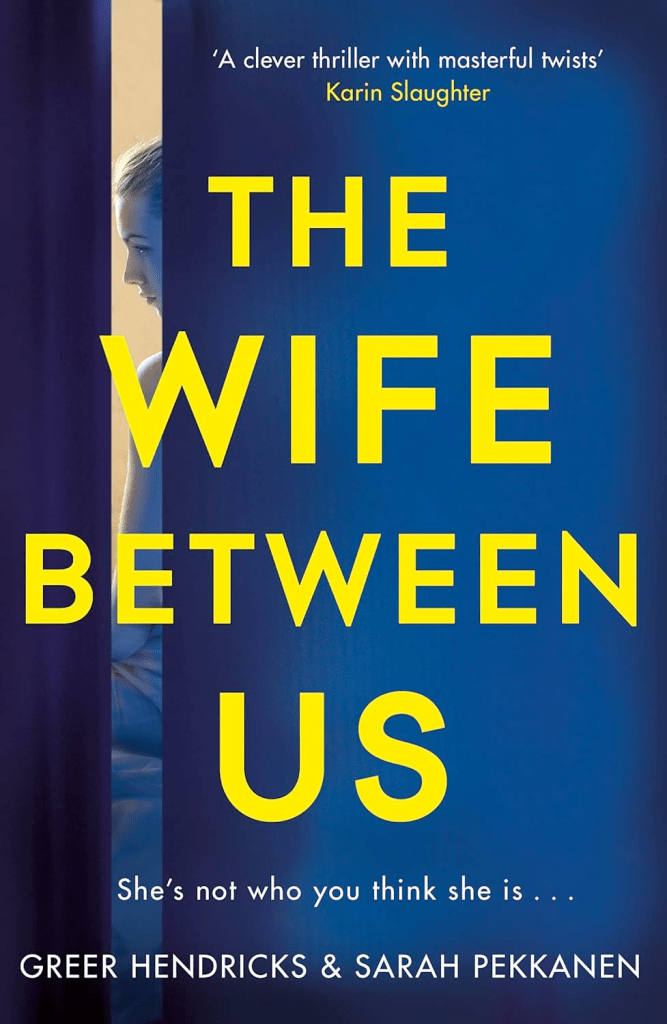
I’m reading another Little Library find, and this one may have cured me of free books entirely. It’s The Wife Between Us, a collab between Greer Hendricks and Sarah Pekkanen that came out in 2018.
This book was everywhere, several years ago: stacked on airport bookstore stands right at eye height and clutched by women readers on the subway.
And it was a massive bestseller. There are nearly half a million GoodReads ratings.
My hand-me-down copy is tattered and the pages are falling out as I turn them, but that may be due to my habit of placing all used books in the freezer for 48 hours in advance of reading them. We had an infestation of silverfish some years ago that I’m convinced followed me from my former university office (where they were eating books and, more crucially, art works), so I’m cautious now.
The book promises twisty suspense.
There are two major twists, and I saw both coming from a mile away, but just in case you’d like to test your own wits against the authors, I won’t give them away.
That’s fine because the point of my critique is not that this is perfectly competent writing in a fast-paced yet largely aimless account of a woman’s desperation to either a) retrieve her ex from his young girlfriend, soon to be his wife; or b) warn the girlfriend not to marry him, because He’s Not Who You Think. The novel vacillates about her motives, and that’s where much of the suspense is supposed to come in: is she stalking the new girl, or trying to save her?
A confession, and it’s a painful one, as a writer: I tried my hand at my own version of Jane Eyre-like tropes of men with flashing eyes, witty repartee, and dark secrets, and I have on my hands a very long MSS from which I am now attempting to cut 25,000 words over the next five weeks. Then a developmental editor will help me shape the remaining 100K into a better book, if that’s even possible, or I will give up the effort and start afresh.
Way back when, I read Gone Girl, Girl on a Train, and everything by Ruth Ware and thought: I could try this genre. I like reading (and writing in) first-person; I’m interested in the multiple ways young women remain vulnerable in a misogynist culture with slowly evolving (and not always for the better) sexual mores.
And I like writing about architecture. A lot of these books are big on setting, infused with gothic elements. Very fun research, incidentally, to figure out how spiral stairs work and how someone might fall down them or through the gap that runs through the middle.
The Wife Between Us is not a thriller: there are virtually no thrills.
The heroine, Nellie, has a complicated back story that includes events that still make her shiver with guilt and shame, and her efforts to hide those from the man she loves create an array of complications.
He has secrets too, of course.
And everybody lies.
But the figure who intrigues me is the wealthy suitor’s older sister Maureen, a gender studies professor who seems oblivious to her kid brother’s emotional abuse and manipulation (sorry, folks: that, in fact, is one of the novel’s biggest reveals; it’s also hinted at from page 1) of young women.
I’m telling you as both a big sister and as someone who has taught gender studies that this doesn’t fly.
Tenured, urbane, and confident Maureen is not going to sit back and sip her fancy wine while her brother introduces her to serial and ever younger wives. She’s not going to let him ruin lives because she feels bad that they are orphans and only have each other.
So making her a feminist professor: what is going on with that? I’m guessing that the authors are trying to suggest that even the savviest and most theoretically-informed of women don’t see through men’s bullshit.
That takes me to this week’s more dramatic and suspenseful story, and I’m so sorry that it’s a real-life tale involving someone who is clearly suffering, and not fiction. Start with Lindy West’s interview with the New York Times Magazine last week, which is painful.
West, who was very famous a decade or so ago, has a new memoir out, and I haven’t read it yet; I read a caution by Jowita Bydlowska this week about not judging memoirs after only hearing about their contents, so I’m going to be circumspect here, but I’m not sure I want to read the book, even though I’ve really enjoyed West’s previous writings.
Here are a couple of interview excerpts, and the purpose of these quotations is to try to rebut my own claim that feminists see through misogyny and gaslighting:
“West: Yes. So we briefly broke up in 2011. It was a bad time. My dad died. It was horrible — a tree fell on my house. Then we got back together. But part of that was Aham was like, “I’ve been divorced twice by age 27, and I feel like possessiveness and jealousy had a lot to do with both of those relationships collapsing. I don’t think that monogamy is healthy for me.”
Martin: He has all these reasons which make intellectual sense. But emotionally, how was this hitting you?
West: Yeah, same for me. It made intellectual sense to me, and in fact, it had always made intellectual sense to me. I was like, I understand how this works and why people do this. I don’t personally have the self-esteem to cope with it.
Martin: I’ve thought this too, yeah.
West: Yeah. So my initial reaction was, I was devastated. Our initial conversation was a lot of me crying and being like, I don’t want anyone else.
Martin: Was it presented as sort of like, “We can get back together if we are non-monogamous?” Was it like a conditional thing?
West: Yes. Basically. But it wasn’t him saying, “I’m going to go out and date people.” We were a couple who loved each other, desperately getting back together. So this was not a moment when either of us was like, “Oh, I want to go out and find someone else.””
West then takes complete responsibility for not being willing to have hard talks with her spouse and soul mate, thus prompting his surreptitious infidelity:
“West: 2019, I find out that someone who knew what Aham looked like had seen him kissing someone at a bar. I went home, and we talked for the rest of the night, and at this point he had sort of come to the conclusion that we couldn’t resolve this, which is why he went ahead and started dating this person. Because I had been gone. I had refused to talk to him about it. And I had technically agreed to be non-monogamous.”
Oof. May I direct readers to the excellent books that have been published about ethical polyamory?
No new romance starts secretly because one member of a couple is reluctant even to talk about opening a monogamous coupling.
That’s just cheating.
And West, throughout this interview, describes her spouse cheating on her despite the fact that it makes her miserable as his journey of self-discovery.
So she goes on her own road trip, and within a few months she and her partner and his girlfriend are a romantic triad. So now it’s no longer him just insisting on doing a thing she says she isn’t okay with, and it’s all consensual.
This kind of outcome makes novels like The Wife Between Us or Gone Girl beside the point. In this version of an ending, Amy Dunne embraces Nick’s possibly fleeting passion for his young student and they all end up in bed together, with no one plotting faux-murder.
A very different kind of book.
But a number of reviewers are digging into West’s memoir in more detail, and they’ve raised interesting questions about emotional abuse and manipulation; about the way we deceive ourselves that we want something that we think is the only thing we can get; about how gender and money and fame and power are entangled in relationship dynamics.
I’m all for ethical polyamory, or any other approach to romantic relationships that consenting adults want to take. In general, approaches that cause less emotional pain seem like a better idea.
And I’d love to hear the fictional Maureen’s take on all of this, but I’d also like to know: at some point, as you watched your little brother mistreat his wives, how did you reconcile your work and your life?
Because either the authors of this supposed dark thriller are misunderstanding human psychology, in creating a professional feminist sister who is oblivious, or they’ve settled on a darker truth: maybe we’re all more cynically out to protect our own interests, even when they contradict our politics and our deepest ethical commitments.
I’ve seen a few examples of that in my life. They haunt me. The feminist bullies who torment and take credit for the work of women who have less power, including grad students. The men who are feminist advocates but let abuses of young women on political campaigns pass without notice or complaint because it serves their interests. It’s appalling, and I’ve been vocal in a few instances where I’ve lost friends and colleagues who turned on me to complain I expected perfection. Like, do I really think it’s fair to hold them partially accountable for bad things when they’re just passive bystanders?
Totally.
Totally fair.
We are all accountable. Kant 101, folks, by way of the Golden Rule. We treat others as ends in themselves, not as means to our own ends; we treat others with respect for their autonomy.
 The Landscape of Canadian Women's Crime Fiction
Leave a comment