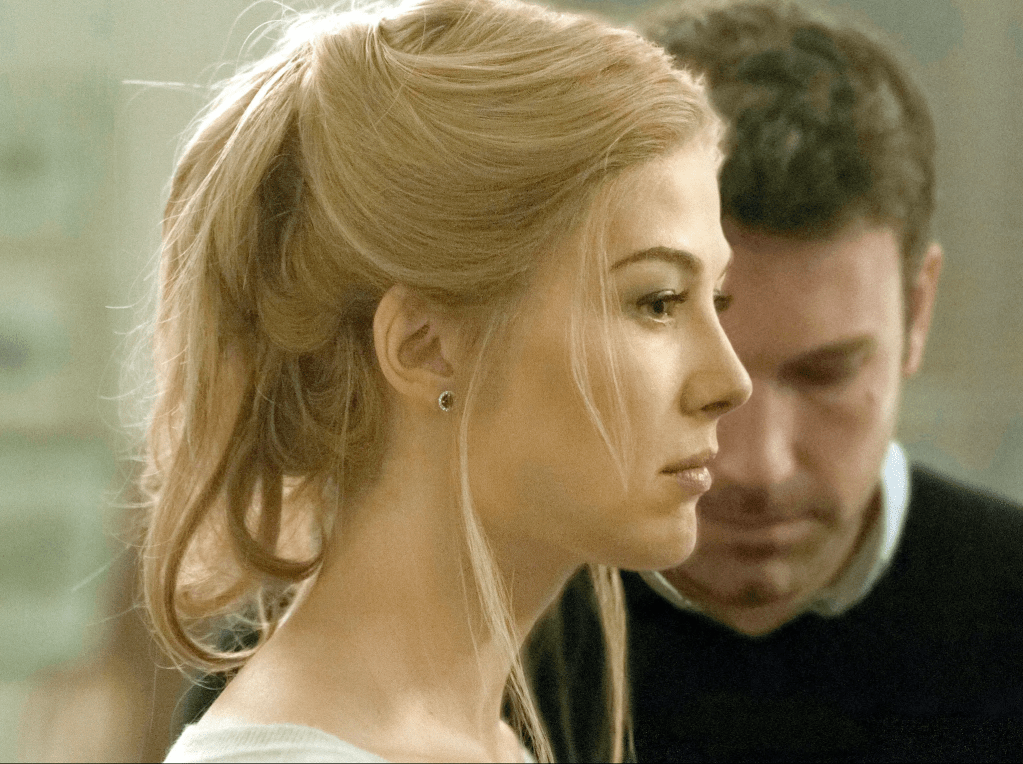
Rosamund Pike and Ben Affleck in “Gone Girl,” directed by David Fincher. Photo: Merrick Morton/20th Century Fox
Gillian Flynn published three novels, culminating in the 2012 sensation Gone Girl. Since then–no more books. It’s a bit like Willy Wonka shutting down the chocolate factory.
Sharp Objects, adapted as an acclaimed television series, is about Camille, a reporter who heads home to her disquieting hometown and complicated family to cover a heartbreaking local story. Camille lives with a mental health disorder that causes her to carve words into her skin. Over the course of the novel, we learn how monstrous her mother is: her younger half-sister is now being subjected to the same treatment that killed Camille’s late sister. It’s a dark, disturbing book, and I didn’t make it all the way through the TV adaptation, although the acting was first-rate.
Dark Places is not to be confused with My Dark Places, a memoir by James Ellroy that I read once, three decades ago, and still recall clearly: he goes back to investigate his late mother’s unsolved slaying. Flynn’s sophomore effort is also gothic in its sensibility. It’s about a survivor of a family massacre, and there’s a film adaptation that I didn’t even try to watch. Too much.
And then Gone Girl. Near-instant acclaim; near-instant bestseller. A decent film adaptation, with very good casting but an odd lack of the sense of place that’s so crucial in the original.
Because of the lapse in time since the publication of this third and final book, they now seem more like a trilogy than when they first appeared in print, with the first two novels probing aspects of trauma survivorship and the third creating the ultimate fake trauma survivor (shades of Atwood’s Zenia), one so committed to her craft of faking her own murder that she’s even willing to die–after enjoying the aftermath of her actions–so that her corpse can function as evidence.
When I first read Gone Girl, I was incensed by the portrait of a smart woman who lies repeatedly about sexual assault to punish men. I found it difficult to fully appreciate what Flynn is achieving in this book.
It still troubles me, as a trope.
I’m reminded of a law school class I took where female class members expressed our appreciation for how tort law can offer sexual assault survivors an alternate means to justice and vindication.
Conversely, our male colleagues worried, out loud and with increasing degrees of fervour, about their life-long fear of false accusations.
Most of them were still in their twenties, but something had seeped into their consciousnesses: they believed that women, not infrequently, lied about rape. They identified with the falsely accused; they could not seem to bring themselves to empathize with assault survivors, and I’ve mulled this over for a long time.
Our professor, who was terrific, pointed out that quantitative evidence demonstrates that people who report sexual assault are far less likely to be making false claims than people who report, say, theft, or arson.
It didn’t matter.
As one young man exclaimed, if he were ever to be falsely accused, his life and his career would be ruined. Over. With no apparent sense of irony, he insisted that the women in the class could never understand what it was like to feel so vulnerable.
That was one of the days where I felt, not yet in my mid-thirties, way too old for this shit.
***
Gone Girl is about a different media trope: the husband who reports his missing wife to the police. He stands, teary or stolid or smiling, in front of the media, begging her to come home. Imploring for her captor to return her, unharmed.
Only to later turn out to be his wife’s killer.
The prototype for Flynn’s depiction of way-too-good-looking Nick is an American man whom I won’t name; all these years later, he still hasn’t exhausted his appeals process.
He killed his very pregnant wife because she stood between him and a new life with his mistress.
But he cried convincingly for the cameras right up until he was arrested.
I’m thinking of Atwood, and paraphrasing: Men are afraid women will laugh at them. Women are afraid that men will kill them.
These two things are incommensurate, and it’s appalling to live in a world where spousal murder seems like a better choice than divorce because it doesn’t come with child support obligations.
For Flynn’s Nick, the motivation is also money: he has none, and in fact owes his wife nearly 100K, the money she advanced him so that he and his twin sister could start a bar after all three of them lost their New York jobs and had to move back to Carthage, Missouri, where Nick and Go grew up in a family with a perennially furious and contemptuous father.
Nick resists repeating his father’s anger, his misogynist insults, but these bubble up, unbidden, when he’s stressed.
This is Nick, thinking about his parents:
“He never beat her, but his pure, inarticulate fury would fill the house for days, weeks, at a time, making the air humid, hard to breathe, my father stalking around with his lower jaw jutting out, giving him the look of a wounded, vengeful boxer, grinding his teeth so loud you could hear it across the room.Throwing things near her but not exactly at her. I’m sure he told himself: I never hit her. I’m sure because of this technicality he never saw himself as an abuser. But he turned our family life into an endless road trip with bad directions and a rage-clenched driver, a vacation that never got a chance to be fun. Don’t make me turn this car around. Please, really, turn it around.”
Goaded by women who irritate him, Nick’s father would say, “dumb bitch.” Confronted by a female police officer who prevents him from opening his missing wife’s anniversary gift, he has to bite back “dumb bitch.” Gone Girl is, among other things, a study in misogyny, a searching examination of how contempt for women passes down from father to son, even when the son is determined not to repeat the same patterns.
***
The first part of Gone Girl juxtaposes Nick’s sometimes-peculiar behaviour, including the odd gap of time in his day which coincided with the disappearance of his wife with Amy’s own past diary diary entries. As we read these, the gushing tribute to old Nick, the one from the days of their courtship and early marriage, we aren’t really sure why we’re reading them. Are the journals giving a voice to a (possibly dead) Amy Dunne? Are they functioning, alternately, as testimony about her marriage?
Is it okay to give away the twist, yet?
I’m going to resist, except to note that Flynn’s brilliance is on full meta display here. Because Amy Dunne is not just a writer of schlocky magazine quizzes for women; she is a daring, subversive author who crafts her own life–and death–through both words and symbolic objects. A murder investigation as scavenger hunt.
And this is where I failed to give Flynn enough credit. This is a very postmodern thriller, to the point that it comes close (in part of its narrative) to being an anti-thriller.
There are some less satisfactory subplots.
No matter. This is a very very smart book, and in my fifth or sixth re-reading I’m trying to pin down just exactly how it works so well.
In Who’s Afraid of Virginia Woolf, the locked-in-deadly-combat married couple play “get the guests.”
Flynn is playing, with high stakes, “get the reader.” It’s a game, it’s a puzzle, it’s a critique of true crime sensationalism and thrillers.
It’s just so smart.
But I’m really hoping it doesn’t prove to be Flynn’s last novel.
***
I spent a chunk of last week thinking about male anger and its relationship to misogyny, because I was trying to puzzle through two complex situations, both of which I can’t write about here.
Because women fear men’s anger (reasonably), we placate and pacify. Tend and befriend. We do this at home and on the playground; in traffic and at work.
In Gone Girl, Nick learns that his mother has advanced cancer, but he is dry-eyed, resolute about moving home to help care for her, and angry.
So angry.
The absence of tears and the inability to express sadness and grief prompts his quiet, rumbling rage at his wife. He accuses Amy of being spoiled and selfish. Of caring only for her parents, and not for his. He refuses to express care or empathy, and she feels the absence of these (where once they flourished) as a small death. She feels that she is disappearing, objectified. His anger has made her a thing, not a person.
Nick is, of course, depressed. He’s been laid off and has no prospects: the entire world of print magazines is vanishing. He is a dinosaur, at 34. He remembers the bad jobs of his youth and fears that they will be what he returns to, even while Amy–who has no such memories, having enjoyed a privileged upbringing, as Nick sneers, of tennis camps and beach weekends–assumes that he will take care of their needs. They move to Carthage and Amy spends long, aimless days, as far as Nick can tell.
In fact, she’s very busy turning herself into a writer. Just like Gillian Flynn, who lost her magazine job as the industry withered, she turns to writing fiction.
She just doesn’t call it that.
Amazing Amy, of the children’s book fame, is Angry Amy now. Her marriage is filled with contempt, silences, and lies.
But she has a very interesting plan that she believes will help her regain her sense of dignity. That, more than anything else, is what she’s lost, due to her husband’s conduct.
And it’s garden-variety marital betrayal, trivial in the grander scheme of things. Nick is lonely, bored, and in need of an ego boost, home in Missouri. His mother dies; his father is dying, slowly and angrily.
Teaching a course or two at the junior college as an adjunct professor of journalism gives him access to a professional identity, of sorts.
It gives him access to adoring students.
I finished Vladimir last night, and I think it was twice as long as it needed to be. Unlike The Chair, it didn’t move me (or enrage me; or require me to take year-long breaks between episodes). It’s not “too true to be good,” as a colleague said about The Chair. It’s not really true at all.
Except possibly for the interesting way that M is persecuted by her female peers. One of the papers I’ve been drafting is about the fraught topic of feminist academics and bullying; I’m anxious about what I’ve been analyzing, because I’m incorporating some true stories. It’s a CNF lyric essay, a braided piece that moves back and forth in time over a few decades. I’m interested in the “women beware women” discourse that sometimes proliferates, the suggestion that women, especially at work, can’t really be friends.
In Gone Girl, a forty-something predatory woman sidles up to Nick to offer tea and sympathy. (Worse, she wants to bake him a chicken Fritos pie.) She’s the kind of woman that Amy, who is freshly missing, would despise, Nick reflects. But when the woman tells him that other women don’t like her, Nick is keen to chime in: his wife has the same problem.
I’ve always been intrigued by women who claim that other women don’t like them. Really? Half the population of the world?
But this is where Flynn is doing something exceptionally interesting: Amy fakes friendships, we learn, for manipulative and strategic purposes. But she’s so good at it that she leaves, in her wake Noelle, a sobbing confidante who knows Amy’s secrets. She’s very dangerous, this loyal friend. Amy is using her, but the woman doesn’t know it.
Amy, in fact, can’t manage friendships, because she views other women as twins, as mirrors. As rivals or as prey.
A deep breath, because this is a very odd story.
Some years ago, I had a neighbour (let’s go with C.) who seemed lonely and needy. She wanted a lot of help with babysitting, with emotional support, with tea and sympathy because had experienced so much betrayal in her young-ish life. She was elliptical and mysterious about the nature of this betrayal. And there were oddities, even from the beginning of her narrative and our “friendship.”
Her mother, for instance, seemed to be on hand virtually all the time, to help out.
But things got weirder.
After a party at my house, a friend paused at the door to point at the neighbour and tell me I had a problem. “She doesn’t like you. The way she talks about you–it actually sounds like she kind of hates you.”
I brushed it off: not everyone copes well at parties, and if C. was prone to complaining about me, as she complained about everyone in her life, it was probably due to what I had condescendingly diagnosed as depression and loneliness.
Oof. I was very wrong.
Over several years, as I started a difficult job, C. became more of a listener, which was a new thing: she wanted to know everything about the department where I worked and, in particular, about my colleagues. And I was too forthcoming, because I was dealing with a difficult situation, and C. understood academic politics.
Long story short: unbeknownst to me, I was working closely with her former husband, and she had been–for over a decade–gleaning stories about him from his colleagues. Most of them knew her, as she’d been a student in the department where I was now teaching. When they ran into her at parties in our very small city, they shared complaints. She thrived on these tales because, like Amy, she was very angry about someone she viewed as having ruined her life. She was even working on a novel about it.
But it took me ages to learn this, because she withheld. I remember a moment that now seems chilling: her young daughter offered to bring out her wedding album, and C. replied, smiling, “Not yet.”
I’d formed the impression that this spouse was dead, her child’s father. None of this was true. There was a sad but familiar story, a divorce, and a level of bitterness that I’ve never before encountered.
Only, soon it seemed to be directed at me.
She thought it was unfair, it turned out, that C. thought I would be “spending the rest of my life” with my colleague. (Thinking of potentially-tenured positions this way is sobering.) She herself had been cheated of this opportunity.
I left the job; after a house break-in and a family illness, we sold the house and moved. I cut off contact, with no room for uncertainty. I wanted to be as far as possible from what I now realized was a plot: a story she had written about herself and her life, in which she had featured me as a bit player.
A patsy, effectively.
I was Noelle to the neighbour’s Amy, although I’m stretching the parallel, here.
But it was a fascinating reminder to me that because as a child I learned to live with parental inventions, even fantastical ones, and treat them as truth, I remained vulnerable to scams, to fraud, to elaborate lies and concealment. I have learned to be more careful.
Not everyone will encounter someone as dangerous as Amy Dunne. We don’t need to go around assuming bad intentions when people offer friendship.
But there’s a fascinating new book out, by a UBC professor, and I’ll collect my copy soon: Poisonous People. And her contention is that while psychopaths are statistically rare, people with personality disorders often thrive in competitive work environments; we’re likely to encounter one or two. And we need to know how to cope.
My vow, now: Don’t get taken in by the best storytellers.
 The Landscape of Canadian Women's Crime Fiction
Leave a comment