I’m enjoying a not-great adaptation of a not-bad novel.
Watching gauzily-filmed melodramas set on Ivy-ish campuses where the sunlight is always dappled and the dialogue is periodically snappy is a tonic, in these times.
An irony! The series was apparently filmed in Toronto, during the summer months. Perhaps that explains why I’m having an odd sense of déjà vu as I watch. Specifically, filming of academic scenes took place on the University of Toronto at Scarborough campus.
Based on Julia May Jonas’s 2022 book by the same title, and written for the screen by the novelist herself, there’s a challenge, here, in adapting a bitterly knowing, densely allusive and darkly comic literary novel:
“The title Vladimir is widely considered to be a reference to Lolita author Vladimir Nabokov, a theory Jonas all but confirmed in an interview with Netflix’s Tudum. “It’s a nod to novels that name themselves after the young woman who the man is obsessed with,” she said. “This is the subject of fixation that we’re going to be talking about, and I wanted to flip the script and have it be coming from a woman’s perspective” (Time Magazine).
Mostly, the novel and film are about obsession, although both open with the object of the obsession bound and immobilized, and not in a manner that suggests role play gone awry. This is more of a kidnapping in progress.
The protagonist, a Creative Writing professor, published one acclaimed novel in her twenties and has spent most of the last three decades coasting on its success, while suffering from writer’s block.
Now her husband, who is in the same department, is the subject of a Title IX sex discrimination case, pilloried by his fellow faculty and by alumni alike for a long history of sleeping with what he calls, to his wife’s irritation, “coeds.”
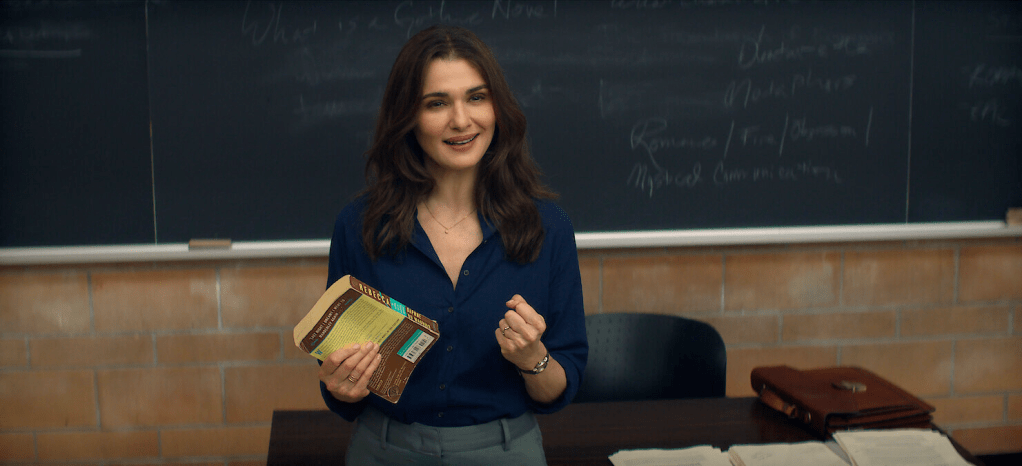
It is, undeniably, a very mannered adaptation, with Rachel Weisz as M, the creative writing prof in her 50s, speaking directly to the camera in an approximation of first-person narration.
This grows tedious, even if it is Rachel Weisz.
The basic plot is a familiar one, with a bit of a Hillary Clinton twist: the creative writing prof, who has a coterie of adoring students, and her poetry professor husband enjoy an open marriage. The kind, she notes acerbically, that dates to an era that didn’t require all that communicating about it. He’s used his sexual license to sleep with (or prey upon, depending on the observer’s stance) a series of his undergraduate students, but he insists he never broke a college rule: it’s been a decade since his last undergrad dalliance, nicely coinciding with the implementation of the policy forbidding faculty-student relationship.
But a group of his past conquests have banded together to denounce him as an abuser; a petition of alumni has reached 1000 names.
And M, several of her female colleagues charge, is complicit, a bystander; a source of anxiety to their young students. They whisper about her, offer her “advice” and tell students to avoid her classes.
M keeps insisting that she was shaped by a different era, a set of expectations about consensual relationship between faculty members and students that has evolved to be puritanical and lacking in nuance.
It’s precisely the power imbalance, she insists, that makes the sex hot. But it doesn’t make it unethical, is her stance.
I disagree. More importantly, the younger generations of students disagree, and in the book and its adaptation, their perspective is more convincing to the college, at least.
Food is important. For a combined faculty meeting/potluck (terrible idea; I hope this doesn’t catch on), M brings a show-off salad, a rainbow hue of colours, layers of healthy vegetables perfectly arranged. She boasts that it’s to put the others in their place; later she tells us it’s so popular that she’s having to eat someone else’s unhealthy contribution.
But in a lovely moment, the camera pans across the intact, still perfectly untouched salad. This is an unreliable narrator, you see, a device that is a bit creaky here, perhaps.
One detail is puzzling me:, M walks into a bakery and has an awkward encounter with the lone employee, a former student. This student failed, due to not attending or submitting assignments.
And the prof requests a bûche de Noël, because her daughter loves them. But there are no other indications that it’s Christmas, and I feel confident assuring readers that xmas chocolate log cakes festooned with meringue toadstools are not a “we always keep one on hand” non-seasonal item. Maybe this becomes clear later?
The dialogue is arch, and sometimes too self-congratulatory in its ostensible cleverness. M speaks in polysyllabic theory-glazed complete sentences, and the series gives her ample space to develop her not-very-coherent arguments.
Sample dinner dialogue, in the company of their adult daughter and her rather older female lover:
John: “It’s like Greek Theatre. It’s the Oresteia.
Narrator: “No, it’s not.”
John: “It’s a family drama where every action sets off a consequence that then has to be reckoned with. What’s more Greek? Caitlyn is Clytemnestra. Khloe is Electra. We’re the Furies.”
The narrator isn’t buying it: “I love pop culture, yay pop culture, but it is not a Greek tragedy . . . something that is open ended cannot be compared to a Greek tragedy. They’re ontologically and phenomenologically opposed.”
John: “Ooh, don’t talk dirty to me.”
So the Kardashians might be the new House of Atreus. Cool, cool.
But there’s a lack of substance, here, under the surface tension created by M’s crush on a new hire, a young male colleagues who is occupying her old office and who has brought with him a trailing spouse, an adjunct instructor given a single course.
When I read the novel, she was the one I wanted to know more about: this wife, with her minimal job, who professes to admire the Narrator’s brilliant novel yet who surely must envy and loathe and resent her.
M has all of the trappings of academic success, while the younger woman is picking up the scraps. And she’s the far more popular teacher: young, and attuned to students, while M is still desperately trying to persuade the skeptical young women in her dwindling classes that Rebecca matters.
Here we have, at last, common ground. I won’t be making M’s rainbow salad, forgiving her husband, or enjoying her perks. But I agree that du Maurier understands sex, power, and the allure of masculine inscrutability.
And in Vladimir, the title character (I neglected to mention he’s also a noted young novelist, a hiring coup) is far more interesting when he’s silent. That doesn’t, however, justify drugging him into a stupor. I’m hoping that aspect of the novel is adjusted in this adaptation.
 The Landscape of Canadian Women's Crime Fiction
Leave a comment