“You might become a detective. You might become a con artist yourself. Or, a blend of the two: you might become a novelist.” Margaret Atwood on writing
“The history of the world, my sweet
Oh, Mr. Todd, ooh, Mr. Todd What does it tell?
Is who gets eaten, and who gets to eat”
- Stephen Sondheim’s “A Little Priest” from Sweeney Todd
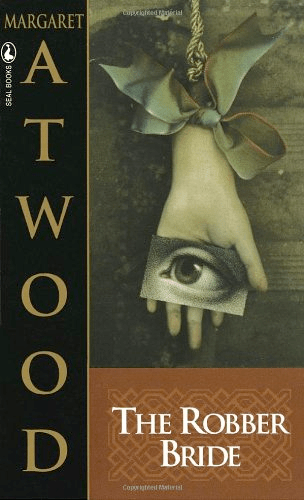
Atwood’s recent memoir has surprisingly little to say about the composition of The Robber Bride.
At the time of its publication, there was literary gossip about whether one or more particular Toronto figures might be the model for Zenia, that quasi-Eastern European purported survivor of abuse, trauma, and fatal illness who re-appears years after her own funeral.
Zenia rises again, a revenant.
A vampire. A cannibal.
People are not happy to see her, and especially not her former friends, all betrayed in baroque and inventive ways.
They are a trio: Tony (the academic historian of war), Charis (an entrepreneur, of sorts, but flaky and traumatized), and Roz (professional, robust, but vulnerable).
Zenia has done them all wrong; she is their Jolene, but back from the dead years after allegedly being blown to smithereens in a foreign country, an innocent bystander in a skirmish.
But Zenia, innocent?
Never.
Hardly ever.
Lorrie Moore’s review of the novel, published in The New York Times, is titled “Every Wife’s Nightmare,” which now feels a bit quaint.
But it was 1993 and that was, as Rachel Weisz-as-the-unnamed-narrator is fond of pronouncing in the new Vladimir adaption, “a different time.”
Here is Lorrie Moore on Zenia, in a perfect summary: “Her past is unclear and fictitious: she alternately passes herself off as the orphaned daughter of White Russians, or Romanian Gypsies, or Berlin Jews. Sometimes she is broke. Sometimes she is dying of cancer. Sometimes she is a journalist doing research and sometimes she is a freelance spy, part of some international espionage caper. To Tony, who almost lost her husband and jeopardized her academic career, Zenia is “a lurking enemy commando.” To Roz, who did lose her husband and almost her magazine, Zenia is “a cold and treacherous bitch.” To Charis, who lost a boyfriend, quarts of vegetable juice and some pet chickens, Zenia is a kind of zombie, maybe “soulless”: “There must be people like that around, because there are more humans alive on the earth right now than have ever lived, altogether, since humans began, and if souls are recycled then there must be some people alive today who didn’t get one, sort of like musical chairs.”
Tony, Charis, and Roz meet in university; they have very different backgrounds, world views, and ambitions, yet they forge bonds that ebb and flow over the subsequent decades.
And at different points, each of our protagonists encounters Zenia: the beautiful, beguiling, shape-shifting and predatory Zenia, who is all id.
Zenia takes what she wants; then she discards. The men she borrows are no more to her than a diversion, a display of her power, a goddess inserting herself into the vulnerable lives of mere mortals but soon tiring of playing with them.
But who is Zenia? We never pin this down.
For me (and this echoes Moore’s review), this is the fundamental lack at the centre of the novel, and I see it echoed later in Alias Grace. And it’s perhaps there in Cat’s Eye, too, with our restricted access to Cordelia.
When you have a character who is a catalyst but who remains essentially amorphous or unknowable, there’s a lacuna at the centre of the story.
That might be Atwood’s point? We build our stories around those of other people who remain fundamentally unknowable, whether they’re lovers–or a nemesis intent on ruining lives.
Toronto in the Late 1980s and 1990s
Academia looked different then, as Atwood’s novel demonstrates in her scenes where Tony is teaching and researching. I remember Trinity College, where I took many of my classes; a semi-underground secret society was quashed after a gross display of sexism and racism. I remember the gothic splendour of Hart House chapel, and playing the piano in an enormous music room filled with light from tall windows. I remember debating Mordecai Richler on cultural appropriation and the care his wife took at dinner to monitor the bottle he gulped down.
Downtown Toronto was more spiky and neon, less culturally smug than it is now, in the wake of the success of the Film Festival, the Book Festival, the numerous other events that have “International” blazoned across the advertising.
In short, the Centre of the Universe, c. 1993, was less confident, still edging into its own assurance.
I encountered my first Zenia in Toronto during that era, a lovely, waif-like poet who drifted like tumbleweed from class to coffee houses to theatre stages, where she emoted.
She had so many stories about herself. So many confusing, incompatible, contradictory stories.
We may all contain multitudes, but her accounts of her childhood and upbringing were different every time she opened her mouth. The same was true of her relationships: a friend or roommate might be beloved, adorable one day, and abjectly cast off the next. And she always cried that she was broke when the bill arrived on table, typically after she had devoured an enormous meal while claiming not to be hungry, which came to feel like a metaphor.
In the end, she drifted back to another city and we lost touch, and that produced more relief than regret. But I remember her mouth, done up in carmine bow lips; her hair, witchy black. Her low throaty voice, pitched so that you had to lean in close to hear her.
All affectations, a mutual friend assured me. They’d attended high school together, daughters of privilege with blonde braids and perfect teeth and horses they visited on the weekend. The gothic fantasies, the dark intimations of past trauma were all an elaborate make-me-up.
Or maybe not. Because who really knows?
My second Zenia experience was decades later, and, intriguingly, came as a matched set, a trio: blonde, lethally dishonest and manipulative. I’ve been reading Mona Awad’s sequel, We Love You Bunny, and I suspect she met some Zenias (except fiction is, of course, not life–and the Atwoods and probably the Awads of the world find it irksome when readers confuse the two).
I was born into a family of fabulists, because both of my parents were wonderfully inventing in re-making themselves, although they took different approaches. My mother has been dead for decades.
But as the daughter of a woman who told elaborate stories that she insisted were the truth, I’ve always been a wee bit susceptible to dramatic tales of pain and loss.
When my mother died, most of her friends and colleagues had been lured into the belief she was suffering from cancer while generously not wanting to impose her illness, her suffering on others. Not at all true, but it’s very possible my mother believed it. I am going to assume that she did.
So why the fabulist instinct, in someone who is not a writer?
In Atwood’s memoir, she acknowledges there is a bit of the scam artist, the liar, the fraudster in writers who make up stories for a living.
But that is a healthy expression, it seems to me, of a potentially destructive impulse. Take Zoe Goodall’s disquieting novel The Fake, where a woman appears and begins to enchant those around her with her woeful tales, her needs for comfort–and money–and a home. Everyone she encounters would be much better off if she embraced, instead, her capacity for fictionalizing and monetized her tales in the literary marketplace rather than in a grief support group.
As I think about Atwood and my three blonde Zenias, who did not like being thwarted, and who lied so readily, I’m recalling that on one occasion I nearly applauded at a meeting (I knew the truth–convenient inventions were being created, on the spot, for a different audience; fantasies spun out, like improv jazz).
It’s a gift.
And as Atwood describes, it’s at least in part a maladaptive response to patriarchy. Male power at work and at home has misshapen how some of us function.
Atwood is excoriating on the role of male fantasies in cultivating female subordination, which ranges from trying to fulfill an image of perfection to seeking sympathy and comfort from other women in the wake of male betrayal:
“Male fantasies, male fantasies, is everything run by male fantasies? Up on a pedestal or down on your knees, it’s all a male fantasy: that you’re strong enough to take what they dish out, or else too weak to do anything about it. Even pretending you aren’t catering to male fantasies is a male fantasy: pretending you’re unseen, pretending you have a life of your own, that you can wash your feet and comb your hair unconscious of the ever-present watcher peering through the keyhole, peering through the keyhole in your own head, if nowhere else. You are a woman with a man inside watching a woman. You are your own voyeur.” Atwood, The Robber Bride
This is an intriguing precursor to Amy Dunne’s “cool girl” monologue in Gone Girl.
Zenia is all fantasy, all projection. She is the sum of her listener’s fears and needs. She makes herself up out of their secrets, adding her own lies.
But Atwood suggests, mischievously, that she is also Everywoman.
 The Landscape of Canadian Women's Crime Fiction
Leave a comment