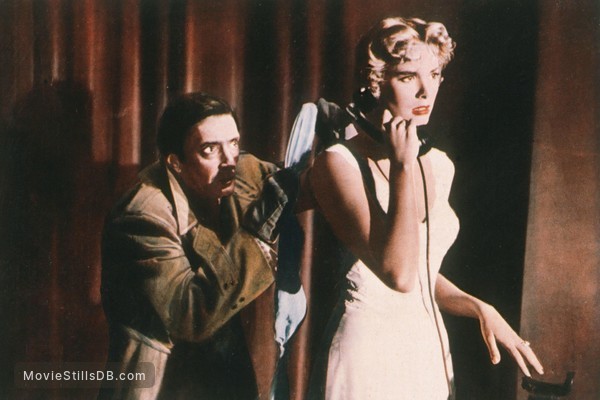
Grace Kelly as Margot and Anthony Dawson as her would-be killer; a still from the 1954 Alfred Hitchcock film.
Earlier in February I spent several days in Vancouver conducting interviews and doing background research for two features that I’m hoping to finish up over the next few months. One is on the play’s director, the extraordinarily productive Jillian Keiley. The other is on poet Pat Lowther, because I think she deserves a book tribute. Working with her daughters, I organized an online panel session last summer that merits a broader audience.
But the juxtaposition of these two projects was a bit uneasy.
The day after interviewing the director, I saw Keiley’s Calgary/Vancouver co-production of an updated Dial M for Murder theatrical version. It made its debut at Theatre Calgary last fall; in Vancouver it’s running at the Stanley BFL CANADA on Granville, a glorious richly decorated theatre.
I love the old vaudeville houses, like Vancouver’s lost 1908 Pantages; advocates have worked hard to ensure their preservation, but they haven’t always succeeded, and Toronto has also lost a slew of them. But the Elgin and Winter Garden is still standing, and still in use, and that’s a very good thing. And the Stanley is a wonderful place: richly-hued in red velvets and brass fittings.
Dial M for Murder, originally written for BBC television by playwright Frederick Knott, was adapted by the author himself as a popular stage play; he then further adapted it as the screenplay for Alfred Hitchcock’s 1954 film, starring Grace Kelly, Ray Milland, Anthony Dawson, and Robert Cummings.
(A much later film adaptation, A Perfect Murder, with Gwyneth Paltrow, updates the story to a contemporary setting; it’s stylish and sleek, but less interesting.)
The story, and the set, are remarkably straightforward.
Let’s start with place, because Knott retained the claustrophobia of the theatrical version in his screenplay by setting nearly all of the action within the married couple’s apartment.
Director Jillian Keiley uses a fascinating device: the stage rotates, but ever so slowly and slightly, bringing different elements (a desk, a set of chairs and a liquor cabinet) closer to and then further from the audience at different points. I haven’t yet had a chance to ask her if she was aiming to mimic the largely-failed attempt in the film version to use 3D to make some objects stand out from the foreground–or at least I think that was the effort, based on contemporary reviews as well as this Guardian piece on the restored 3D version of Dial M.
The plot is not complicated, although, as many have commented, it has much in common with Strangers on a Train, the Hitchcock film where two men meet and decide to “exchange” the murders they seek to have committed, so that each of them will be apparently without connection to the victim and the crime.
)For context, my Hitchcock top ten roughly runs Vertigo, Rebecca, Rear Window, Shadow of a Doubt, Dial M for Murder, Marnie, Spellbound, Strangers on a Train, The Lady Vanishes, and North by Northwest. Now and again I shuffle these, or add in The Birds, or The 39 Steps. Notorious is pretty good. Suspicion holds up. In short, I spend a great deal of time thinking about Hitchcock.)
In Dial M for Murder, a tennis pro, Tony Wendice, has learned that his wealthy wife, Margot, on whose financial largesse he is dependent, is having an affair with an American crime novelist.
He decides to kill her.
First, though, Tony sets in place an elaborate plot, quitting his job and taking on a corporate role while assuring his delighted wife that he wants to take care of her financially. He spends a year getting ready, and all the while (presumably) he is a loving and attentive husband.
Hitchcock truly understands, like few other directors or writers, how much acting is built into marriage.
The plot the husband engineers also involves his old college acquaintance, who is manoeuvred into committing the murder on his behalf, allowing him to establish an alibi at his club.
The murder is to look like a spontaneous act of violence committed during a break-and-enter. Tony will phone late at night, rousing his wife, and purportedly startling the thief, who then strangles her.
There’s some business with a letter used for blackmail, with keys, with scarves, and with locked doors and windows. But by and large, it’s straightforward, and Margot is entirely unsuspecting
Grace Kelly as the wife/intended victim is very good, and she’s a bit warmer here than in some of her icy Hitchcock blonde roles. Kelly, Kim Novak, Janet Leigh and several others were slotted in to the sometimes thankless Hitchockian stereotypes of wives, girlfriends, and femmes fatales. But in a few instances, through the writing or their own acting, they’re able to transcend the limitations of Hitchcock’s angel/whore dichotomies.
Kelly was born to wear the glorious 1950s dresses of this film. She glows.
A decade and a half ago, I saw a V & A exhibit of Grace Kelly’s gowns and then purchased the exhibit catalogue for my daughter, who was smitten. Rear Window and Vertigo have largely failed to work their magic on anyone in my family other than me, but the frocks were a hit.
Back to the plot.
The murder-for-hire scheme is disrupted by the plucky would-be victim, who fights back and kills the would-be assassin, inconveniently for her husband, Tony.
Now he needs a Plan B.
The second act of the play (or the film, since there’s a somewhat arch “Intermission” title inserted between the two parts of the movie) takes an even darker turn: he frames his wife for murder.
And her only ally is her former lover, the writer, who is determined to help her prove her innocence before she is hanged.
This is all very good fun and not the least bit scary (unlike The Birds or, worse, Psycho, which I can’t watch). It’s mannered but not unbearably theatrical.
And in Keiley’s hands, the updated version, where the crime writing-lover is now a woman, sings. It’s a delight. The cast is uniformly excellent; the pacing is precise, a Keiley hallmark.
Re-watching the film today, I’m missing the theatrical adaptation’s touches: the sense of intimacy and claustrophobia, in particular, that Keiley achieved in a good-sized theatre by bringing the action closer to the audience, before having it recede, periodically, to further to the back of the stage. It was an exceptionally strong performance of a good script, as well as a helpful reminder that plays that may appear to be old chestnuts can, in the right hands, be updated for contemporary audiences. The spectre of fear associated with lesbian activity in the 1950s setting that Keiley retained was especially powerful: the heroine is hiding not just an affair, but one that would occasion her dismissal from polite society.
Patricia Highsmith meets Hitchcock, in short.
And I do wonder what they made of each other: Strangers on a Train, after all, was adapted from Highsmith’s work.
From a wonderful interview with Highsmith at the British Film Institute:
She only talked to Hitchcock once, while Strangers on a Train was in pre-production: “I was in New York. He was in California. He rang me to make a report on his progress and said, ‘I’m having trouble. I’ve just sacked my second screenwriter.’” Hitchcock eventually hired Raymond Chandler to write the final script. Highsmith never met Chandler or seemingly any other writer of suspense novels. She doesn’t read them, she says, except, over and over again, the master: Dostoevsky. Also Graham Greene, a declared Highsmith admirer, with whom she exchanges occasional letters. “I have his telephone number but I wouldn’t dream of using it. I don’t seek out writers because we all want to be alone.”
 The Landscape of Canadian Women's Crime Fiction
Leave a comment