“Bad” is relative, here.
Agatha Christie never wrote a truly terrible book.
But my commitment to reading Elephants Can Remember was quickly shaken by the prose style, plotting devices, and endless digressions. This is not a very good Christie, at any rate, and since I’m reading it in an ugly Internet Archive version, with a hideous font, I am giving myself permission to chuck it and turn, instead, to the final (in sequence and in publication, not in composition) Poirot novel.
Here’s the opening passage of Elephants, for context, as copied from IA:
“Mrs. Oliver looked at herself in the glass. She gave a
brief, sideways look towards the clock on the mantel-
piece, which she had some idea was twenty minutes
slow. Then she resumed her study of her coiffure. ITie
trouble wth Mrs. Oliver was — and sho admitted it
freely— that her styles of hairdreasing were always be-
ing changed. She had tried almost everything in turn.
A .severe pompadour at one time, then a wind-swept
style where you brushed back your kx:ks to display an
intellectual brow, at lea.st she hoped the brow was in-
tellectual, She had tried tightly arranged curls, she had
tried a kind of artistic disarray. She had to admit that
it did not matter very much today what her type of
hairdressing wa.*?, because today she was going to do
what she very seldom did— wear a hat.”
Oh dear. And not just the bad typesetting.
I think Virginia Woolf could have made something of this: a woman of a certain age, a successful writer, deciding on the unexpected gesture of affixing a hat to her coiffure. There would be symbolism; there would be imagery; there might even be allusions to the war.
But Christie was going through the motions.
And why not? Elephants Can Remember appeared in 1972, just a few years before Christie’s death. She’d been churning out Poirot stories since 1916 and she was, as my previous post indicated, heartily sick of her own creation.
Famously, the final book–Curtain: Poirot’s Last Case–had been written back in the 1940s and tucked into a bank safe for decades. It was published shortly before Christie passed away. Sleeping Murder, the final Miss Marple novel, came out posthumously, and it was also crafted during the war years.
Theatrical touch. Heartily approve.
And Sleeping Murder is terrific.
Today I’ll finish up work projects and then curl up with Curtain, novel and then the Suchet-starring adaptation. I also have in my TBR pile a book by David Suchet, Poirot and Me; here’s a nearly hour-long audio preview.
But first my other DNFs.
And I am sorry to say that, like Christie, reliably excellent writers sometimes have misfires.
Let’s start with Laura Lippman’s Murder Takes a Vacation, which uses as its protagonist the cheerful and friendly Mrs. Blossom, a minor character from her wonderful Tess Monaghan books.
If this were not a library book, I would have thrown this across the room, because it is just that irritating. An elderly, overweight (we keep hearing about this; fat phobia on full display here, although Lippman insists she is trying to provide positive representation) narrator-protagonist is on her first trip to Europe. She falls under the sway of a charming and attractive man. He drugs her, presenting a cannabis gummy in the guise of melatonin for an overnight flight. That causes her to miss her connection. So naturally she takes his advice about where to stay, last minute, in London, and dines with him on a sumptuous Indian feast.
This left me speechless.
Mrs. Blossom is relatively recently widowed, and her husband has always sheltered her. A fortuituous lottery win, after she found a stray ticket in a parking lot, has left her unimaginably wealthy, so her life has changed abruptly.
But she has also lived in the same world as the rest of us for decades, and she has access to the savvy Tess for advice, not to mention other friends and family members. Yet she’s behaving like a credulous and overprotected twelve-year-old (and not one from the current generation: they would all know better, and they would use their smartphones to summon help).
What on earth is Lippman up to, here? I’ll never know, because I can’t bring myself to finish this one. Very disappointing.
Exhibit 3: Kathy Reichs’s Evil Bones.
The last few Reichs novels have been a bit of a slog, although with some high points linked to setting.
This one is a disquieting, graphically violent introduction to animal torture/murder. Ugh.
Reichs’s forensic scientist-investigator is spending altogether too much time in the company of a taciturn, unpleasant local police officer who inexplicably persuades her to accompany him on such time-consuming errands as visiting a dozen pet shops in search of a particular toy.
Temperance Brennan is a busy woman, with work in Montreal as well as in her home state of North Carolina. There’s no need for her to be following Detective “Skinny” Slidell all around the county chasing down leads.
She also has a young and wayward great-niece to watch over, and she’s not doing an especially good job of that, either.
This is an unpleasant book to read, and just over halfway through, I’m giving myself permission to stop.
So that’s three for three, on my last three reading attempts.
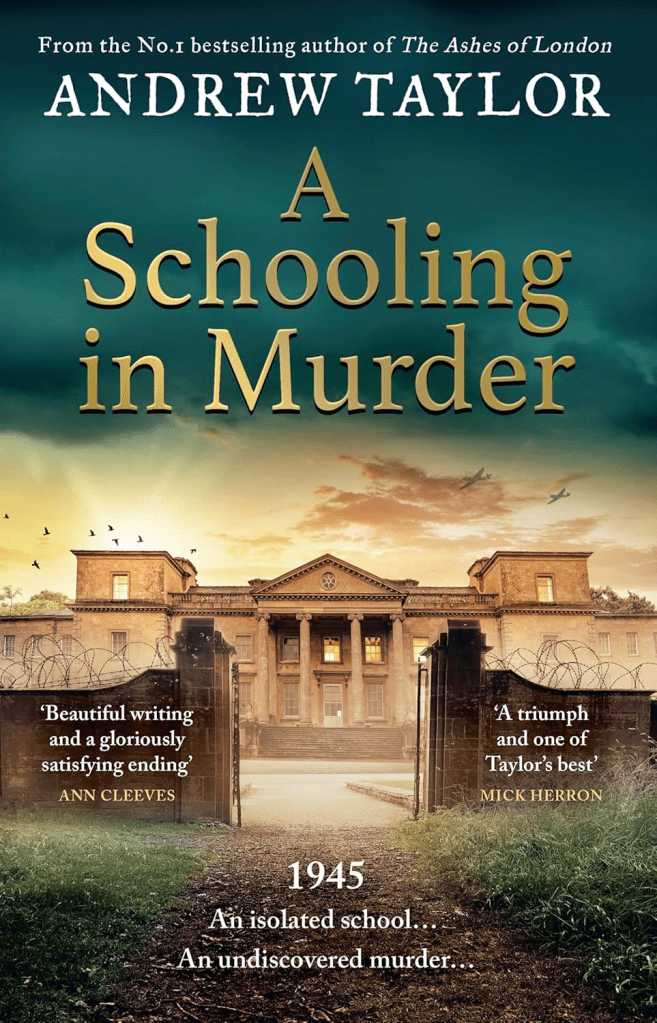
But here’s a glimmer of a silver lining: I was so frustrated with my library finds last night that I consulted my shelf of novels retrieved from Free Little Libraries and started on Andrew Taylor’s A Schooling in Murder.
I was a bit skeptical: the author’s new to me (but highly commended by some of my favourite mystery writers). And the narrator is a ghost, a murder victim seeking justice, so shades of The Lovely Bones.
The happy surprise is that it’s terrific, at least at the mid-point of the novel. The setting, which is very late World War II, is sketched in delicately but convincingly. The girls’ school hothouse environment of lesbian eroticism and teenage bullying is developed effectively (and by a male author, so extra props for that). And the narrator is affecting and compelling. All in all, I’m thrilled with this fortuitous find.
But have a look at the GoodReads reviews! We have readers complaining about a male author writing about lesbian sex; other grievances linked to plotting and setting; and a substantial number who are disappointed that a reliable series author has tried something new.
Lots of positive reviews, too, of course.
So my point is that there needs to be some affinity between a novel and a reader. I’m clearly not in the mood for late Christie, or for new offerings by two of my favourite writers. But I’m ready for something completely new, perhaps in the spirit of this Fire Horse year. And I’m pleased that fate put Andrew Taylor in my path.
 The Landscape of Canadian Women's Crime Fiction
Leave a comment