
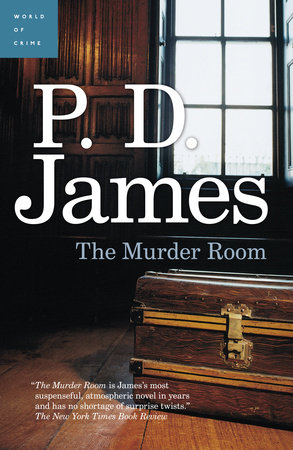
The Murder Room is one of my favourite P.D. James mysteries, although many other readers are less rapturous. Kirkus Reviews complained about “a plot less ineluctable than her best” but praises the intriguing cast of characters and–as always in James–the extraordinary sense of place.
The novel is set largely at the Dupayne Museum, which explores the interwar period through art, books, and one rather lurid display: an eponymous “murder room” that pays tribute to the sensationalized crimes of the era, which includes a number of unsolved murders.
For most of the Dupayne Museum trustees, employees, and volunteers, the Murder Room is a bit of an embarrassment, but it brings in visitors, while the Nash and Grant paintings tend to appeal more to scholars and art buffs.
But should the Museum close? It does, after all, operate on a shoestring. The three siblings, two brothers and a sister, who inherited their duties from their obsessive and distant father don’t share an equal fondness for the place. Caroline is more involved with the finishing school for heiresses where she works, and which she hopes to inherit; Neville, a psychiatrist, is preoccupied with the inadequacies of caring for his NHS patients. Only Marcus, who has just retired from a disappointing career, plans to be at the Museum full-time.
The Dupayne Museum is, however, housed in a perfect space, just off Hampstead Heath; the terms of the restrictive covenant on the house ensure it will be used as a museum or cultural space, which keeps the rent low. But a new lease is due to be signed, and one of the three trustees announces that he is unwilling to accede to his siblings’ wishes to continue the Museum. When he turns up dead, and Scotland Yard is asked for a high-ranking officer (because some of the staff and volunteers have very interesting histories), Adam Dalgliesh takes up the case, alongside his stalwart deputies.
Adam’s a bit distracted this time around, and not by his poetry.
A previous case introduced him to the lovely and brilliant Emma, a Cambridge English professor; he’s fallen in love.
But his career keeps him very busy and he has been missing dates with Emma, thus annoying her and her devoted friends. He’s determined to keep the weekend free, no matter what happens in his murder case, so that he can finally tell Emma, who will be visiting London, that he loves her.
And he will do so by presenting her with a letter, outlining his feelings and his dreams for their shared future. Like Jane Austen’s Captain Wentworth, he will pour out his secrets onto the page and hope that his beloved is, as in Austen, persuaded.
I love Persuasion; I love the idea that Dalgliesh presents himself as “no Captain Wentworth” when he is, of course, a perfect successor to Austen’s hero: a later-in-life suitor who has known disappointment and loss and who comes to love with a greater sense of maturity about what is possible between two intelligent but not innocent people who love one another and want to share a life.
For me, this is a perfect book, and in its quiet, muted way it’s a passionate love story as well as a murder mystery.
But here the critics are scathing. This is Patricia T. O’Connor writing for the New York Times, and praising the mystery but not the romance:
“Alas, James’s efforts to inject suspense into Dalgliesh’s romantic life are less effective. For one thing, the love affair is not seamlessly integrated into the action. Every once in a while, James calls a timeout to update the Emma angle, then turns with relief back to comfortable old homicide. The plots rarely intersect, apart from one inspector saying to another, ”Gee, I wonder what’s eating Dalgliesh,” or words to that effect.
What’s more, the ups and downs of the romance hardly merit yanking us away from the murder investigation. Emma and Adam are simply two hard-working professionals who live in different cities and have a tough time working each other into their schedules. As a spine-tingling question, ”Will Adam cancel another date?” doesn’t quite measure up to ”Who will die next and by what foul and nefarious means?” All right, so romance is not P. D. James’s forte. We knew that already.”
But do we?
Because P.D. James–for this reader–has written a perfect Valentine’s Day murder mystery/love story.
 The Landscape of Canadian Women's Crime Fiction
Leave a comment