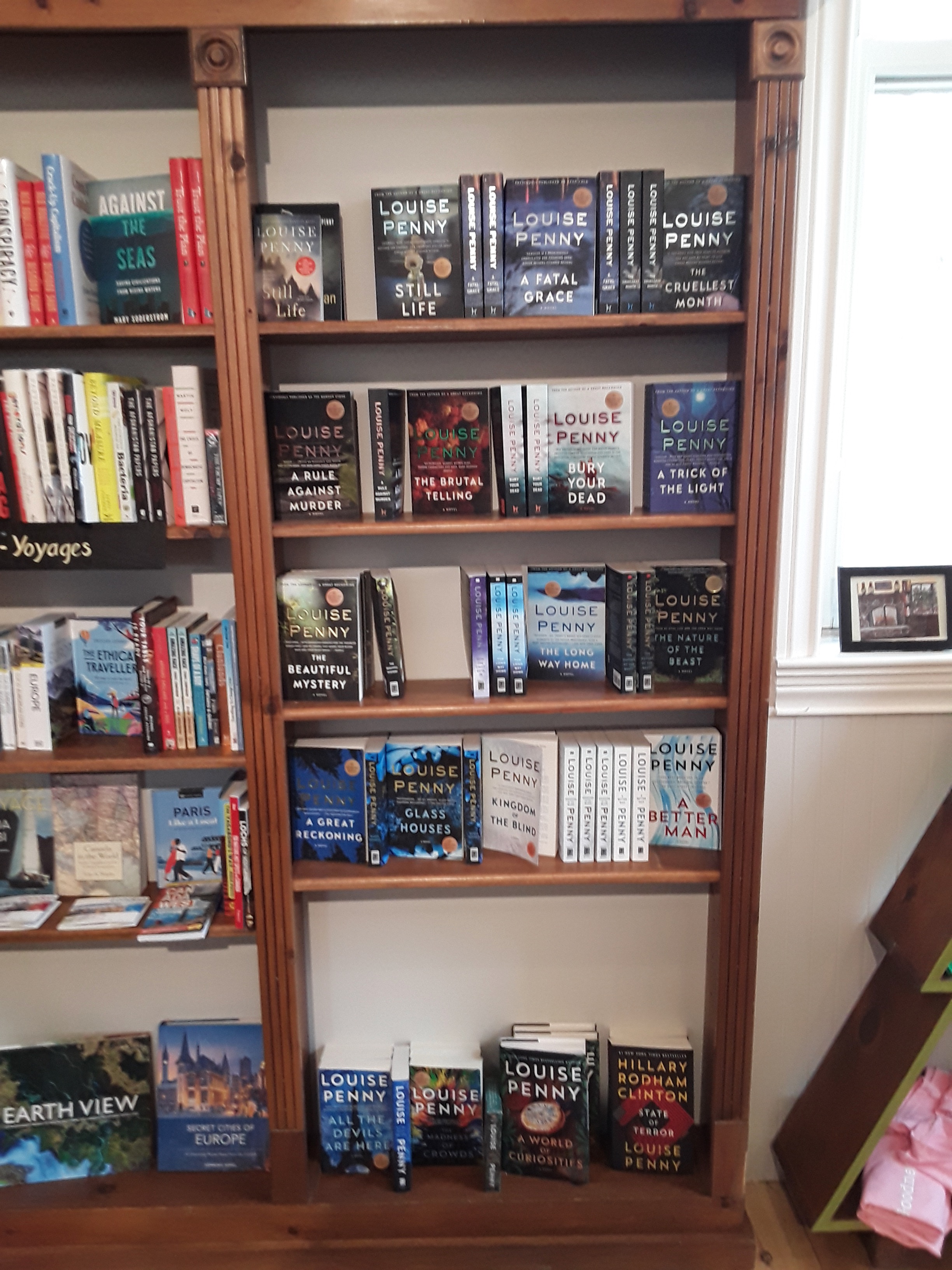
Much of my knowledge of Canadian literature has been gleaned from CBC radio. The voices of Eleanor Wachtel and Shelagh Rogers are instantly recognizable to me.
And in recent years, Louise Penny’s wonderfully throaty speaking voice has become just as familiar.
I missed her early years as a CBC broadcaster, but it’s a great pleasure to hear her in this Bookends episode with Mattea Roach, recorded at Massey Hall in late November.
This is a wonderful interview. Go have a listen. That’s really the point of this post.
And then I’m going to talk about something grim.
*****
Isn’t it terrific?
But let’s talk about the U.S., and I say this with grief and some rage.
I was born in the United States and have spent nearly all of my life in Canada.
The U.S. was (and sometimes still is) deeply ambivalent about the concept of dual citizenship. About a decade ago, I was crossing the border in a car, concealing a cake with fresh fruit on it at my feet. When we’d purchased it, I’d failed to consider that it might not be permitted across the border. Strawberry- and kiwi-festooned contraband.
So I was nervous. A rule follower, I’d suggested to the friend who was driving us to her Buffalo home that we ditch the cake before we reached the border. She’d laughed. It would be fine. She was back and forth across the border a few times a month and didn’t bother searching her purse for stray fruit before she pulled up to the booth.
When the border guard looked at my passport and then asked my citizenship, I gave my default reply: “dual citizen of Canada and the U.S.”
That was the wrong answer.
“The United States of America does not recognize dual citizenship, Ma’am.” He glared at me. “What is your citizenship?”
“American,” I said weakly, and fished out the U.S. passport I’d brought along just in case. I’d forgotten that Americans are always supposed to enter the U.S. on their U.S. passports.
Here we are in 2026, five years after the start of the pandemic, and four years after my diagnosis with Addison’s, which has put me on life-long steroids that have many salutary effects but also depress my immune system. This combo has cut down on my travel, and I didn’t notice when my U.S. passport expired. Then I noticed, but Trump was back in office.
It seems highly improbable that I’ll cross the border anytime soon. My academic and scholarly organizations are urging Canadians to make only necessary trips to the U.S. and prepare for them with measures that would never have occurred to me even a year ago, like deleting social media profiles, or not bringing a smartphone.
I’m just going to stay on this side of the border.
And this past year, several Canadian (and Canadian-American) writers made the same decision.
John Irving, who is still (heavens!) producing thick tomes, decided not to do a U.S. book tour.
But Louise Penny is the one who kicked off the trend. (And some writers whom one might think would concur with a self-imposed travel restriction–like Margaret Atwood–included U.S. dates in their book tour itineraries, which is fascinating, given her bona fides in Canadian cultural nationalism and protectionism.)
Here’s a recent G & M headline to harrow the soul: “We need to prepare for the possibility that the U.S. uses military coercion against Canada.” This piece is by deeply experienced and informed experts. I don’t think we can ignore the fact that the world’s longest undefended border is looking very vulnerable. Countries that boast resources their much larger neighbours covet have always had to worry; we’ve been an anomaly, but this particular form of Canadian exceptionalism is in jeopardy.
I’m reminded–ridiculously–of the Family Ties episode where Alex Keaton and a friend are in a bar, trying to impress women by boasting about their military affiliation.
He announces he’s invading Canada in the morning, and the cute but thick blonde across the table is puzzled. “We’re not at war with Canada. Are we?”
 The Landscape of Canadian Women's Crime Fiction
Leave a comment