My 2025 highlight was an event, rather than a book, although there were a number of new crime novels this past year that were a lot of fun, or that experimented in interesting ways with genre conventions.
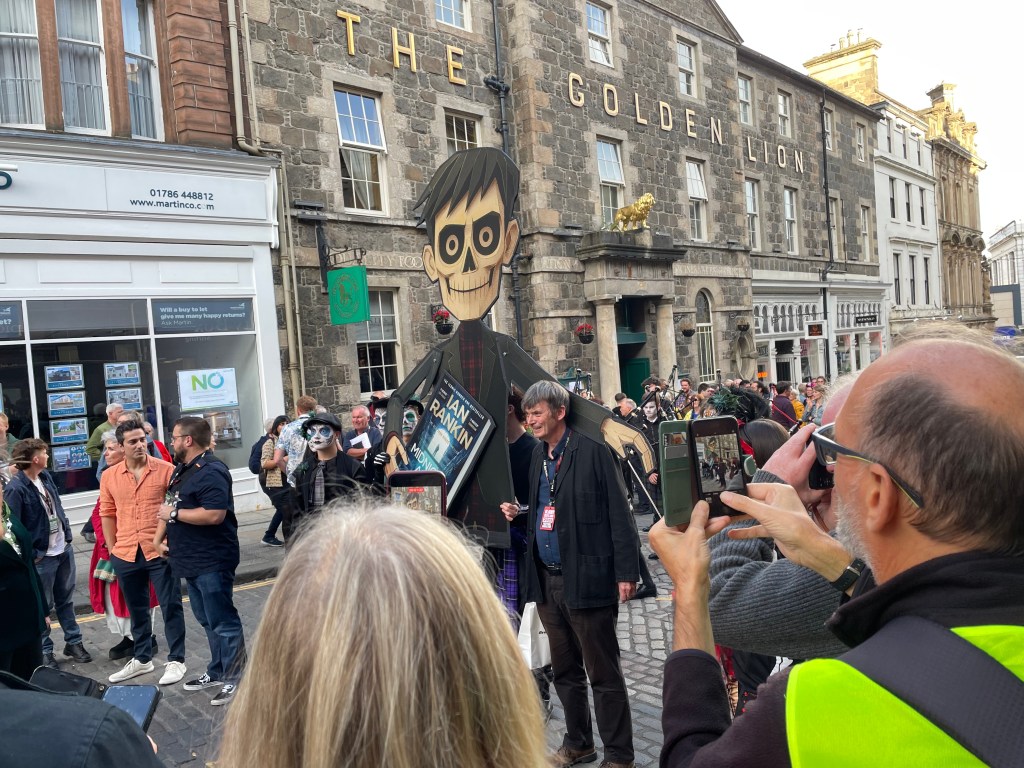
Bloody Scotland is an international crime writing festival held annually in Stirling, a small central Scottish city a short distance from both Edinburgh and Glasgow. I didn’t manage to catch all of the Canadians who appeared at the September event–Linwood Barclay and Shari Lapena were in residence before I arrived–but I did get to see a good range of writers: Kate Atkinson and Sir Ian Rankin (in the photo above, at the Day of the Deid celebration and parade); Ruth Ware, Abigail Dean, and Erin Kelly; Kathy Reichs, in conversation with Rankin (who appeared at multiple events, as the guest programmer); and Mick Herron, of Slow Horses fame, in conversation with a writer who is new to me, Nick Harkaway, who also happens to be John le Carré’s son.
It was a terrifically friendly festival, with well-known writers milling about in the walkable downtown. The kind of weekend where you bump into Denise Mina in a local bookstore/café, or collide with Sir Ian (who was everywhere) stepping out of an elevator. Hordes of readers keen to discuss their favourites while waiting in line at book signings.
Bliss.
The doyenne of Scottish crime fiction, Val McDermid, has played a momentous role in the success of Bloody Scotland, so I’d been hoping to catch a glimpse of her. I’m hoping for her new novel in my Christmas pile.
To its credit, the festival is welcoming of emerging writers, offering them short reading slots before featured events. These worked surprisingly well, and the festival offers a range of mentoring opportunities that other crime fiction festivals could consider adopting.
I missed seeing Abir Mukherjee, but he’ll be the International Guest of Honour at next October’s Bouchercon in Calgary, and he’s a writer to seek out, if you haven’t yet had the pleasure of encountering his work.
Speaking of Bouchercon 2026: hotel rooms are starting to book up, so plan ahead! Registration is required before hotel bookings can be confirmed.
Louise Penny will be the Lifetime Achievement Guest of Honour. My 2025 disappointment was missing Penny’s Massey Hall appearance in Toronto, when I had to adjust a research trip’s timing, but the interview with Mattea Roach was recorded for CBC and will air in early January.
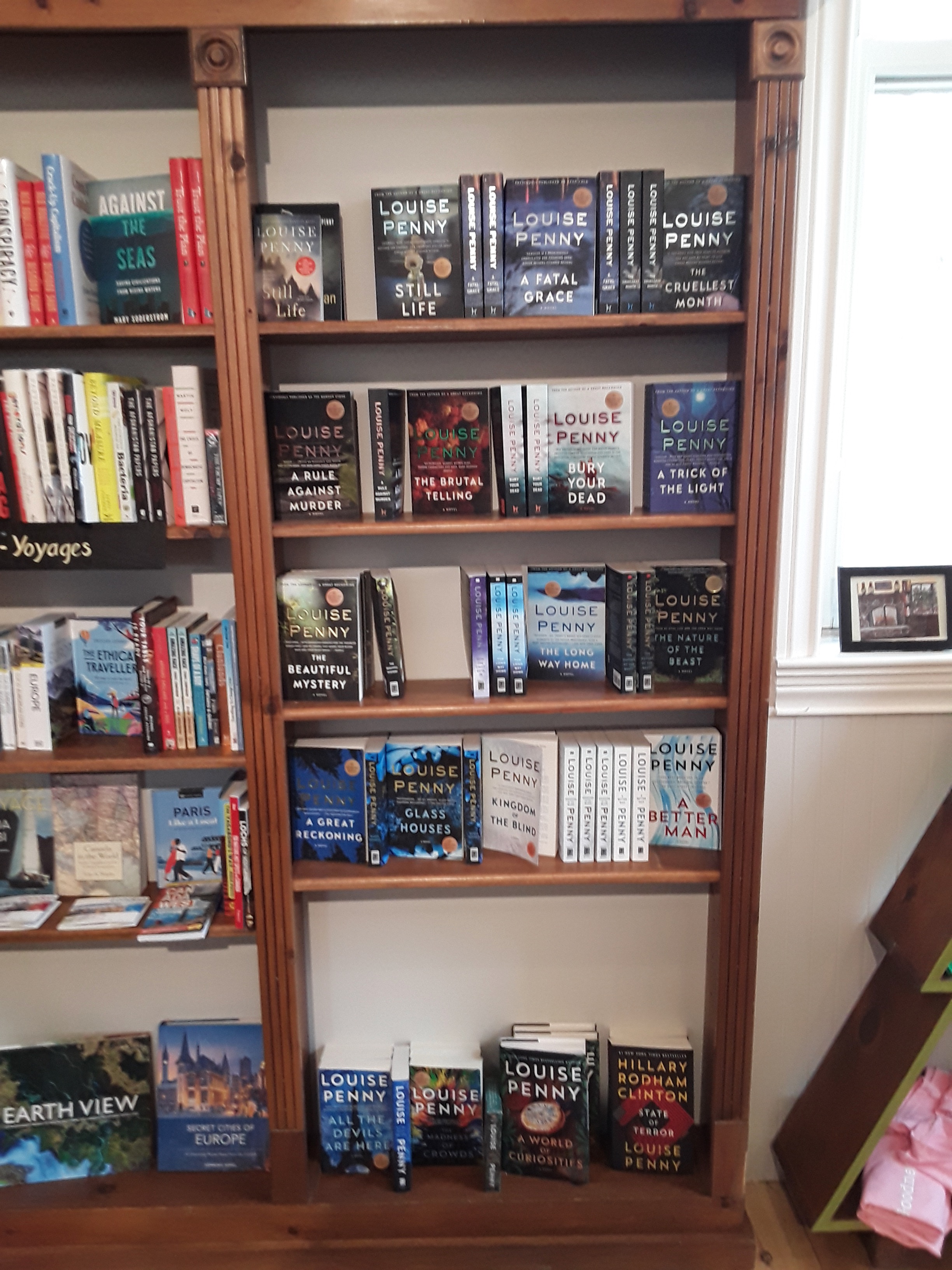
Penny’s 2025 achievements were momentous: as well as publishing The Black Wolf, the follow-up to The Grey Wolf, she opened a café below the Knowlton, Quebec bookstore, Brome Lake Books, that has championed her writing from the beginning. She also announced a forthcoming co-authored novel with Canadian journalist Mellissa Fung, her second collab, following her co-authored thriller, with Hillary Clinton.
To perhaps even more international attention, Penny also announced that her fall book tour would not include the United States, and for this gesture of patriotism (alongside countless other good reasons), she has been named the Globe & Mail‘s Artist of the Year.
And as for the books I read in 2025: I was disappointed by several new releases by favourite writers, but I also found several new-to-me authors to enjoy, including Giles Blunt, whose work I’ve often attempted without finishing–there’s a lot of violence, but he’s brilliant at setting and atmosphere. Literary criticism about Blunt is stellar: I enjoyed reading work by Manina Jones and Pamela Bedore.
I re-read all of P.D. James and expanded my vocabulary about residential and church architecture.
I read Gail Bowen’s new novel and also re-read most of the Joanne Kilbourn series, in an attempt to draft a chapter about academic mystery fiction in Canada. I was reminded, and yet once more, that Bowen has produced an extraordinarily robust set of books over several decades. A national treasure.
The two authors I enjoyed the most this year are decidedly not new: Eve Zaremba (who passed away this fall) and Lauren Wright Douglas produced remarkable lesbian private eye series set in Canada starting in the late 1970s and late 1980s, respectively. The books, and their plucky protagonists, hold up well. Working on a chapter on lesbian crime fiction (with the able assistance of the ArQuives in Toronto, which offered several promising research leads) has re-shaped my book project in some crucial ways, and that’s been a very good thing. Most of my writing time has been spent on the work-in-progress rather than on this rather neglected blog.
Some terrific new Canadian reads from this past year:
Uzma Jalaluddin‘s Detective Aunty
Kate Hilton and Elizabeth Renzetti’s Widows and Orphans
Iona Lam’s Fowl Play
Eliza Reid’s Death on the Island
On a more somber note, many of us in CanLit and mystery lit teaching have been contending with the question of how we should now read and interpret Thomas King’s DreadfulWater mystery series. There are relatively few crime novels by Indigenous writers living and working in Canada; this was a welcome exception.
King has recently withdrawn the next installment about his Cherokee ex-cop, in the wake of revelations that King, who believed himself to be Cherokee on his father’s side, does not, in fact, have Indigenous ancestry. This is a deeply painful situation for the author, and the informed perspectives are, of course, those of Indigenous people who have been affected by King’s writing, and his prominent place in CanLit.
Perhaps in 2026 we can work towards a publishing industry and teaching practices that don’t canonize a small number of authors at the expense of a larger group of gifted voices. My own commitment on this is to seek out new writers and expand the list of authors I teach.
Best wishes to all as we close out 2025.
 The Landscape of Canadian Women's Crime Fiction
Leave a comment