As The Black Wolf opens, Clara is struggling with the completion of her latest art project, a series entitled Just before something happens, which anticipates one of the key themes of Penny’s latest novel: how to portray the time that precedes a dramatic, or traumatic, event? How, even, to know if one is in the offing?
This is the question that preoccupies investigator Armand Gamache, who is recovering from the violent events that took place at the end of The Grey Wolf. (The two books are closely linked, and plunging into The Black Wolf without reading the previous volume would be challenging.)
In The Grey Wolf, Gamache came close to being murdered while attempting to halt a plot to poison Montréal’s water that would have killed tens of thousands of people. A gun fired right next to his head has left the veteran homicide investigator with a maddening tinnitus that makes communication, sleep, and even careful thought challenging. But Gamache needs his wits now, more than ever, because he has begun to suspect that his team thwarted only one small part of a larger and potentially catastrophic plan.
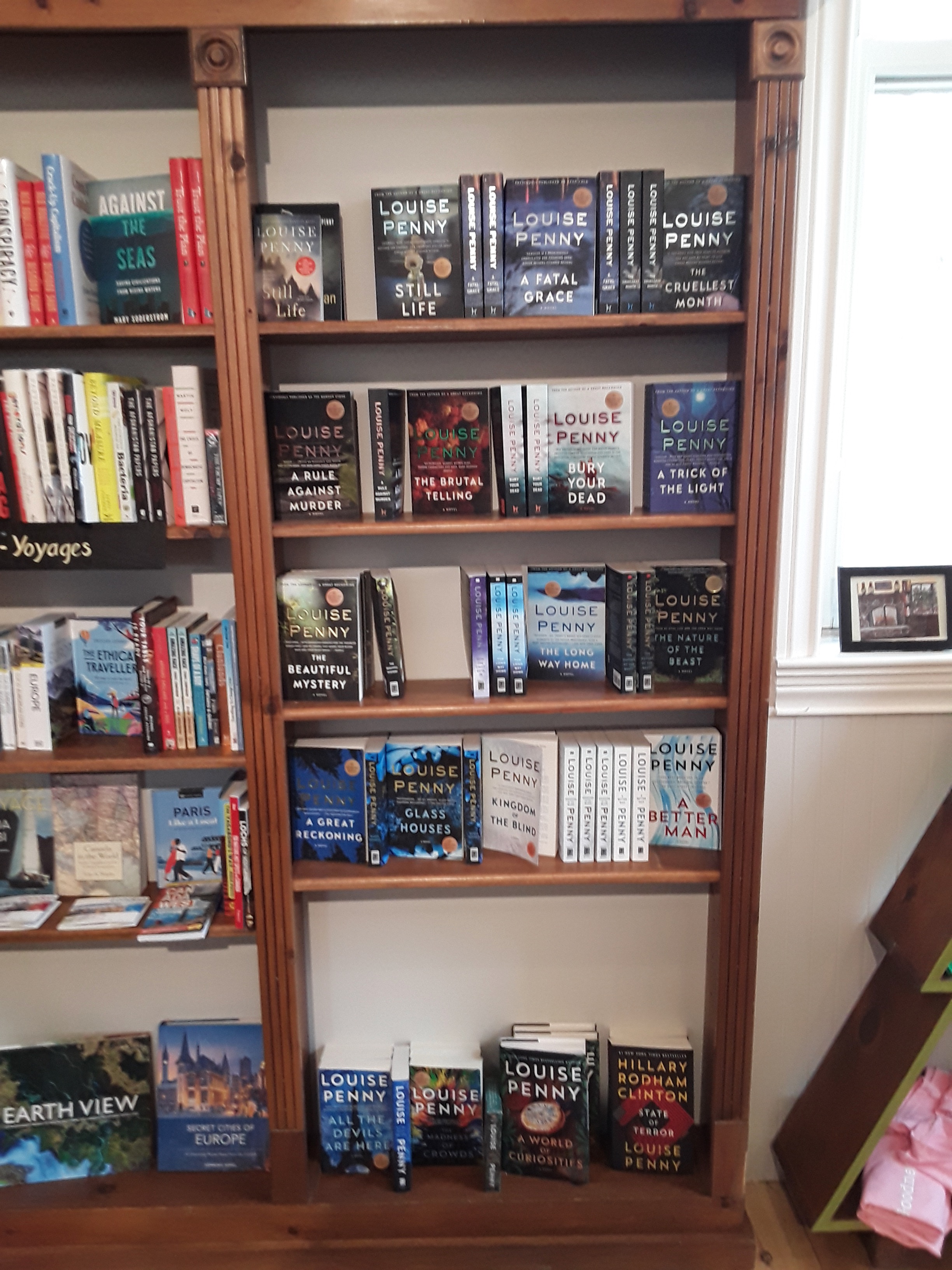
This is the second time that Penny has returned to the events of the previous book in the series to suggest that Gamache’s investigation may have reached erroneous conclusions. In Bury Your Dead, Gamache is swayed by Gabri’s passionate faith in his beloved Olivier, who was arrested for murder at the conclusion of the previous book, The Brutal Telling. He asks Beauvoir to return to Three Pines and have a second look at the evidence. By the end of Bury Your Dead, Olivier has been exonerated and the real murderer’s identity revealed.
As Pamela Bedore describes in The Routledge Introduction to Canadian Crime Fiction, the revelation of Olivier’s innocence results in “essentially overturning the detective work of a seemingly complete murder mystery, and thus unraveling the uncovered narrative the reader has observed being constructed by the detectives.” In The Black Wolf, however, there is less of an undoing of the previous book’s resolution than an expanding outwards to an even more sinister plot with international ramifications, as Gamache seeks to learn whether he has correctly identified the titular “Black Wolf” as the country’s disgraced, and now imprisoned, former Deputy Prime Minister.
Or could there be an even more powerful threat, a wily adversary who is still hiding in the shadows, perhaps one who is even more highly or strategically placed to affect millions of people’s lives?
When Penny writes her periodic thriller-style plots in this series, where Gamache and his team race to prevent disaster, the action tends to shift away from Three Pines. The Black Wolf‘s Acknowledgements includes a note by the author, explaining her choice:
“I know, because I read the emails, that some readers want me to set each book totally in Three Pines. To have the villagers front and center. And in many of the books they are. But that is not always possible. I made the decision early on that for the longevity of the series, for its credibility, and for my own creative health I needed to set every few books away from the village.”
A substantial number of scenes still take place in Three Pines, because Gamache and his wife Reine-Marie have made the village their permanent home. But Gamache, Beauvoir, and Lacoste are on the move, seeking evidence on the shores of distant northern lakes and in secretive encounters in Washington, D.C.
A pivotal and brilliantly composed scene takes place, fairly late in the novel, at the Haskell Free Library and Opera House, which straddles the Canada-U.S. border. During this encounter, a character poses a weighty question to Gamache: “Would it be so bad to be the fifty-first state?”
Canadians think annexation is unlikely, and their anxiety has diminished in recent months about whether the American president’s apparently off-the-cuff and jokey comments to the contrary should be taken as earnest threats. (But they no longer want to dress up like him for Halloween, apparently.)
Penny’s novel, as she has discussed, appears eerily prescient. It’s an engaging and thoughtful thriller, and while some some members of the fan community may be longing to linger at the bistro with Clara, Myrna, and co. at greater length, it’s an interesting addition to a serious that has proven to be capacious and genre-blurring.
Some readers may find the book a bit slow to get started, but there are set pieces, like a charged Sunday roast chicken lunch in the Gamache home, featuring an eclectic guest list, that are well worth the wait. There are also intimate moments, as when Gamache pauses in front of a cathedral to think lovingly about his wife, Reine-Marie, that demonstrate the profound knowledge that Penny has of her complex and evolving cast of characters who uphold kindness and goodness in a broken world.
 The Landscape of Canadian Women's Crime Fiction
Leave a comment